

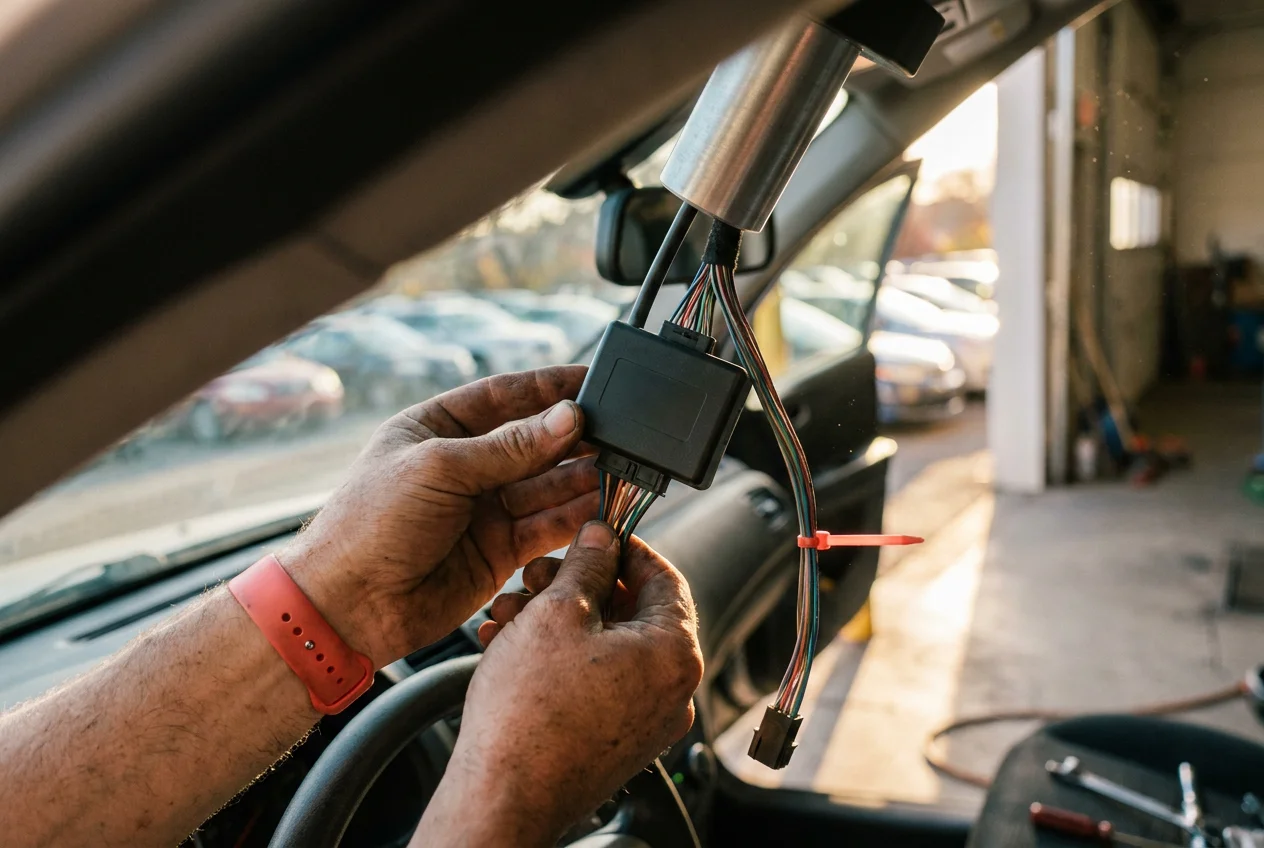
Dealers and auto lenders running starter interrupt and GPS programs need three things in writing: a plain disclosure inside the retail installment contract, documented notice periods before any shutoff, and a working emergency restart. GPX supplies the location intelligence and relay hardware behind those programs, giving buy-here-pay-here operators lot inventory tools and recovery visibility in one system.
Note: this article is general information, not legal advice. State rules on asset tracking and vehicle disablement vary widely. Confirm your compliance plan with qualified counsel.
A buy-here-pay-here (BHPH) or auto lending book puts expensive collateral on the road every day. The National Insurance Crime Bureau recorded 1,020,729 vehicle thefts in 2023, a record year. Theft volume dropped 17 percent in 2024 to 850,708, but the exposure for lenders holding the paper did not go away.
Most operators pair a GPS tracker with a starter interrupt relay. The relay stops a vehicle from starting once an account runs far enough past due.
Hardware that can disable a vehicle brings state and federal oversight with it. Regulators focus on two questions: how you disclosed the policy to the borrower, and how you executed the shutoff.
Federal agencies police auto loan servicing directly. The CFPB sued USASF Servicing in 2023. The complaint alleged the servicer wrongly disabled vehicles at least 7,500 times. It also alleged warning tones played more than 71,000 times when consumers were not in default, plus at least 1,500 shutoffs after the company promised it would not disable the car.
Privacy law then shapes what you do with the location history. Under California Civil Code section 1798.140, precise geolocation means a point inside a radius of 1,850 feet. That data counts as sensitive personal information, which brings disclosure duties and retention limits.
| System Type | Primary Function | Location Tracking | Execution Method |
|---|---|---|---|
| GPX Intelligence | Asset visibility and relay hardware | High-precision tracking, multi-network connectivity | Hardware relay output for third-party tools |
| Payment assurance software | Collections and borrower communication | Parses GPS data from third-party devices | Software triggers and SMS alerts |
| Consumer tracking apps | Personal vehicle recovery | Basic street-level mapping | No ignition relay support |
Compliance and Recovery Obstacles in BHPH Operations
Auto lenders hit the same friction points when they balance asset protection against consumer rights. BHPH GPS tracking laws differ by state, and skipping standard process invites litigation and fines. The main hurdles:
- Writing contract disclosures that leave no doubt about when and how the vehicle shuts down.
- Blocking any shutoff of a moving vehicle, the one failure that creates serious liability.
- Matching hardware behavior to state notice periods and emergency override rules.
- Tracking right-to-cure notice timelines, which run on a different clock in every state before a disablement becomes lawful.
- Purging old location data before stored records turn into a compliance problem.
- Answering consumer complaints to the FTC and the CFPB about location data moving beyond the recovery purpose the borrower agreed to.
- Replacing aging relays when a carrier retires a network generation, because a tracker on a dead network leaves the collateral invisible and the shutoff command unanswered.
- Auditing logs so every warning tone and shutoff lines up with the borrower’s actual account status.
California Disclosure and Disablement Rules
California runs the strictest rules on vehicle tracking and payment assurance devices. California Civil Code section 2983.37 requires a clear written disclosure of starter interrupt technology inside the retail installment contract. Tell the borrower how the device works and what triggers a shutoff.
The statute also sets the warning timeline. Weekly-payment contracts get a five-day warning before disablement, and other contracts get ten days. Every contract type also requires a final warning no less than 48 hours before the shutoff.
The law requires a failsafe as well. The borrower must get an emergency restart that runs the vehicle for at least 24 hours after the first disablement. That keeps people from being stranded or cut off from a medical emergency.
Nevada Rules for Electronic Tracking
Nevada works through timelines and data retention limits. NRS Chapter 598 covers electronic tracking and starter interruption, and it requires full written disclosure before the sale closes. The chapter also blocks early collection pressure: the starter interrupt stays off until the account runs more than 30 days past due.
Once the account hits that threshold, Nevada requires 48 hours of actual notice before the shutoff command goes out. Florida passed a 2025 law that carves out starter interrupt devices used as part of a regular payment program, so check how its terms apply to your contracts with counsel. Borrowers then get two separate 24-hour emergency overrides.
Nevada also limits how long you keep the trail. The state requires a rolling 180-day purge of GPS data. Configure your software to delete stale tracking records on schedule instead of warehousing borrower location history.
CFPB Guidelines and Federal Laws on Wrongful Vehicle Disablement
States govern contracts and notice periods. Federal regulators judge the fairness of the collection process itself, and CFPB auto loan servicing guidelines put servicer conduct under direct review. The 2023 USASF Servicing case shows what auditors look for.
The complaint put numbers on the problem: more than 71,000 warning tones played for borrowers who were current, at least 7,500 wrongful disablements, and at least 1,500 shutoffs after the company said it would not act. The lesson is operational. Your accounting system and your device activation log have to agree, every time.
Triggering alerts or shutting down a vehicle on bad billing data is an unfair practice. It is also the easiest kind of violation for an examiner to prove from your own records.
Data Privacy and Geolocation Limits
Tracking collateral means collecting location data on the person driving the car. California treats precise geolocation, meaning accuracy inside a 1,850-foot radius, as sensitive personal information.
Sensitive personal information carries consent, security and purpose-limitation duties. Track the vehicle to protect and recover collateral, not to collect behavioral data. Secure the location records and limit access to authorized recovery staff. Unauthorized sharing of that history is what turns a tracking program into an FTC or CFPB complaint file.
Best Practices for Dealership GPS Tracking and Starter Interrupt Compliance
Federal guidance and state law meet inside your daily workflow. Treat every device installation as part of the legal agreement, not just a hardware job.
Mandatory Written Disclosures
Dealers ask whether it is legal to put a GPS on a financed car. It is legal when the borrower receives written disclosure of the device and agrees to it in the contract, which is why the paperwork carries as much weight as the hardware. Put every technology disclosure in the finance contract. Spell out what triggers a shutdown, how warnings reach the borrower, and how to use the emergency override. Have the borrower sign or initial that section.
Automated Notice Periods
Manual calendar checks produce illegal shutoffs. Starter interrupt device state laws set different grace periods, right-to-cure windows and final-warning rules, so use software that counts each state’s clock automatically. The system should confirm the 48-hour final warning reached the consumer before it unlocks the disablement command.
Emergency Restart Access
Keep the restart process simple. Borrowers need their 24-hour override at 2 a.m., not at the start of business hours. Reliable hardware delivers the restart command to the vehicle on the first try.
Protecting Moving Vehicles
Never disable a moving vehicle. The starter interrupt device should confirm the ignition is off and the vehicle is parked before the relay opens the starter circuit. Shutting down a running engine creates a serious safety risk and the liability that follows it.
Data Retention Limits
Set your management system to purge tracking records past the statutory limit. A rolling 180-day deletion schedule keeps you from holding sensitive personal information that regulators or attackers can reach.
Hardware Lifecycle Checks
Audit the installed base by device generation and network. When a carrier retires the network a tracker depends on, that unit stops reporting and stops accepting relay commands, which puts the account outside your compliance workflow entirely. Replace those units before the sunset date, not after the first missed recovery.
Staff Training
Technology performs only as well as the people running it. Train collections and recovery teams on the legal boundaries of device activation. Warning tones are collection tools, held to the same accuracy standard as a phone call or a mailed notice.
Verifiable Audit Logs
Keep a permanent record of every system action. You should be able to produce logs showing when a warning tone played, when an SMS notice went out, and when the relay fired. Those logs are the proof that you followed the law before you secured the collateral.
How GPX Hardware Supports Dealership Goals
A compliant recovery program separates location intelligence from collections software. GPX supplies the hardware and the tracking data. The RoadTrack Wired hardwired tracker includes a relay output as a core specification, which gives your payment assurance platform the physical connection to the ignition circuit.
For inventory on the lot, the AssetTrack OBD plugs in and reports in minutes. Our work is GPS tracking for BHPH dealers that holds up in the field.
GPX provides high-precision location data and the relay hardware. We do not sell remote disable software interfaces or consumer payment-reminder messaging. Dealers feed our hardware data into their own compliance and collections platforms, so the vehicle stays visible the moment a contract goes into default.
A hardware partner that serves auto lenders and dealerships keeps the tracker responding exactly as commanded when a recovery agent rolls out.
When GPX Is Not the Right Fit
GPX builds enterprise location intelligence for commercial operations running dozens or hundreds of high-value assets. To track one personal vehicle or a family car, consumer-tier products fit the budget and the use case better: our sister brand Logistimatics and independent options such as Bouncie both serve that buyer. GPX is also not a dashcam provider or an engine-diagnostics telematics suite for trucking fleets. We build for asset visibility, lot inventory and physical recovery.
Which Tracking Configuration Fits Your Dealership
Hardware selection goes past the map screen. You need trackers that hold a cellular connection in steel buildings and underground lots, relays that actuate on command from your management software, and device generations that will still be on a live network at the end of your longest contract term. Good location data tells your recovery agent exactly where the unit sits the hour the notice period ends.
Better lot inventory and recovery hardware protects your capital and shortens your default cycle. Contact our team for a quote and we will map GPX hardware into your current workflow.
Frequently Asked Questions (FAQs)
Are starter interrupt devices legal in all 50 states?
No federal law bans them, and lenders use them in most states, but the rules are not uniform. California and Nevada set statutory disclosure wording, warning timelines and emergency override duties, while other states apply general consumer protection and repossession law. Check the statutes in every state you lend in before you standardize one workflow.
What counts as precise geolocation under privacy laws?
California law defines precise geolocation as data that places a consumer inside a radius of 1,850 feet. That makes it sensitive personal information, with specific rules for handling, storage and deletion.
Can a dealership disable a vehicle while it is being driven?
No. Disabling a moving vehicle creates severe safety risk and liability. A starter interrupt system blocks the next start attempt instead. GPX hardware such as the RoadTrack Wired tracker exposes a relay output that your payment assurance software controls, and the relay engages only once the engine is confirmed off.
What does a starter interrupt disclosure need to include?
The disclosure must state that the vehicle carries tracking and disablement technology. It also needs the conditions that cause a shutdown, the warning notice timeline, and the exact steps for using an emergency override.
How does an emergency restart work?
State law requires emergency restarts so borrowers are not stranded. The restart overrides the disablement for a set window, commonly 24 hours. Borrowers trigger it through a mobile app, an automated phone line, or a hardware prompt.
Can the CFPB fine auto lenders for using GPS warning tones?
Yes. The CFPB treats warning tones as collection conduct, and its 2023 action against USASF Servicing cited tones played more than 71,000 times for borrowers who were not in default. The exposure comes from the inaccurate account data behind the tone, so your billing system and your device activation log have to match on every account.