

The BLE indoor location market will climb from USD 4.3 billion in 2025 to USD 11.8 billion by 2030. That growth traces back to one problem: assets keep going missing, and manual audits eat hours no operation can spare.
Every tracking method forces a trade-off between cost, effort, and data accuracy. Pick wrong and you either overspend on tags you don’t need or lose sight of equipment you can’t afford to misplace. This guide compares the two most common approaches: QR code asset tracking and BLE tags.
We break down how each one updates your asset register, where each one wins, and how a hybrid model delivers total visibility without overspending.
Scan-Based Events vs Real-Time Location Systems (RTLS)
QR codes and BLE tags differ in one fundamental way: how they update your asset register. Get this distinction right and the technology choice becomes obvious.
A QR code or barcode system runs on a scan event. An asset’s location and status update only when a person scans the label with a phone or scanner. Your data stays accurate only as long as people keep scanning.
Miss a scan and the record goes stale immediately. Move, use, or return an asset without scanning it, and your system shows the wrong location. Accuracy depends entirely on human discipline.
A BLE tag runs on a presence signal, the foundation of a real-time location system (RTLS). The tag broadcasts continuously, and any gateway or phone in range updates its location automatically. No one has to remember anything. The system detects the asset and logs it for you.
Where QR Code Asset Tracking Genuinely Wins
QR code tracking earns its popularity. For assets that are numerous, low-cost, or mostly stationary, it beats every alternative on price and simplicity.
- Pennies per label. A QR code costs almost nothing to print. Generate thousands of unique codes on durable polyester or vinyl for a fraction of what electronic tags cost.
- No battery to manage. A printed code has no power source to replace. That removes a recurring maintenance task tied to active tags.
- Any smartphone scans it. Your whole workforce already carries the hardware, so you skip the cost of dedicated scanners.
- Rich digital records. Scan a machine and pull its full maintenance history, warranty, manual, and service schedule. Platforms like GoCodes and Asset Panda build entire systems around this workflow.
Where It Breaks Down
The scan-event model has one critical weakness: it depends entirely on people. Three failure modes follow from that.
First, lost and stolen assets stay invisible. Remove tagged equipment from a job site without scanning it out, and your system still shows it on-site. You have no idea it left, let alone where it went.
Second, high-volume operations break scanning discipline. On a busy dock or distribution floor, requiring a scan on every pallet slows the work. Scans get missed and the register drifts out of sync.
Third, your data quality mirrors your team’s diligence. Under pressure, that diligence slips, and the register you audit against no longer matches reality.
What BLE Adds and What It Costs
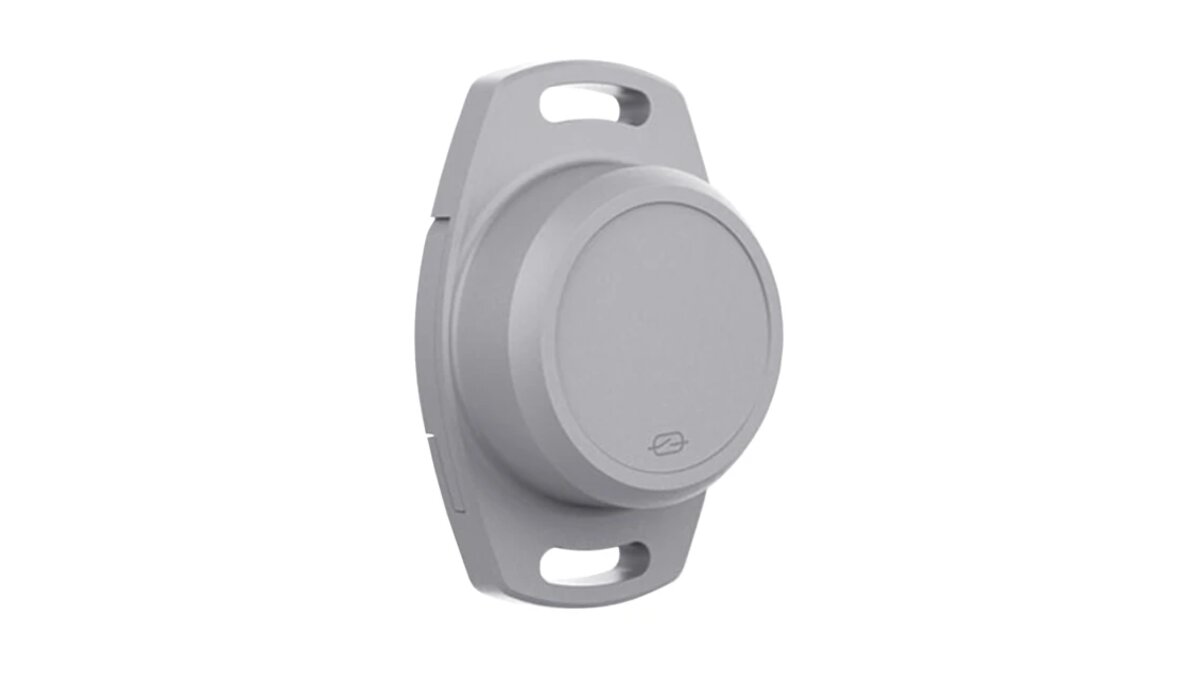
BLE tags fix the core weakness of QR codes: they detect presence automatically, in real time. The GPX AssetTag broadcasts its location on its own, turning a facility or yard into fully visible space. You stop wondering whether a tool is on-site. The system confirms it.
This model fits high-value, mobile assets that get misplaced or walk off: medical equipment in a hospital, specialty tools on a construction site, or returnable containers moving through a supply chain. High-precision systems using Bluetooth Angle of Arrival (AoA), like those from Blueiot, deliver sub-meter accuracy for indoor asset tracking inside large buildings.
The cost model differs from QR codes. You pay for hardware per tag plus a software subscription. The GPX AssetTag starts at $45/yr per device, hardware and platform access included. It runs on a 4-year replaceable battery, so one swap keeps a tag in service for years. That price pays for itself the first time it saves a single misplaced tool.
| Method | Updates When | Per-Asset Cost | Needs Infrastructure | Battery | Best Fit |
|---|---|---|---|---|---|
| GPX AssetTag (BLE) | Automatically, in real time near a phone or gateway | $45/yr per device | No (uses phones and gateways) | 4-year replaceable | High-value, mobile assets; real-time visibility |
| Printed QR Label | Manually, when a person scans it | Under $0.50 (one-time) | No (uses any smartphone) | None | Static assets; linking to maintenance and service records |
| Barcode Label | Manually, when a person scans it | Under $0.25 (one-time) | Requires barcode scanner or app | None | High-volume inventory; retail and warehouse checkouts |
| Passive RFID | Automatically, when passing a fixed reader portal | $0.10 to $1.00 (one-time) | Yes (fixed readers/portals) | None | Choke-point tracking; high-volume supply chain |
| Cellular GPS Tracker | Automatically, in real time with satellite view | $100+ hardware plus $15+/mo subscription | No (uses cellular network) | Yes (rechargeable) | Vehicles, trailers, and high-value remote assets |
Running Both: The Hybrid Approach
Most complex operations don’t choose QR codes or BLE tags. They run both. Match the technology to the asset and you optimize cost and data quality at the same time.
Put cheap QR labels on stationary and low-cost assets: office furniture, desktop IT, large machinery, bins of consumables. The code links each item to its record for periodic audits and maintenance. Open-source platforms like Shelf Asset Management handle this well.
Put BLE tags on the assets that get lost, left behind, or hoarded: specialty tools, diagnostic gear, medical devices, key transport containers. Real-time presence gives you the accountability QR codes can’t. Together, the two methods cover every asset without overspending on any of them.
Key Challenges to Plan For
QR code systems work well until they scale. At volume, several practical problems surface that you have to plan for.
- Label durability. Industrial labels get dirty, scratched, and abraded. A code that won’t scan is dead weight. Spec durable materials like polyester or metalphoto aluminum from the start.
- Scan discipline. Success hinges on your team scanning at every step. Without a fast process and consistent enforcement, data integrity degrades quickly.
- Line of sight. A scanner needs a clear view of the code. Assets on high racks, in crowded rooms, or behind other equipment defeat that requirement.
- Duplicate or unreadable labels. Printing and application errors create duplicate codes or low-resolution labels that won’t scan, and both cause confusion during audits.
- Register drift. With no automated presence check, the central register slides out of sync with reality. Reconciling it means time-consuming manual audits.
BLE tags remove the scan dependency, but they introduce challenges of their own.
- Signal interference. BLE shares the crowded 2.4 GHz band, and dense metal infrastructure, machinery, and RF noise degrade signal strength and dent location accuracy in heavy industrial settings.
- Battery management at scale. A thousand tags means a thousand batteries on a replacement schedule. Stagger the swaps so a fleet of tags never goes dark at once. The GPX AssetTag’s 4-year replaceable battery stretches that interval to a rare, quick task.
- System integration. A tracking layer only pays off when it feeds your ERP, WMS, or EAM. Budget for the API work that syncs asset data both ways from day one.
- Signal security. BLE broadcasts get jammed or spoofed by bad actors, so high-value deployments need encrypted payloads and anomaly alerts to catch tampering fast.
How to Choose the Right Asset Tracking Method
The right technology depends on the asset and the problem you’re solving. There is no single best method, only the best fit for each case. Work through four questions.
1. What is the asset worth? For high-value equipment where one loss hurts, an active BLE tag or a full GPS tracker pays off fast. For low-cost, numerous items, a QR code wins on economics.
2. How often does it move? Stationary assets like HVAC units and large machinery need only a QR code for maintenance history. Daily-moving assets like tools and returnable containers need the automated, real-time updates a BLE system provides.
3. What does not knowing cost you? If a misplaced asset triggers operational delays or financial penalties, you need a presence signal from a BLE tag. If you only need a record for annual audits, a scan event covers it.
4. What is your environment? Open outdoor yards and transport routes call for cellular GPS. Large, complex interiors call for BLE, where GPS signals can’t reach. A QR code works anywhere a person can walk up to it.
Score your assets against these four questions and you build a hybrid system that delivers real operational clarity across your entire inventory.
GPX runs a multi-sensor platform that combines these technologies on one screen. Our AssetTag BLE devices give you real-time visibility on your most critical mobile equipment. Talk to our team to map the right mix of QR, BLE, and GPS to your operation.
Frequently Asked Questions
How is AI used in asset tracking with BLE or QR codes?
AI turns the raw data both methods produce into decisions. With BLE presence signals, AI flags idle or missing assets, predicts maintenance windows, and surfaces movement anomalies in real time. GPX Scout AI answers plain-English questions like ‘which assets sat idle over 48 hours?’ so your team acts on patterns instead of digging through scan logs.
Can you track the location of a QR code in real time?
No. A QR code has no signal of its own, so you see only where the last scan happened. The system logs the asset to the GPS coordinates of the phone or scanner at the moment of that scan.
How much does a BLE asset tracking system cost?
You pay for the tags plus a software subscription. The GPX AssetTag starts at $45/yr per device, including hardware, platform access, and support. Total cost scales with the number of assets and the vendor you choose.
Do BLE tags require a gateway?
Not always. Some systems need dedicated gateways installed across a facility to pick up tag signals. Others, including GPX, use a network of phones running an app as a mobile, gateway-free network, which cuts deployment cost and time.
Can BLE and QR tracking be combined in one system?
Yes, and most mature operations run both. Put low-cost QR labels on static assets and BLE tags on the high-value, mobile ones that go missing. The GPX multi-sensor platform reads QR, BLE, and GPS on one screen, so a mixed inventory stays visible without overspending on any single method.
Author: Mitch Belsley