
Quick answer
A decoy GPS tracker for trailers is a visible device mounted where thieves expect to find one. Crews hunt for trackers before they move a stolen trailer. When they find and pull the decoy, a second tracker hidden elsewhere on the trailer keeps reporting. You keep the location and a path to recovery.
US cargo theft had its costliest year on record in 2025. Estimated losses rose 60 percent from 2024 to nearly $725 million, and the average theft value climbed 36 percent to $273,990. Confirmed incidents rose 18 percent, so the losses grew far faster than the theft count.
Trailers sit at the center of the problem. Thieves stole 204 semi-trailers in Q1 2025, up 39 percent from 146 a year earlier. If your trailer security depends on one tracker, one discovery ends your visibility. Layered GPS trailer tracking fixes that with two devices: a decoy meant to be found and a hidden tracker that stays on the job.
| Setup | What Thieves Find | What Happens Next | Best Fit |
|---|---|---|---|
| GPX layered setup: visible decoy + hidden AssetTrack Mini | The decoy, mounted where they expect a tracker | Hidden unit keeps reporting; Scout AI alerts on unauthorized movement | High-value trailers and freight, 10+ assets |
| Commercial paired decoy (Triplezeta, Geotab Marketplace) | A visible decoy wired to vehicle power | Removing it triggers an alert; the paired hidden tracker keeps reporting | Listed for Central and South America and Mexico; not trailer-specific |
| Single visible tracker or standalone trailer telematics unit | The only tracker on the trailer | The trailer goes dark once the tracker is removed | Low-risk assets with short dwell times |
| Single hidden tracker, no decoy | Nothing obvious, so the sniffer search continues | Exposed to discovery or jamming while the search runs | Lower-value loads that do not justify a second device |
Why Parked Trailers Carry the Highest Theft Risk
Trucking freight carries more risk than air or sea freight because trailers sit exposed and unattended for long stretches at rest stops, yards and docks. That idle time gives a crew room to search for a tracker and disable it.
The risk also clusters by place and hour. In a recent quarter, 37 percent of recorded US thefts happened within 200 miles of Torrance, California, and 28 percent of reports came between midnight and 6 a.m. Those overnight hours give thieves the most time to search a trailer without interruption.
The calendar works against you too. Friday is the most common day for trailer theft, at 21 percent of incidents. A trailer stolen on Friday often goes unnoticed until Monday, which hands a crew the whole weekend.
What Goes Wrong When a Trailer Relies on One Tracker
A stolen trailer costs more than the freight inside it. Three losses stack up once the only tracker goes dark:
- Downtime and missed deliveries. The trailer and the load leave service together. The shipment misses its window, and your customer feels the miss long before the claim settles.
- A heavier loss history. Every theft claim joins the loss record your insurer reviews at your next cargo coverage renewal.
- False confidence in one hardwired unit. A factory-installed or hardwired trailer telematics unit feels like protection, but it draws trailer power, and that wiring leads a crew straight to it.
Can thieves detect GPS trackers on a trailer?
Yes. Cargo thieves use handheld sniffer devices to find covert GPS trackers embedded in a trailer, then use a GPS jammer to block the technology once they find it. Every transmission gives a sniffer another chance to locate the device.
That is why the decoy works. The sniffer picks up a signal and leads the crew to the visible device. They pull it, assume the trailer is dark and stop looking. Our guide on whether thieves can detect GPS trackers covers detection methods in more depth.
Reporting frequency matters for the hidden unit. A tracker set to report once or twice a day stays silent most of the time. That leaves a sniffer very little to pick up while the trailer sits parked.
Where is the best place to hide a GPS tracker on a trailer?
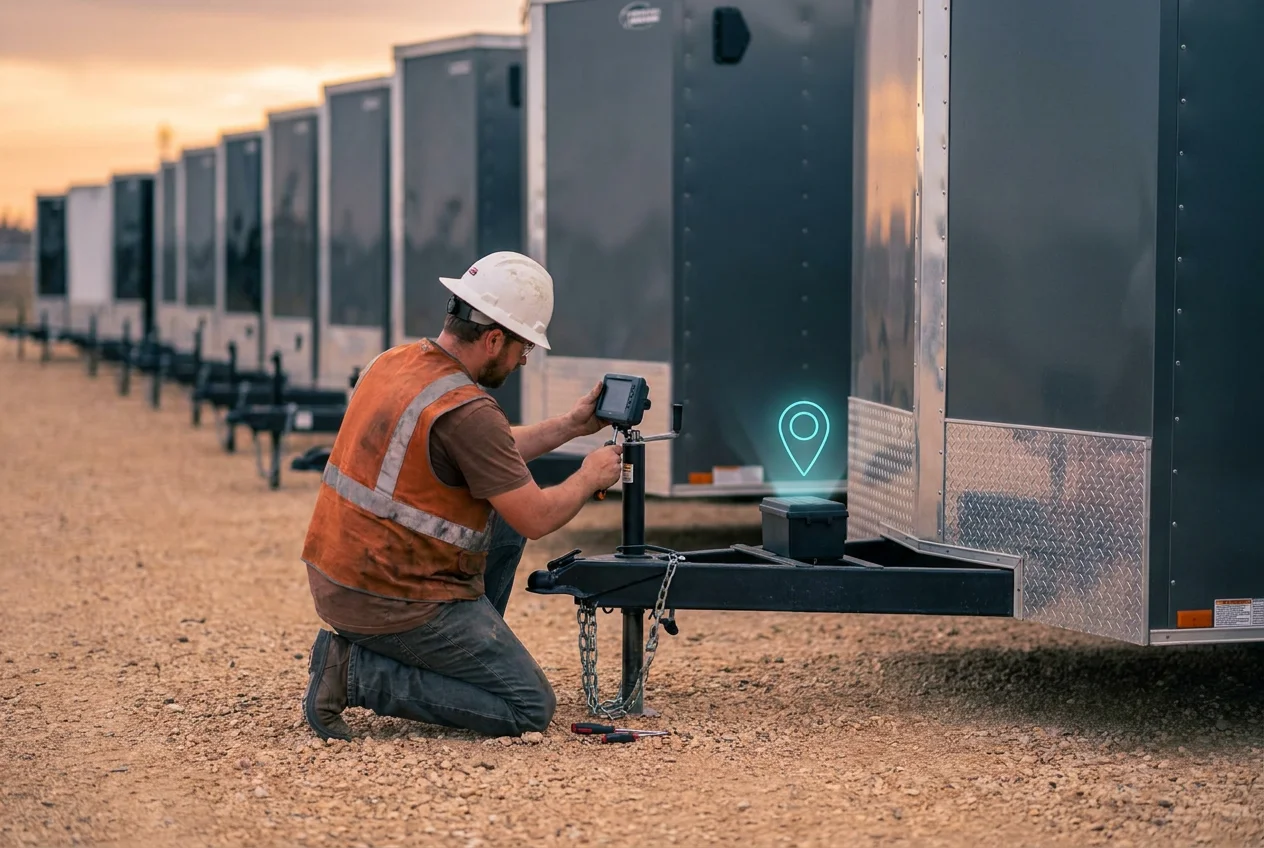
Put the decoy where thieves expect to look: the trailer nose, near the wiring or another obvious mounting point. Its job is to be found fast.
Put the hidden tracker somewhere that does not follow the trailer’s wiring. Power lines lead straight to hardwired units, so a battery-powered tracker with no wires to trace is harder to find. Cross-members, frame rails and the steel behind bumpers all work. Our AssetTrack Mini is built for this job: it has a small profile and holds to steel with an internal magnet.
GPS needs a path to the sky. Solid steel enclosures block it, while wood floors, plastic and fiberglass panels let the signal through. Test the location before you commit to it. The same approach protects yellow iron on job sites, as our guide to choosing a skid steer anti-theft device explains.
Do GPS jammers stop a hidden tracker from working?
Yes, while the jammer runs. A jammer floods nearby frequencies with noise and blocks any tracker in range from reporting, hidden or not. No tracker beats a jammer on its own.
The decoy deals with jamming indirectly. Thieves jam a tracker once they find one. A crew that finds and removes the decoy thinks the job is done. Your hidden tracker’s best protection is a search that ends before anyone goes looking for it.
How do thieves find and remove GPS trackers from stolen trailers?
The search follows a pattern. Crews sweep with a sniffer, check the obvious mounting points and trace any wiring that draws trailer power. Once they find a device, they cut its power or pull it off.
Commercial decoy products already exist, which shows the decoy-plus-backup pattern is an established security concept. A Geotab Marketplace listing for a decoy GPS product made by Triplezeta describes a visible device wired to vehicle power and built to be mistaken for the real tracker. It pairs with a hidden tracker. Removing the decoy breaks a circuit and triggers an alert instead of silencing tracking.
That listing targets Central and South America and Mexico, and it is not trailer-specific. The logic still applies to US trailers: make the first find the wrong find.
Should a trailer have more than one GPS tracker?
Yes, for any trailer or load you can’t afford to lose. One tracker is one point of failure. Find it, remove it, and the trailer goes dark.
A layered, dual GPS tracking setup splits the work. The visible tracker absorbs the search. The hidden tracker handles covert asset recovery.
Add geofences in Scout AI, which fires an instant alert on unauthorized movement. Your team knows a trailer is moving when it moves, not when someone notices an empty spot on Monday.
How long does a hidden trailer GPS tracker’s battery last?
A hidden tracker should run on its own battery. Hardwiring gives thieves a power line to follow straight to the device.
Battery life depends on the device and how often it reports. Our AssetTrack Mini runs 5 years on its battery. The full-size AssetTrack runs up to 10 years on one daily GPS fix. Both are IP67-rated and anti-tamper.
The more often a tracker reports, the faster it drains. Set the hidden unit to a slow reporting schedule while the trailer is parked.
When GPX Is Not the Right Fit
GPX serves operations tracking 10 or more high-value assets, plus fleet and enterprise operations. If you need one tracker for a personal utility trailer, a family car or a pet, our sister brand Logistimatics fits that need.
GPX is an AI-powered asset tracking and supply chain visibility platform. It is not a dashcam, a telematics suite or an ERP. If your main need is driver behavior scoring or engine diagnostics, a telematics provider is the better fit.
Which of Your Trailers Need a Second Tracker Now
Start with exposure. Cargo crime hit an all-time high in 2024, up 27 percent, and the pace has not slowed. Q3 2025 recorded 645 incidents, up 29 percent year over year. Trailers that sit overnight, over weekends or in high-theft corridors need a layered setup first.
Check any setup you consider against three tests:
- A decoy that gets found first. Mount it where thieves look.
- A hidden tracker with no wires to trace. Battery-powered, small and placed off the wiring path.
- Alerts that beat the weekend. Geofences and movement alerts that reach your team the moment a trailer moves.
Recovery depends on data that investigators can act on. Over an 18-month span, the National Insurance Crime Bureau assisted in more than 240 cargo crime investigations, leading to 70 recoveries valued at nearly $40 million. A hidden tracker that keeps reporting gives them that data.
Ready to stop relying on a single tracker? Get started with GPX or book a live demo to see a layered trailer setup built around your own fleet.
Frequently Asked Questions (FAQs)
How do commercial dual GPS tracking systems protect against cargo theft?
They keep a stolen trailer recoverable. A visible decoy draws the thieves’ search, and a hidden tracker keeps reporting after the decoy is pulled. In the paired product listed on the Geotab Marketplace, removing the decoy breaks a circuit and triggers an alert. You can build the same pattern with two standard trackers.
What is the best covert asset recovery solution for semi-trailers?
Layer three things: a visible decoy, a battery-powered hidden tracker placed off the wiring path, and movement alerts that reach your team the moment the trailer moves. Our AssetTrack Mini fits the hidden role with a small profile, an internal magnet for steel, a 5-year battery and an IP67, anti-tamper build. Pair it with Scout AI geofences so a Friday theft surfaces on Friday, not Monday.
How does a battery-powered hidden tracker report without wired power?
It runs on an internal battery and reports over cellular networks on a set schedule, then sleeps between reports. Long gaps between reports extend battery life and give a sniffer fewer signals to detect.
Why do thieves target trailers on Fridays?
Friday is the most common day for trailer theft, at 21 percent of incidents. A trailer taken on Friday often goes unnoticed until Monday, which gives a crew the whole weekend to move it.
Does a hidden tracker need a clear view of the sky?
GPS works best with a path to the sky, so never seal the tracker inside solid steel. Wood, plastic and fiberglass let the signal through. Some trackers add WiFi positioning as a fallback, including our AssetTrack Mobile.
Can GPX alert me the moment a trailer moves without authorization?
Yes. Scout AI geofences every site in seconds, and unauthorized movement fires an instant alert. Your team hears about it when the trailer moves, not when someone finds the spot empty.