
Manufacturers put real capital into custom racks, intermediate bulk containers, and heavy-duty totes. They buy those assets expecting a decade of trips. Instead, units stall in a customer yard, get repurposed as local storage, or disappear into the scrap market. McKinsey Global Institute found companies face supply chain disruptions lasting a month or longer every 3.7 years, with losses equal to almost 45 percent of one year’s profits over a decade. A rack shortage triggers that same shutdown.
Regulation is tightening in parallel. The EU Packaging and Packaging Waste Regulation requires that from 1 January 2030, at least 40 percent of transport packagingmoving between sites in the EU is reusable. Spreadsheets will not survive that audit. Buying the asset is the easy part. Getting it back on schedule is the actual business model.
Five Circular Packaging Models That Define Modern Supply Chains
Enterprises run five distinct circular packaging models. The right one depends on who owns the asset and who controls the network. Each carries its own capital load and reverse-logistics burden.
Internal reuse pools are closed loops. The manufacturer owns the custom dunnage and moves it between its own plants and tier-one suppliers. Control is total. So is the capital outlay, the maintenance bill, and the responsibility for end-of-life disposal.
Pooling providers run shared networks at scale. Enterprises rent standardized pallets and foldable large containers, and the provider handles repair, sanitation, and repositioning. Capital expense becomes a predictable operating expense. Operators still track every rented unit, because lost and damaged assets carry penalty fees.
Deposit-return systems put cash on the line. The receiver pays a fee upfront and reclaims it when the empty container reaches a designated processing site. That incentive drives return rates up fast. It works best for standardized, high-volume items moving through fragmented retail and distribution networks.
Refill models run bulk chemical and agricultural supply. The original manufacturer retrieves, cleans, and refills specialized intermediate bulk containers, which protects material purity and blocks cross-contamination. The production schedule depends on empty tanks coming back fast enough to fill the next batch.
Take-back programs sit at the end of the line. Equipment manufacturers reclaim custom shipping materials for remanufacturing or controlled recycling, which keeps specialized materials out of general waste streams. Retrieval has to start the moment installation finishes, so it requires direct coordination with the end customer.
What Makes B2B Reuse Work in Reality
Every one of these models lives or dies on unit economics. The moment replacement costs outrun single-use alternatives, the program is finished. Four numbers decide the outcome.
Pool sizecomes first. Operators balance having enough containers to fill orders against parking capital in idle inventory. Getting that number right means knowing how many units sit empty at remote customer sites right now. Shrinking the pool safely requires faster asset velocity.
Cycle time drives revenue directly. Asset velocity dictates how much value each unit produces per quarter. If a specialized automotive rack takes 45 days to return instead of 30, you buy 50 percent more racks to support the same production volume. That math never improves on its own.
Loss rate drains the budget without warning. Returnable transport packaging, known across enterprise logistics as Returnable Transport Items or RTIs, ends up in unauthorized storage yards or sold for scrap plastic. Every unit lost is a unit you buy twice, and the second purchase comes out of margin. Quarterly audits surface the loss months after the money is gone.
Cleaning throughput decides whether the loop keeps moving. Specialized containers need rigorous sanitation between trips. Without arrival predictions, wash bays swing between idle shifts and overtime backlogs. Plant managers schedule labor against incoming empty traffic or they schedule it blind.
How Do Companies Track Returnable Containers, Cable Drums, and Packaging Assets Across Customer Sites?
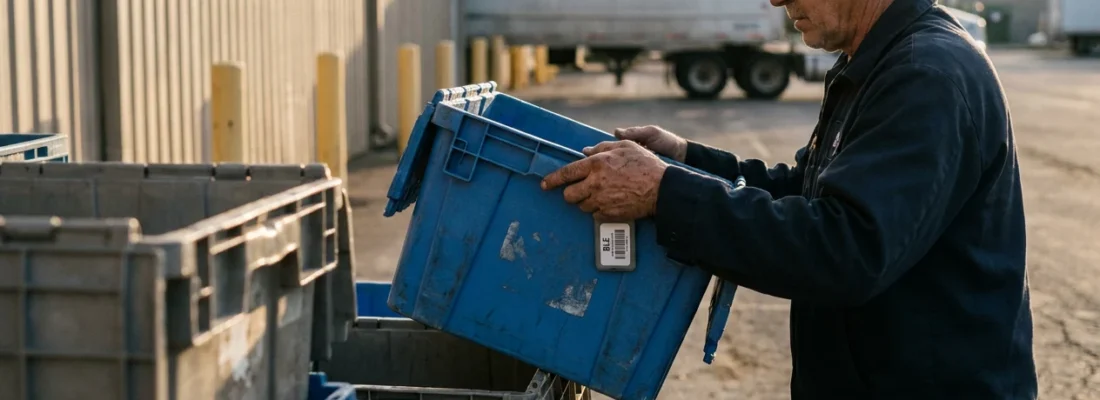
Industrial operators use returnable packaging trackingto hold visibility across fragmented global networks. Supply chain digitization in reusable packaging logistics started with barcodes and passive RFID, and both require a person to scan the empty unit. When a warehouse worker skips the scan on an empty cable drum, the asset drops out of inventory, and the operations team is left guessing between in transit, sitting in a yard, and stolen.
Modern enterprises deploy IoT asset tracking devices instead. Ruggedized hardware combines cellular LTE-M, Cat-M1, GPS, and BLE positioning, then reports location to an AI intelligence platform on its own schedule. No scan required. Teams see hoarding at a third-party distribution center the week it starts and dispatch retrieval before the asset is gone for good.
How Returnable-Asset Tracking Approaches Compare
Buyers evaluating reverse logistics tracking software usually weigh the same handful of options. The difference that matters is where each one goes blind.
| Approach | How assets report | Where it goes blind | Best for |
|---|---|---|---|
| GPX Intelligence | Active multi-network connectivity: cellular LTE-M, Cat-M1 and NB-IoT, plus GPS, BLE, satellite and WiFi positioning | No scan dependency. Reports from plants, yards, transit and customer sites | Universal asset & fleet tracking |
| Passive RFID portals | Reads only when an asset passes a fixed gate | Everything between gates, and every customer site with no reader installed | High-volume flows inside fully instrumented facilities |
| Barcode scanning | Manual scan by a worker at each handoff | Every skipped scan and every third-party yard | Low-value pools with strict scan discipline |
| Consumer Bluetooth tags (Apple AirTag, Tile) | Crowd network dependent on nearby consumer phones | Industrial yards, rural lanes and cross-border routes | Single consumer items, not industrial pools |
| Spreadsheet reconciliation | Quarterly manual counts | Every day between audits | Small pools with a single destination |
Why OTIF Delivery Matters More Than You Think in Packaging Supply
On-time in-full is a finished-goods metric. Apply it to the empty containers and the picture changes. A late delivery of empties stops the line. Chemical manufacturers cannot ship without clean tanks, and automotive suppliers cannot move parts without racks.
Supply chain leaders use AI-powered supply chain visibilityto make sure empties land when the schedule needs them. Predictive ETAs let planners reroute inventory while there is still time to act. When a load of empty totes stalls at a congested port, the platform flags it early enough to source alternative packaging. That is the difference between a rescheduled truck and a stopped line.
The Friction in Returnable Operations
Scaling a circular model exposes every weak seam in reverse logistics. Without continuous visibility, six barriers inflate operating costs and stall production.
- Asset hoarding at customer sites:Distributors and end users keep heavy-duty totes, chemical tanks, and custom racks for their own local storage. That traps your capital off-site and manufactures an artificial shortage back at the plant.
- Cycle-time data gaps:Manual scanning breaks the moment a worker skips an empty container. Planners lose sight of real turnaround speed and make seven-figure purchasing decisions on stale spreadsheet math.
- Emergency replacement orders:When high-value transport assets go missing, procurement expedites replacements to keep the line running. Those rush orders erase the margin the reuse program was built to capture.
- ERP and WMS integration friction:Container data stranded in a standalone portal forces planners to re-key numbers into the systems that actually run production. Platform-agnostic APIs that write pool counts and cycle times straight into your ERP, EAM, or WMS of record end that duplicate entry.
- Connectivity dead zones on cross-border lanes:Single-carrier devices go silent across ocean legs, rural corridors, and customs yards, and the gap always lands on the leg where assets go missing. Multi-network connectivity that fails over between cellular, satellite, BLE, and WiFi positioning keeps reporting where a single-network tag stops.
- Unpredictable sanitation schedules:Specialized containers need strict wash cycles to prevent chemical and biological cross-contamination. With no arrival predictability, wash bays sit idle one week and run overtime the next, and clean-container shortages follow.
Managing EPR and Regulatory Compliance
Extended Producer Responsibility (EPR)rules require companies to document the lifecycle and recycling rates of their industrial materials. Location data supplies that evidence without adding manual reporting work to your team. Our guide to EPR compliancebreaks down the reporting framework in detail.
One caveat worth stating plainly: no current environmental legislation requires GPS tracking devices. Location intelligence simplifies the reporting. It does not satisfy the mandate by itself.
What Comes Next: Agentic Asset Intelligence in Reverse Logistics
The shift from passive tracking to agentic asset intelligence is already underway in returnable networks. Tracking told you where a rack was. Agentic orchestration opens the retrieval order the moment that rack passes its dwell threshold at a supplier site.
Modern logistics teams treat tracking as an intelligence layer, not a status page. Reverse logistics becomes an autonomous control tower: wash bays staffed against predicted arrivals, purchase orders triggered by real pool depletion, and recovery crews routed to the yards holding the most idle capital.
Audit the Loss Rate Before You Approve the Next Container Order
Start with the money. Pull your most expensive custom containers and calculate the historical loss rate. Put a dollar figure on what leaks out of the network each quarter. That number sets the budget ceiling for any RTI tracking program, and it is the number your finance team will ask for first.
Then pilot IoT asset tracking devices on a subset of high-value RTIs and map real cycle times against your planning assumptions. The gap between the two shows which facilities hoard your equipment and where the loop breaks. Commit to the platform that reports without human scans, holds signal indoors and across borders, and turns dwell data into retrieval actions.
Stop buying replacement containers to cover for inventory you already own. The GPX platform delivers the predictive ETAs and pool-level clarity that make a reuse program profitable, with 246,000 returnable containers already tracked across customer networks. Talk to our teamto secure your asset network.
Frequently Asked Questions (FAQs)
How do equipment manufacturers track returnable packaging and containers?
Manufacturers attach ruggedized active sensors to racks, pallets, drums, and bins. The devices report location to an AI intelligence platform on their own, with no barcode scan required. Operations teams get an accurate unit count across every supplier and customer location.
Which GPX products track returnable containers and IBCs?
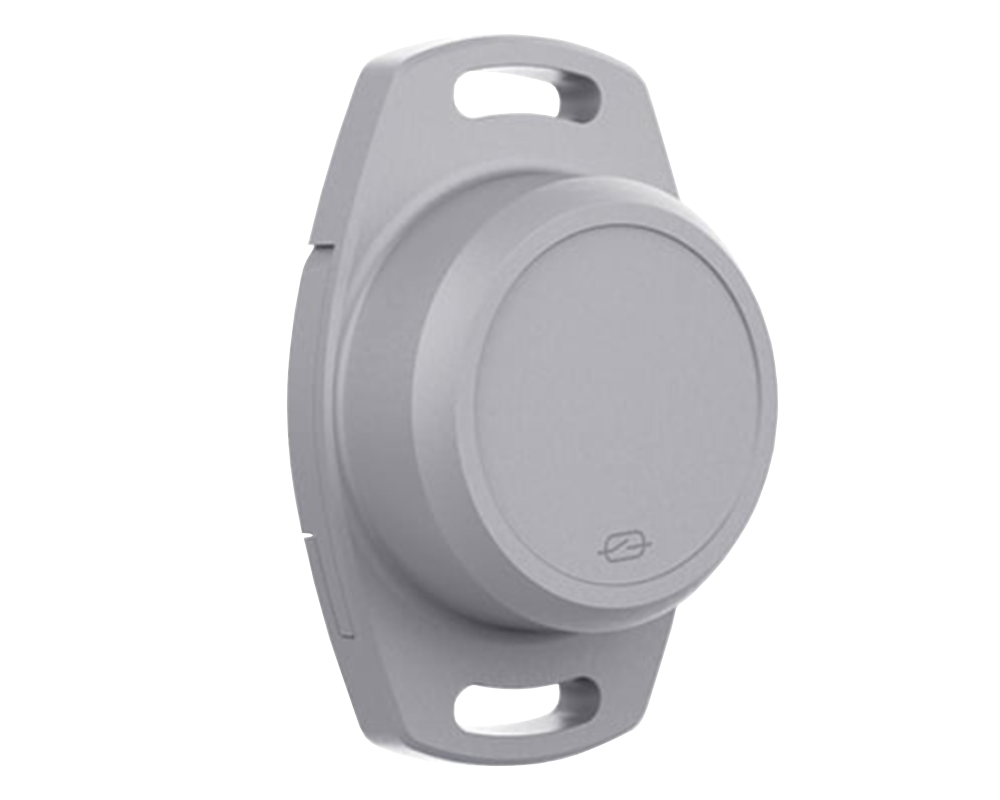
AssetTag Procovers indoor and yard visibility with a battery that lasts three to five years, depending on the model, as low as $45/yr per tag with the hardware included. SmartLabelhandles one-way shipment tracking as low as $13 per label. BLE RoadWiredturns forklifts and facility vehicles into mobile gateways, and Scout AIanswers plain-English questions such as “Which containers have been idle more than 48 hours?”
What defines returnable transport packaging?
Returnable transport packaging, also called Returnable Transport Items or RTIs, covers durable assets built for repeated trips through an industrial supply chain. Common examples include heavy-duty plastic pallets, steel intermediate bulk containers, cable drums, and custom automotive parts racks. These units survive harsh environments and repeated high-pressure wash cycles.
What is the ROI of tracking Returnable Transport Items (RTIs) with IoT?
Return on investment shows up on three budget lines: a smaller container pool carrying the same production volume, fewer units written off as lost, and rush replacement orders that stop happening. Device and subscription costs sit well below the replacement cost of a single custom rack or steel IBC. Operators measure payback by comparing quarterly write-offs before deployment against write-offs after.
Why does tracking returnable packaging improve profitability?
Location data ends the cycle of buying replacement units for inventory that is sitting somewhere findable. Faster cycle times and visible hoarding let you support the same production volume with a smaller pool. That frees capital and takes rush replacement orders out of the budget.