
Quick answer
Choosing between the GPX SmartLabel and the Tive Solo 5G comes down to gateway coverage on your lanes and how sensitive the cargo is. The SmartLabel is a peel-and-stick BLE label built for high-volume one-way freight, while the Tive Solo 5G is a rigid cellular tracker with environmental sensors for remote global routes.
Picking a single-use IoT freight tracker comes down to two variables: how dense the gateway coverage is on your lanes, and how sensitive the cargo is. The GPX SmartLabel is a peel-and-stick BLE label built for high-volume one-way freight. The Tive Solo 5G is a rigid cellular tracker with environmental sensors for remote global routes.
The money at risk is not theoretical. Verisk CargoNet put U.S. and Canada cargo theft losses at an estimated $725 million in 2025. The McKinsey Global Institute found companies absorb a disruption lasting a month or longer every 3.7 years, costing the equivalent of 45 percent of one year’s profits over a decade.
One-way freight stacks three problems at once. You lose the hardware, you lose the picture between carrier scan events, and you find out about the exception after the customer does. The fix is matching the device architecture to the route, not buying every sensor on the spec sheet.
| Product | Connectivity | Sensors | Coverage | Reuse Model |
|---|---|---|---|---|
| GPX SmartLabel | BLE | Location, plus temperature and humidity with AssetTemp | 150M+ terrestrial gateways already in the field | Single-use, nothing to recover |
| Tive Solo 5G | Cellular, multi-network | Location, temperature, humidity, shock, light | Global cellular | Single-use, optional return program |
| Emerson GO Real-Time | Cellular | Location, temperature, light | Global cellular | Single-use disposable |
| Sensitech TempTale GEO | Cellular with GPS | Location, temperature | Global cellular | Single-use disposable |
| Roambee BeeBeacon | BLE | Location | Needs a gateway or paired device in range | Reusable, recovery required |
What One-Way Freight Costs When You Cannot See It
On a dedicated loop, hardware recovery is already part of the workflow. On dispersed outbound freight, recovery turns into a reverse logistics project with its own cost center.
Once return freight and lost-device rates cost more than the tracking data is worth, the visibility program dies on the spreadsheet. That is why so many shippers monitor one-way lanes with nothing but carrier scan events.
Checkpoint data only tells you where the freight was. Between a port gate and a cross-dock, the shipment goes dark, and the first signal of trouble is a missed delivery window or a chargeback.
Density decides the technology. Cellular trackers carry their own radio and SIM across 5G, LTE-M, and NB-IoT networks, which buys coverage on remote highways and costs size, weight, and dollars. BLE labels drop the cellular radio to get thin and cheap, and they report through gateways already in the field.
GPX SmartLabel
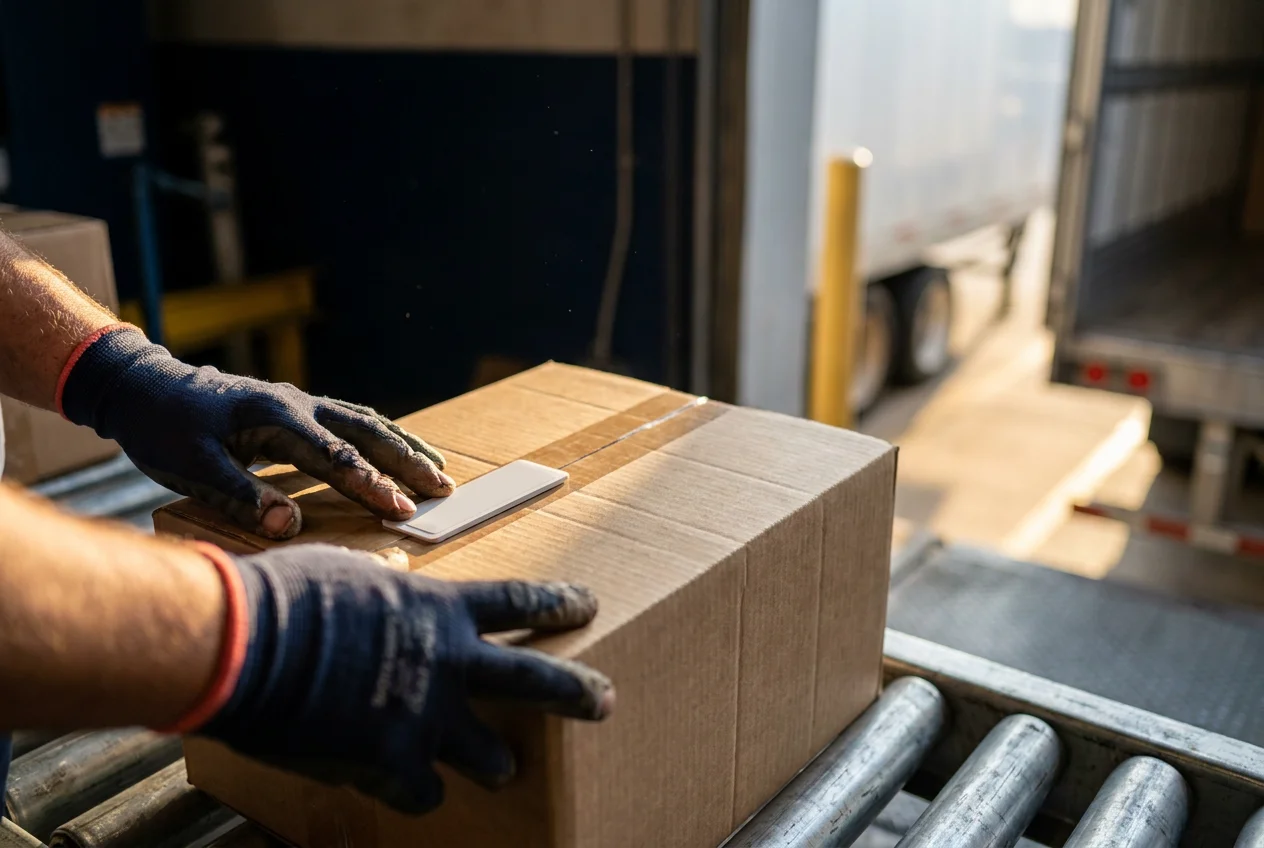
The GPX SmartLabel is a peel-and-stick disposable shipment label for high-volume one-way freight. You tear the tab, the label goes live in seconds, and nobody can power it off in transit. There is nothing to recover at the destination.
The label reports over Bluetooth Low Energy through more than 150 million terrestrial gateways already in the field, so your team installs no infrastructure. Where condition matters, pair the label with AssetTemp sensors so every location fix carries a temperature and humidity reading, which is the entry point to condition-based monitoring (CBM) on freight you never get back.
- Location: Kernersville, North Carolina, serving operators globally.
- Best for: High-volume outbound lanes where recovering hardware costs more than the data is worth.
- Connectivity: BLE reporting across 150M+ terrestrial gateways, with cellular, GPS and WiFi positioning available across the wider GPX hardware line.
- Standout features: Tear-tab activation, no SIM and no charging, zero reverse logistics, AssetTemp pairing for cold chain, and Scout AI for plain-English questions about any shipment.
Strengths
- Peel-and-stick form factor sits flat on a carton or pallet without a mounting plan.
- No hardware comes back, so there is no return freight and no lost-device write-off.
- Tear-to-activate construction keeps labels dormant in the stockroom and live the moment freight moves.
- BLE reporting runs on gateways that already exist, so deployments go live in days, not quarters.
GPX AssetTrack Voyager
When device recovery is standard operating procedure, the GPX AssetTrack Voyager covers the same lanes with cellular hardware. It ships one-way or recharge-and-reuse, uses hybrid-mode fixes, picks up WiFi position at the cross-dock, and confirms arrival by geofence.
For parcels that ship inside a box, GPX MicroTrack rides inside the package itself, palm-sized and rechargeable.
- Location: Kernersville, North Carolina.
- Best for: Closed-loop lanes and high-value shipments that justify standalone cellular connectivity.
- Connectivity: Cellular with hybrid-mode fixes and WiFi positioning at indoor handoff points.
- Standout features: Geofence-confirmed arrival, cross-dock WiFi position, and a reuse model that survives repeated transits.
Strengths
- Standalone cellular reporting works without any gateway in range.
- One-way or recharge-and-reuse deployment fits both dispersed and closed-loop lanes.
- WiFi positioning holds the location picture inside buildings where GPS drops.
Tive Solo 5G
Tive builds the Solo 5G as a rigid multi-sensor shipment tracker. It reports location, temperature, humidity, shock, and light exposure over cellular, so it holds the thread on remote stretches with no gateway coverage. Tive publishes a NIST-traceable temperature specification for cold-chain users, and buyers validating audit requirements should request the current calibration certificate.
Most shippers deploy it once and leave it with the freight. Tive also runs an optional tracker return and recycling program for customers who want the hardware back out of the waste stream.
- Location: Boston, Massachusetts.
- Best for: Global pharmaceutical and perishable shipments that need standalone cellular coverage end to end.
- Connectivity: Cellular across multiple carrier networks, with no gateway dependency.
- Standout features: Five-sensor payload, traceable temperature records, and an optional return program.
Strengths
- Reports independently on routes with no BLE gateway density.
- Shock and light data documents handling disputes, not just arrival time.
Limitations
- The rigid body limits placement on small parcels and thin cartons.
- Unit cost runs above a disposable BLE label, which hurts on high-volume lanes.
Emerson GO Real-Time Tracker
Emerson builds its GO Real-Time line for food, beverage, and produce supply chains. The trackers log temperature and location across international transit and push alerts when a shipment breaches a threshold you set.
Light exposure logging flags unplanned door openings, which matters on cross-border loads with multiple handoffs. Compliance reporting is the reason most exporters buy it.
- Location: St. Louis, Missouri.
- Best for: Agricultural and food exporters working under strict cold-chain compliance requirements.
- Connectivity: Cellular, with no gateway dependency.
- Standout features: Threshold alerting, excursion reporting, and light exposure logging.
Strengths
- Reporting lines up with food and produce cold-chain documentation needs.
- Threshold alerts reach the operations desk while the load is still recoverable.
Limitations
- Device size restricts placement inside tight packaging.
- Cellular-only reporting goes quiet in ocean transit and deep indoor facilities.
Sensitech TempTale GEO
Sensitech, a Carrier company, built the TempTale GEO for life sciences freight. It pairs GPS and cellular reporting with the temperature logging that pharmaceutical distribution audits require.
The appeal is documentation discipline. Teams moving clinical trial material and biologics get a condition record that stands up from the plant to the hospital dock.
- Location: Beverly, Massachusetts.
- Best for: Life sciences logistics and clinical trial material transport.
- Connectivity: Cellular with GPS positioning.
- Standout features: Pre-calibrated sensors and pharma-grade condition reporting.
Strengths
- Regulatory documentation is the core of the product, not an add-on.
- Continuous condition monitoring covers long international lanes.
Limitations
- Overbuilt and overpriced for dry freight or industrial equipment.
- Provisioning takes more setup than a location-only deployment warrants.
Roambee BeeBeacon
Roambee sells the BeeBeacon as a reusable BLE tag that reports through a gateway or a paired device in range. It fits internal loops and tote-level tracking inside facilities you control.
Reuse is the trade. Every tag has to come back, which puts you right back in the reverse logistics business on dispersed outbound freight.
- Location: Santa Clara, California.
- Best for: Reusable packaging and internal loops with controlled gateway coverage.
- Connectivity: BLE, dependent on nearby gateways or paired mobile devices.
- Standout features: Low-cost reusable tags and tote-level granularity inside managed sites.
Strengths
- Reusable hardware spreads cost across many transits on closed loops.
- Small tag format suits totes, bins, and returnable packaging.
Limitations
- Coverage collapses outside managed gateway zones.
- Tag recovery adds the handling cost that one-way lanes exist to avoid.
Three Objections That Stall Single-Use Tracker Rollouts
The data has to land in your TMS, not in another dashboard
Planners already log into enough screens, and a tracker that reports only into its own portal creates work instead of removing it. Ask every vendor for documented REST API access, webhook events that fire on exception, and real-time API and EDI integrations into the TMS, ERP, EAM, and WMS systems you run today. GPX is platform-agnostic on integration, so a gateway ping becomes a milestone update in the software your team already uses.
Sustainability teams will challenge single-use electronics
Scope 3 reporting puts every consumable in scope, and a battery inside a shipping label is exactly what an ESG reviewer flags. Answer it with arithmetic instead of adjectives: a thin BLE label carries no cellular radio and no rechargeable cell, and a reusable device only pays back its material footprint on lanes where the return trip actually happens. Route spent labels through the certified electronics and small-battery stream your facility already uses, document that route, and ask cellular vendors about their tracker return and recycling programs before you sign.
High-value freight puts lane data into security review
Pharmaceutical, semiconductor, and aerospace shipments turn tracking data into something worth stealing, because a live map of loaded trailers is a target list. Require encryption in transit and at rest, a stated data retention window, and role-based access so a carrier contact sees one shipment while your planners see the network. Scout AI enforces role-based access on GPX accounts, and any vendor that cannot describe its payload protection on the first call does not belong in the pilot.
When GPX Is Not the Right Fit
GPX builds asset and supply chain visibility: the tags, the trackers, the network, and the platform. We are not a dashcam product and not a driver-behavior suite. If you need engine fault codes and driver scoring, that is the fleet telematics category where Samsara, Motive, and Geotab compete, and we integrate with those systems rather than replace them.
Volume matters too. Ten or more high-value assets, or any fleet and enterprise operation, belongs on GPX. One car, one pet, or one personal device belongs on a consumer tracker such as an Apple AirTag, a LandAirSea unit, or our sibling brand Logistimatics.
What Platforms Keep Freight Visible in Real Time
Hardware reports; software decides. A real-time transportation visibility platform (RTTVP) pulls label pings, tracker fixes, real-time API and EDI integrations, and warehouse events into one operational view, then turns that stream into a predictive ETA.
When a SmartLabel hits a gateway at a consolidation facility, the platform updates the manifest and recalculates arrival against port congestion and weather. GPX tracks assets across many industries, and Scout AI answers questions in plain English, so a dispatcher asks which loads are late instead of building a report.
That difference decides whether your team stages labor and reroutes freight ahead of a delay, or explains the delay after it lands.
What Comes Next for In-Transit Visibility
The next step is an autonomous control tower: tracking data that triggers the reroute, the carrier claim, and the customer notice without a human assembling the evidence first. Agentic orchestration turns exception handling into a workflow instead of a fire drill.
The layer underneath it is a digital freight twin, where every shipment, container, and lane runs as a live model you test against before you commit the load. Modern logistics teams treat tracking as an intelligence layer, not a status page. That is what we mean by going “beyond dots on a map,” and it is the reason lane-level device choice still matters at the hardware level.
Specify by Lane Density, Not by Sensor Count
Start with gateway density on your actual lanes. High-volume outbound freight moving through facilities, yards, and urban corridors with existing gateway coverage reports fine on a BLE label, and you never pay to bring hardware home.
Switch to a cellular tracker when the route runs remote, crosses borders, or carries biopharma and perishable cargo that needs a defensible condition record. Buy sensors against the audit you have to pass, not against the longest spec sheet in the shortlist.
Then price the exit. If recovery is not already in the workflow, a reusable device is a recurring expense disguised as a one-time purchase, and the integration, waste, and security answers above decide which vendor survives procurement.
Stop paying to recover hardware on freight that only moves one way. Talk to our team and we will match the device to your lane density, cargo value, and audit requirements.
Frequently Asked Questions (FAQs)
When should I use a disposable tracker instead of a reusable one?
Use a single-use tracker on dispersed one-way freight, where nobody at the destination has a reason to send hardware back. Keep reusable trackers on closed loops and returnable assets, where recovery is already part of the workflow and the device earns its cost across many transits.
Does the GPX SmartLabel require a cellular subscription?
No. The SmartLabel reports over Bluetooth Low Energy through more than 150 million terrestrial gateways already in the field. There is no SIM to provision and no cellular data plan to buy for each label.
What is the difference between a BLE label and a cellular shipment tracker?
A BLE label has no cellular radio, so it stays thin and cheap and reports when it passes a gateway. A cellular tracker carries its own radio and reports from anywhere with carrier coverage, which costs more size, more weight, and more money per unit.
Can a disposable tracker monitor temperature?
Yes. Pair a SmartLabel with GPX AssetTemp sensors and every location fix carries a temperature and humidity reading. Multi-sensor cellular units such as the Tive Solo 5G log temperature, humidity, shock, and light on the device itself.
How does single-use tracker data integrate with our existing TMS or WMS?
Through an API feed, not a file drop. GPX is platform-agnostic across ERP, EAM, WMS, and TMS systems, so a gateway ping arrives as a milestone update and an exception alert inside the software your planners already use. Ask any vendor to confirm real-time API and EDI integrations plus webhook events on exceptions before the pilot starts.
Are single-use freight trackers compliant with ESG and electronic waste standards?
Compliance comes from your disposal path, not from the device category. Route spent BLE labels through the certified electronics and small-battery stream your facility already uses, document that route for Scope 3 reporting, and ask cellular vendors about their tracker return and recycling programs. On dispersed one-way lanes, a reusable device that never comes back is the worse outcome for both the budget and the waste report.