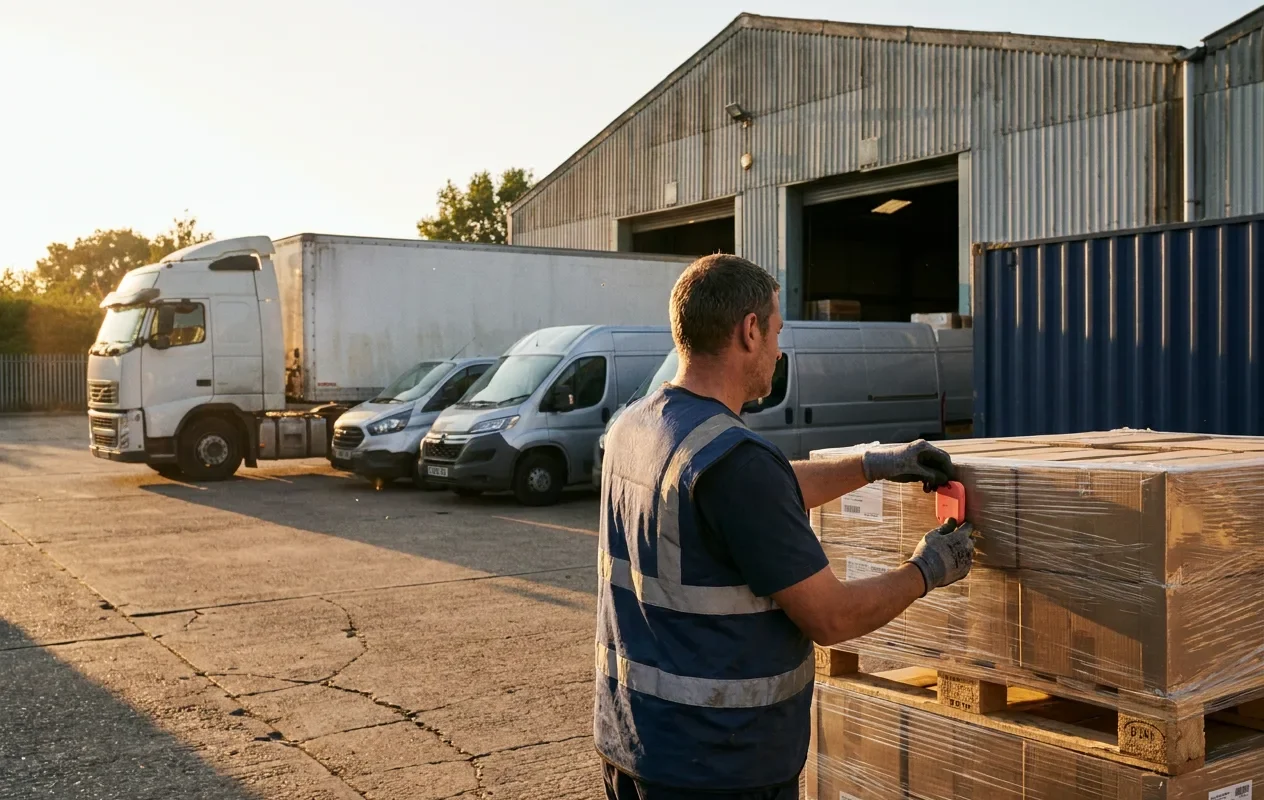

Assets rarely vanish on the open highway. They vanish in the places a GPS tracker cannot see: stacked container yards, concrete plants, service bays, and overflow lots. The signal drops, the last known location goes stale, and somebody starts walking the yard with a clipboard.
The cost of that blind spot keeps climbing. Verisk CargoNet reports that estimated supply chain theft losses surged 60 percent to nearly $725 million in 2025, with the average value per theft climbing to $273,990. On-site loss runs on its own meter. The National Retail Federation’s National Retail Security Survey put total shrink at $112.1 billion on a 1.6 percent shrink rate, which is the gap between what the books say is on hand and what is actually there.
Gateway-free Bluetooth low energy (BLE) tracking closes the indoor RTLS blind spot. You get zone-level location on every tagged asset without wall gateways, electrical work, or a new IT project.
| Tracking Technology | Infrastructure Required | Indoor Accuracy | Best For |
|---|---|---|---|
| GPX Gateway-Free BLE | None. Relays through GPX trackers, BLE RoadWired hubs, and 100M+ terrestrial gateways already in the field | 75 ft indoors, 150 ft outdoors | All asset types across dense yards, plants, and low-signal facilities |
| Legacy BLE and WiFi RTLS Gateways | Hardwired 110V wall gateways throughout the building | Zone level | Fixed, single-facility inventory |
| Cellular GPS | None. Uses 4G, 5G, and LTE-M | Low. Signal blocks indoors | Over-the-road transit and open yards |
| Active RFID | Portal readers at every chokepoint | Chokepoint only | High-volume conveyor sorting |
| UWB (Ultra-Wideband) | Fixed, wired anchors in every zone you want covered | 10 cm to 30 cm | Single-room precision and safety-zone use cases |
Where Legacy Asset Visibility Breaks Down
- Cellular and GPS signals die indoors. Satellite fixes need sky. Cellular needs a tower path. Move a high-value machine into a concrete building or under a metal roof and the platform freezes on a last-known location that is already wrong.
- Fixed gateways bill you before they track anything. Legacy RFID and WiFi tracking systems run on powered wall readers. You hire an electrician, pull conduit, schedule downtime, and wait months before a single asset appears on a map.
- Tags burn power hunting for a network. Devices that keep searching for a dropped cellular connection drain their cells fast. Deep inside a facility, that turns into dead hardware and silent gaps in the record.
- Yard assets sit on a different system than transit assets. Over-the-road freight reports to one platform while the yard runs on paper counts. Assets fall through that seam the moment a trailer hits the gate.
- Location data never reaches the systems that run the business. A tracking screen nobody opens changes nothing. Zone-level location earns its keep once it writes back into ERP, WMS, and EAM records, so the cycle count, the work order, and the shipment all reference the same physical asset.
- Broadcast security gets treated as an afterthought. A tag that shouts a static, unencrypted identifier hands anyone in the parking lot a free inventory of your site. Enterprise IoT asset management calls for encrypted identifiers and role-based access to the location record, and consumer-grade BLE beacons deliver neither.
How Gateway-Free Bluetooth Tracking Actually Works
Gateway-free BLE deletes the fixed wall reader. The tag behaves like a BLE beacon, broadcasting an encrypted identifier at set intervals, and any receiving device in range forwards that broadcast to the cloud along with its own position.
Your Own Vehicles Become the Gateways
A tagged pallet of medical supplies pings the forklift parked two aisles over. That forklift carries a BLE RoadWired hub or an AssetTrack unit, receives the broadcast, and relays it with a location stamp. Every truck, forklift, and service vehicle you already operate turns the site into a self-updating network. Nobody mounts anything on a wall.
The Terrestrial Gateway Network Covers the Rest
Tags also report through GPX’s wider terrestrial gateway network, with more than 100 million gateways already in the field. Smartphones and connected IoT hardware pick up the broadcast and pass the location along. That is the whole idea behind gateway-less BLE asset tracking: you use coverage that already exists instead of building it.
Matching the GPX BLE Tag to the Job
Tag choice decides whether a deployment holds up. GPX builds three BLE tags, and every one of them runs on a replaceable battery. Nobody pulls charging cables into a container yard.
GPX AssetTag Pro
The flagship tag. Hang it, stick it, or screw it down. It ships activated with no app pairing, carries an IP67 rating, and runs 5 years on a replaceable coin cell. Put it on high-value equipment that moves between buildings, yards, and job sites.
GPX AssetTag
The rugged, screw-down option for assets that take abuse. It runs Bluetooth 4.2, reports up to 80 feet from an AssetTrack unit, holds an IP67 rating, and delivers 3 to 4 years on a replaceable CR2477 cell. Bolt it to steel and forget it until the battery swap.
GPX AssetTag Edge
Bulk coverage in a small footprint: 8.5 grams, 6 mm thin, Bluetooth 5.0, 150 feet outdoors and 75 feet indoors, IP67, and up to 4 years on a CR2032. It fits returnable bins, hand tools, diagnostic gear, and small parts containers where a full GPS tracker will not fit or pencil out.
What Bluetooth Does Better Than GPS
Gateway-free Bluetooth wins in the exact conditions that break satellite tracking. The work shifts from searching to knowing.
Indoor and Below-Grade Reliability
Bluetooth reports where satellite coverage stops. You see which dock door, storage rack, or basement level holds a specific generator, infusion pump, or tool crib item. Consumer trackers depend on one phone platform and one crowd; GPX tags report through enterprise hardware your operation already runs.
Dense Yard Penetration
A staging yard stacked with steel containers scrambles cellular reception and blocks satellite fixes. Bluetooth broadcasts relay off nearby vehicles and assets instead. One yard truck driving a single aisle collects hundreds of tag reports and pushes them to the platform in one pass.
No Electrical Work, No IT Battle
Pulling wall gateways out of the plan moves deployment from months to days. No contractor invoices. No conduit runs. No security review over unknown hardware joining the corporate WiFi. Crews stick the tag on the asset and get back to work.
Where Gateway-Free BLE Pays Off First
Every industry describes the same problem in different words. The fix travels well.
Construction and Heavy Equipment
Excavator buckets, hydraulic hammers, plate compactors, and portable generators separate from the cab constantly. Full GPS trackers are too large and too power-hungry for most attachments. Tag them instead, and every supervisor pickup that rolls onto the site refreshes the location of every attachment on the ground.
Returnable Containers and Logistics
Metal racks, plastic totes, and specialized cages get hoarded downstream and swallowed inside distribution centers. Edge tags let an OEM run returnable container tracking across thousands of units without putting cellular hardware on every bin.
Healthcare and Mobile Medical Equipment
Infusion pumps, specialty beds, and diagnostic carts wander across multi-story campuses, and thick concrete stops traditional tracking cold. BLE tags give biomedical and materials teams a live count by floor and department, so clinical staff stop hunting for equipment during a code.
Automotive and Dealer Lots
Dealerships and Buy Here Pay Here lots move hundreds of units between service bays, overflow lots, and test drives every week. Tags relay off shuttle vehicles and porter trucks, which gives the manager an exact inventory count without a physical lot walk.
From Location Pings to Predictive Control
Location is the input, not the outcome. GPX feeds BLE reports and cellular GPS fixes into one enterprise IoT asset management view, so an asset stays on the same map whether it sits on a highway or three floors underground.
From there, Scout AI does the analysis. Ask it in plain English which assets have been idle more than 48 hours, and it answers. It geofences every site in seconds, flags unauthorized movement instantly, and surfaces dwell time in staging yards before it turns into a missed delivery window. Push that same stream into a supply chain digital twin and the model finally reflects the yard as it stands, not as the paperwork remembers it. Modern logistics teams treat tracking as an intelligence layer, not a status page, and that is the step from reactive searching toward an autonomous control tower.
How to Choose the Right Gateway-Free BLE Setup
Start with where your assets actually spend their hours. Equipment that lives indoors, inside dense metal yards, or outside reliable cellular coverage will keep producing stale data on a satellite-only system. Bluetooth tags give you room-level and zone-level certainty without the electrical bill.
Then match the tag to the duty cycle. High-value mobile equipment takes AssetTag Pro. Assets that get hit, washed, and scraped take the screw-down AssetTag. High-count returnable bins and small tools take AssetTag Edge. Confirm at least one relay device moves through each site daily, whether that is a forklift with a BLE RoadWired hub, a service truck, or an AssetTrack unit on a trailer. Then confirm the location record writes back into the ERP, WMS, or EAM system your team already opens every morning, because a second login is where visibility projects quietly die.
Ready to close the indoor dead zones and put a live count behind every asset on your books? See how gateway-free BLE deploys across your sites in days rather than quarters. Talk to our team.
Frequently Asked Questions (FAQs)
How does gateway-free BLE asset tracking work?
The tag broadcasts an encrypted Bluetooth signal at set intervals. Any GPX tracker, BLE RoadWired hub, or terrestrial gateway in range picks up that broadcast and forwards it to the platform with its own location. There are no wall gateways to install and no site wiring to schedule.
Does Bluetooth asset tracking require cellular coverage?
The tag itself carries no SIM and no cellular radio. The relay device supplies the connection, so a tagged asset reports whenever a GPX tracker, a BLE RoadWired vehicle, or another network device passes within range. Keep one relay device circulating through each site and the location record stays current.
How long do GPX BLE tag batteries last?
AssetTag Pro runs 5 years on a replaceable coin cell. AssetTag delivers 3 to 4 years on a replaceable CR2477, and AssetTag Edge runs up to 4 years on a CR2032. Every GPX BLE tag uses a replaceable battery, so an expired cell costs a battery swap instead of a new tag.