
Quick answer
A hardwired GPS tracker for commercial vehicles runs on the vehicle’s own power, so there is nothing to charge. GPX Intelligence makes two: RoadTrack Wired, a 2-wire install with a 24-hour backup battery, and BLE RoadWired, which also reads the tagged equipment around the vehicle. Choose a telematics suite instead if you need ELD logs and engine data.
Commercial vehicles and the cargo they carry are a growing target. Cargo theft losses reached an estimated $725 million in 2025, according to Verisk CargoNet. One missing truck or stolen machine can stall a project and wreck a delivery schedule.
Idle and misrouted vehicles also cost more to run every year. In 2025 the industry-average cost to operate a truck hit $2.336 per mile, the highest in the history of the American Transportation Research Institute’s cost report. Manual driver check-ins and legacy tracking leave blind spots that make both problems worse.
The right hardware closes those gaps. To choose the right tracker, start with the data your operation actually needs.
| Tracking Technology | Installation | Power Source | Primary Data Reported | Best For |
|---|---|---|---|---|
| GPX RoadTrack Wired and BLE RoadWired | 2-3 wire direct connection | Vehicle battery (RoadTrack Wired adds a 24-hour backup) | Real-time location, movement, nearby BLE-tagged assets | Powered vehicles and the tagged assets around them |
| Telematics suite (Samsara, Motive, Geotab) | Diagnostic port or wiring kit | Vehicle power through the diagnostic connection | ELD logs, engine data, dashcam integration, location | Hours-of-service compliance and engine data |
| Plug-in OBD tracker | Plug-and-play OBD-II port | Vehicle power, small backup battery on some models | Location, geofence alerts | Fast rollouts and rotating rental vehicles |
| Battery-powered asset tracker | Magnetic or screw mount | Internal battery | Scheduled location fixes | Unpowered trailers and containers |
| Consumer GPS (Logistimatics) | Varies by device | Internal battery or plug-in | Location for personal use | One car, family or personal tracking |
The Hidden Risks of Operating in the Dark
Idle Equipment and Surplus Rentals
When managers can’t confirm where their assets are, they over-rent equipment or buy extra vehicles. Field teams hold on to trucks and trailers “just in case” while other sites wait for the same resources. Capital spend goes up while expensive assets sit idle.
GPX Intelligence idle and dwell analytics show you which assets are sitting unused. You put them back to work before you rent or buy more.
Security Gaps at Unmanned Sites
Vehicles parked overnight at job sites, yards and staging areas are easy targets. Fences and occasional patrols won’t tell you when a truck starts moving. The longer a theft goes unnoticed, the worse your odds of getting the asset back.
A geofence alert system for vehicles closes that gap. Scout AI geofences every site in seconds and sends an instant alert on any unauthorized movement.
Insurance Exposure Without Recovery Data
A stolen truck becomes a claim on your commercial auto and cargo policies. Without a live position or location history, recovery comes down to luck, and you have little to show your insurer about how fast you responded.
The RoadTrack Wired keeps reporting on its backup battery after a power cut, so you have a position to hand to police and your carrier.
Split Data Across a Mixed Fleet
Electronic logging devices cover drivers who must log hours of service. Trailers and loose equipment have no driver and no log, so they sit outside that data. A mixed fleet ends up with compliance data on some units and no location data on the rest, and dispatchers switch between systems to answer one question: where is everything?
GPX integrates with the telematics system you already run, so location data on every asset sits next to the compliance data you already collect.
Stale Data and Slow Dispatch
With end-of-day reports and manual check-ins, dispatchers are working from stale data. Without a live position, they can’t predict arrival times or send the closest vehicle to a new job. You pay for it in wasted fuel, extra miles and frustrated customers. Enterprise customers expect accurate arrival windows, and a phone call to the driver is a slow way to give one.
Real-time location data lets your dispatchers plan routes ahead instead of reacting after the fact.
Hardwired, plug-in OBD or battery-powered: which tracker fits a commercial vehicle?
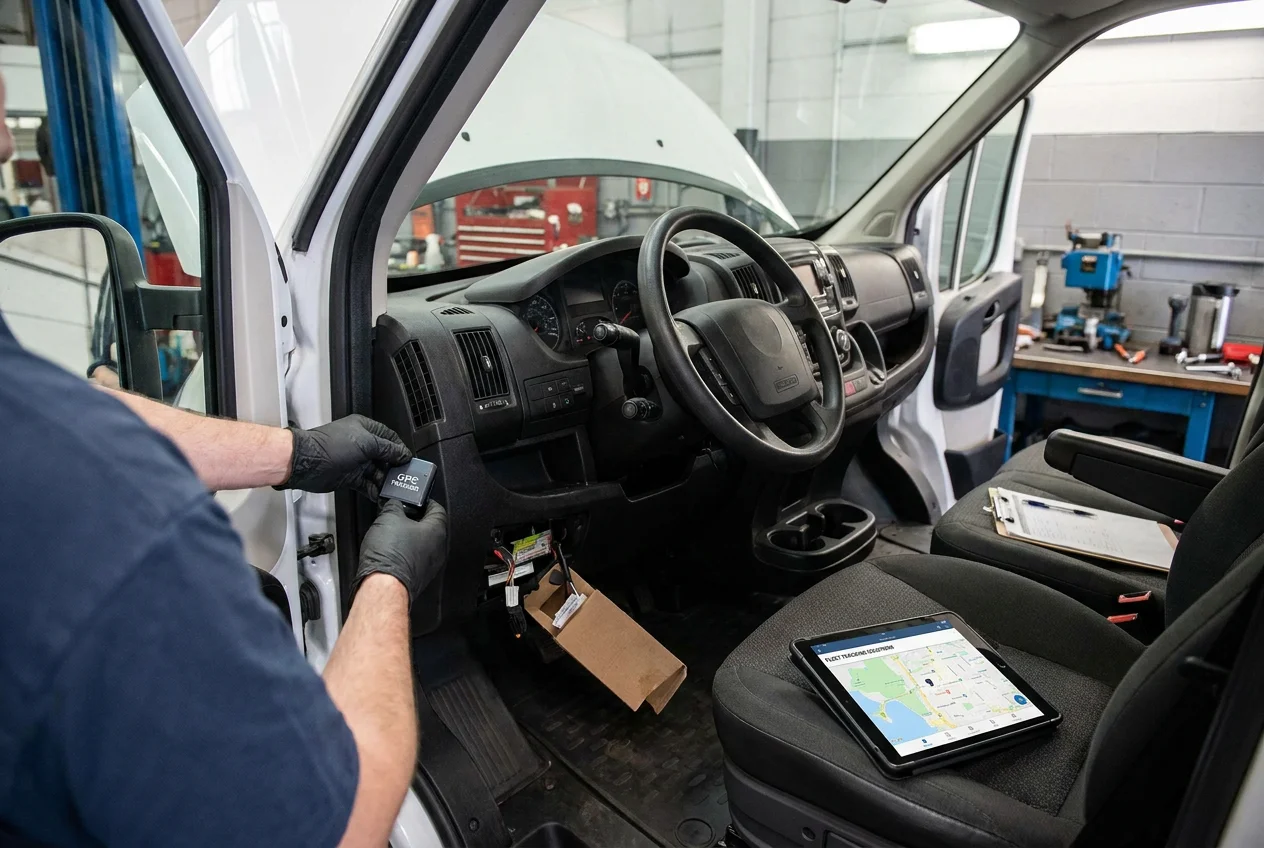
A hardwired GPS tracker for commercial vehicles gives you the most permanent, tamper-resistant installation. The GPX RoadTrack Wired runs on the vehicle’s 9-36 V DC system through a two-wire power and ground connection.
It reports a GPS fix every 400 meters while the vehicle is moving. If main power is cut, its 24-hour backup battery keeps it reporting. That makes it the right fit for heavy equipment and dedicated fleet vehicles.
The GPX AssetTrack OBD plugs into the OBD-II port in under a minute, and every car and light truck built since 1996 has that port. It runs on vehicle power, has a 12-hour backup battery and sends geofence alerts. Choose it for fast rollouts or for trackers that move between rental vehicles.
Battery-powered units run independently of the vehicle. The GPX AssetTrack runs 10 years on one daily GPS fix, with a replaceable battery and an IP67 rating. If you need to track the flatbed trailer or storage container rather than the cab that pulls it, this is the right hardware. All three have a place in a complete GPS fleet tracking strategy.
When do you need a telematics suite with ELD, engine data and dashcams instead of a hardwired tracker?
If your operation has to log hours of service, you need a telematics suite, not a standalone asset tracker. Samsara, Motive and Geotab build their platforms around engine data, compliance and driver monitoring.
Motive’s Vehicle Gateway connects through a J1939 9-pin, J1962 OBD-II or J1708 6-pin diagnostic port. It runs on 8-32 V, works as an electronic logging device (ELD) and pairs with the Motive AI Dashcam. Motive lists location updates as often as every two seconds.
The Geotab GO device records location, speed, engine idling and distance. It also monitors equipment status such as power take-off, driver seatbelt and cargo door signals. When you compare the best GPS tracking companies for commercial vehicles, separate compliance platforms from pure visibility tools.
GPX is not a telematics suite. It integrates with the telematics system you already run and adds visibility over the trailers, tools and tagged equipment around the vehicle. If your goal is location intelligence and loss prevention, a hardwired GPS tracker gives you that data without the overhead of compliance logging.
How does a hardwired tracker also see the trailers, tools and tagged equipment around the vehicle?
The truck is only part of what you need to track. The equipment riding with it matters just as much. The GPX BLE RoadWired combines a hardwired 12/24 V GPS tracker and a mobile BLE 5.0 gateway in one IP68 unit, installed with 2-3 wires.
The gateway reads nearby GPX AssetTag Pro tags on tools, returnable containers and heavy machinery. Each AssetTag Pro runs 3 years on a replaceable coin cell and ships activated, with no app pairing. As the truck moves through a yard or stops at a job site, the gateway logs every tagged asset in range.
The same unit turns forklifts and vehicles into mobile BLE gateways for infrastructure-light indoor tracking. You get visibility over trailer tracking and loose equipment without installing fixed gateways at every temporary site. When the vehicle itself becomes a mobile network, every stop doubles as an equipment check.
What does installing a hardwired tracker involve, and what happens when the vehicle’s power is cut?
The more data you need, the bigger the install. The GPX RoadTrack Wired needs only a power and a ground connection to the vehicle battery. That keeps installs fast and changes to vehicle wiring minimal. Once powered, it reports over LTE Cat-M1 / NB2.
Telematics suites connect deeper into the vehicle. Samsara’s light-duty Vehicle Gateway guide has installers detach the vehicle’s diagnostic port and connect a Samsara cable. Installers then fasten the free diagnostic port back in its original spot and zip-tie the gateway. The indicator takes 1-3 minutes to turn green.
Geotab GO devices plug directly into the diagnostic port. Specialty and heavy-duty installs need a dedicated wiring kit and professional installation, and so do installs that keep the port free.
Security depends on continuous power. A tracker without a backup battery goes dark the moment a thief cuts the battery cables. The GPX RoadTrack Wired switches to its 24-hour backup battery and keeps reporting after main power is lost.
Where a GPS tracker sits on the vehicle matters too. A unit wired in behind the dash is harder to find and pull than one plugged into an exposed port. Backup power and a concealed install are the first two specs to check in any anti-theft GPS tracker, whether it rides on a semi truck or a service van.
What’s Next for Commercial Vehicle Tracking
Modern logistics teams treat tracking as an intelligence layer, not a status page. Scout AI answers plain-language questions such as “Which assets have been idle for more than 48 hours?” so your team stops building complex reports. It also sends predictive disruption alerts.
Predictive ETA combines location, traffic, weather and historical patterns to predict arrival windows your dispatchers can plan around. Paired with hardwired trackers and BLE gateways, it moves your operation from reacting to problems to planning around them.
When GPX Is Not the Right Fit
GPX is built for operators tracking 10 or more high-value assets. If you need to track one car, a family vehicle or a pet, our sister brand Logistimatics is the right choice.
If you mainly need ELD hours-of-service logging, engine data or dashcams, choose a telematics suite such as Samsara, Motive or Geotab. GPX integrates with these systems but does not replace their compliance and driver-monitoring functions.
Which Tracker Belongs on Each Vehicle in Your Fleet?
Start with the data that drives your operation. If you need engine data and compliance logs, evaluate telematics providers. If you need reliable location data across vehicles, unpowered trailers and tagged tools, a hardwired GPS tracker is the stronger choice.
Use three checks to narrow the field:
- Define the data requirement: Decide whether you need hours-of-service compliance or location and movement data.
- Match the power source to the asset: Use hardwired units for powered cabs and battery-powered units for trailers.
- Map the secondary assets: Decide whether turning your vehicles into mobile BLE gateways closes the visibility gaps on your tools and equipment.
For a side-by-side look at hardware, review the best commercial GPS tracking devices. When your hardware matches your real visibility gaps, you stop paying for redundant rentals and lost equipment.
Stop relying on manual check-ins and legacy tracking that leave your assets exposed. See how GPX puts every vehicle, trailer and tagged asset on one map. Explore our product lineup or book a live demo.
Frequently Asked Questions (FAQs)
Can a hardwired GPS tracker lower commercial fleet insurance costs?
It depends on your carrier and your policy. What a hardwired tracker with backup power does give you is a live position and a location history after a theft. Ask your broker whether your carrier offers anything for tracked vehicles before you count on a lower premium.
What is the best hardwired hidden GPS tracker for commercial trucks in the USA?
For anti-theft, the best tracker is one a thief can’t easily find or disable. Look for a concealed hardwired install and a backup battery that keeps reporting after the main power is cut. The GPX RoadTrack Wired runs on 9-36 V DC systems, which covers 12 V and 24 V trucks, and switches to a 24-hour backup battery when main power is lost.
Do all vehicles have GPS trackers?
No. Factory connectivity varies by make, model and year, and it doesn’t cover the trailers, tools and equipment that travel with the vehicle. Operators who need one view across a mixed fleet install hardwired or plug-in OBD trackers.
How does Scout AI improve commercial vehicle tracking?
Scout AI is a conversational supply-chain analyst built into the GPX platform. Ask it which vehicles have been idle for more than 48 hours and you get the answer without building a report. It also geofences every site in seconds and sends an instant alert on unauthorized movement.
What separates AI asset tracking from standard fleet management?
Legacy tracking shows dots on a map and leaves the analysis to you. AI asset tracking does the analysis for you: it flags idle assets, predicts disruptions and tells you where to act. Hardware like the BLE RoadWired extends that view from the vehicle to the tagged equipment around it.