
Quick answer
A lost returnable rack costs far more than its replacement price. When a supplier has no rack to ship parts in, the shortage can stop your assembly line. Tracking every rack shows where the pool leaks, so you buy fewer replacements and head off shortages.
An idle production line at a large automotive plant costs about $2.3 million per hour, according to Siemens’ True Cost of Downtime 2024 report. Missing racks are one of the ways a plant ends up paying it.
Just-in-time schedules leave no buffer. If a supplier has no returnable packaging, it cannot ship parts, and without parts the line stops.
Most plants never connect the two costs. Procurement sees what it spends on replacement racks, and operations sees the shortages and expedited freight. Both trace back to returnable transport items (RTIs), the racks and totes nobody can find.
The Essentials
- A lost rack costs its replacement price plus the freight, labor and downtime risk that follow it.
- Shortages caused by missing packaging put a downtime cost of about $2.3 million an hour in play.
- Your own replacement count is the loss benchmark that matters.
- Tracking shows which Tier 1 or Tier 2 supplier is holding your racks and for how long.
- AssetTag Pro runs on the Hubble network of 150 million terrestrial gateways, with no dock-door readers to install.
| Tracking Method | Infrastructure Required | Visibility | Dwell Insight |
|---|---|---|---|
| GPX | None. Hubble network of 150 million terrestrial gateways | Live location on one map | Idle and dwell analytics with Scout AI |
| Passive RFID | Dock-door portals and readers | Only at read points | Manual reports from scan logs |
| Wired vehicle telematics | Hardwiring to vehicle power | Built for vehicles, not racks | Vehicle location only |
| Manual audits | Labor hours at every site | Delayed spreadsheet updates | Only as good as the last count |
Where Automotive Packaging Networks Go Wrong
Automotive supply chains run on tight time windows, so a missing rack leaves little room for resilience. When a custom steel rack or plastic tote disappears into the supplier network, the gap ripples back through the production schedule.
Plant teams then buy emergency corrugated packaging or pay for expedited freight to keep parts moving. That money comes out of budgets meant for equipment and plant improvements.
Racks pass through stamping plants, sub-assembly sites, 3PL warehouses and cross-docks every day. Without one record of those moves, teams work from spreadsheets and late supplier reports.
Some suppliers hold extra racks on purpose. A spare stack at their dock protects their own shipments, and the OEM pays for that buffer through a thinner pool and more replacement orders.
Cross-dock and 3PL sites add an accountability gap. With no record of who received a rack last, racks get reused for other customers’ parts or walk off the property, and nobody can say where the loss happened.
The waste lands on your sustainability report too. Every reusable rack replaced by single-use corrugated adds disposal volume, which cuts against the reason the plant invested in returnable packaging.
So teams chase rumors of hoarded racks instead of running planned production. Many plants buy extra racks just to cover the next shift, and that bigger pool hides the leak instead of fixing it.
How much does it really cost when a returnable rack or container goes missing?
The price of a steel rack or heavy-duty tote is only the starting cost. Every rack that leaves the loop for good has to be bought again to keep the pool whole.
That spend repeats every year the leak stays open. It pulls capital away from maintenance, upgrades and other plant investments.
The bigger cost shows up when a missing rack delays a part shipment. If a supplier cannot ship engine components without the right rack, your line waits. At about $2.3 million an hour for a large plant, minutes of downtime add up fast.
Teams then pay for expedited shipping or single-use packaging to bridge the gap. GPX built IoT tracking for returnable transport items (RTIs) to close that leak at the source.
What is a normal annual loss rate for returnable packaging?
Industry estimates put automotive losses at roughly 15% to 20% of returnable pallets and lids every year, and the cost of replacing lost reusable packaging at about $750 million a year in North America, according to an industry roundup citing Deloitte and AIAG figures. Treat those as a range, not a target for your own plan.
Some loss is normal. Racks get crushed by forklifts, damaged in transit or retired at end of life. The problem is the loss you cannot explain.
Build your own baseline instead. Count the racks you bought last year that were not tied to documented damage or retirement. That number is your leak.
Then put a price on it. A pool of 10,000 racks that leaks 5% a year means buying 500 racks every year. Multiply that by your unit cost and you have the number tracking goes after in your automotive operation.
Why do automotive supply chains lose so much returnable packaging?
Automotive production runs on multi-tier supplier networks spread across large regions. A single vehicle carries thousands of parts from hundreds of suppliers.
Returnable packaging travels through sub-assembly plants, sequencing centers and cross-docks before it comes home. Every extra stop is another chance for a rack to be misrouted.
Each handoff between a 3PL and a Tier 2 supplier breaks the chain of custody. Without automatic arrival and departure records, racks sit in warehouse corners or end up storing a third party’s own parts. Spreadsheets cannot keep up with thousands of racks moving across dozens of sites.
What hidden costs come from a missing returnable container besides just replacing it?
Labor is the first hidden cost. Logistics coordinators spend hours on calls, emails and old records trying to find missing racks.
That time comes out of route planning and managing active freight. Your best people end up working as a recovery crew for plastic totes.
Substitute packaging is the second. When the right racks are missing, plants switch to corrugated cardboard or generic wooden pallets.
Those substitutes need different handling, raise the risk of part damage and take up floor space. They also create waste the plant pays to haul away.
How does tracking actually reduce the cost of lost returnable racks and containers?
Tracking turns every rack into an asset that reports its own location. Your team stops searching after the fact and starts managing the pool before it runs short.
Once you know where every rack sits, you stop ordering replacements you do not need. Over time, you can run the same lines with a smaller pool.
GPX pairs that location data with Scout AI, a conversational supply-chain analyst. Ask it which assets have been idle for more than 48 hours and you get the answer in plain language. Predictive disruption alerts flag trouble before it reaches the line.
Which customer or supplier is holding my racks?
Finding out who holds your racks is how you stop the leak. GPX shows every tagged rack on one map, along with how long it has sat at each site.
Idle and dwell analytics break that time out by location. If your rule is three days and a supplier has held a batch for five, you see it.
Your team gets objective data for supplier conversations. You stop arguing over bills of lading and start planning the pull.
How do you track racks without power?
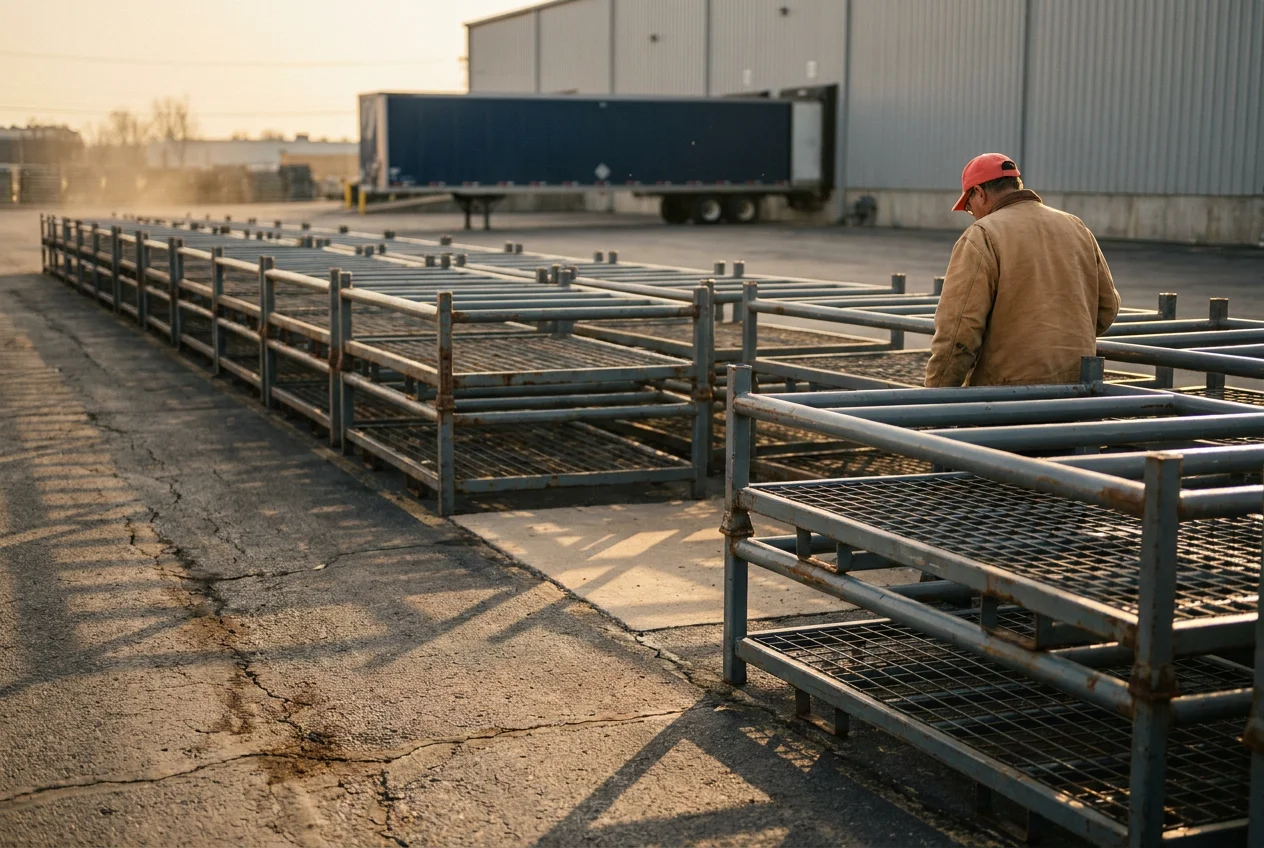
A steel rack in an outdoor yard has no outlet and no vehicle battery. The tag on it has to run for years without charging or wiring.
AssetTag Pro is built for that job. It hangs, sticks or screws on, carries an IP67 rating and runs 3 years on a replaceable coin cell. It ships activated, with no app pairing.
AssetTag Pro reports through the Hubble network of 150 million terrestrial gateways, so there are no dock-door readers to install. Pricing starts as low as $45 per tag per year, hardware included.
A plant can put SmartLabel on one-way outbound freight and AssetTag Pro on the racks and totes coming back. Both show up on the same GPX map, which gives you IoT supply chain visibility in both directions.
When GPX Is Not the Right Fit
GPX is built for businesses tracking 10 or more high-value assets across sites and suppliers. If you only need to keep tabs on a handful of items, a single consumer tracker will cost less.
GPX is not a dashcam product, a fleet telematics suite or an ERP. It connects to your ERP, WMS and TMS and focuses on asset and supply-chain visibility.
Tag One Supplier Loop First, Then Size the Pool
Pick the loop where racks disappear most often and tag a test group there. The platform maps how that part of your network really behaves.
GPX deployments go live in days, not quarters. Within the first cycles you see where racks stall and which suppliers hold them longest.
Take that data into your next supplier review. Enforce your dwell rules, recover stalled racks and cut the next replacement order to what your lines actually need.
Ready to see beyond dots on a map? Get a demo and find out where your racks are today.
Frequently Asked Questions (FAQs)
How does AI asset tracking differ from traditional GPS tracking?
Traditional GPS tracking plots a dot on a map. GPX adds idle and dwell analytics plus Scout AI, which answers plain-language questions such as “Which assets have been idle for more than 48 hours?” It also sends predictive disruption alerts.
What is the ROI of tracking automotive returnable transport items (RTIs)?
The return comes from three places: fewer replacement racks, less expedited freight and fewer hours spent searching. Start with your own baseline of unexplained replacement purchases and freight premiums. Compare it with the tag cost, which starts as low as $45 per tag per year for AssetTag Pro.
Does rack tracking require dock-door readers?
No. AssetTag Pro reports through the Hubble network of 150 million terrestrial gateways. You have no RFID portals or dock-door readers to install.
Can I track outbound freight and inbound returnables in one system?
Yes. Put SmartLabel, the disposable peel-and-stick label, on one-way outbound freight. Put AssetTag Pro on the racks and totes that come back, and see both on one map.
What is the battery life of AssetTag Pro?
AssetTag Pro runs 3 years on a replaceable coin cell. It ships activated with no app pairing, so your team can tag racks the day the tags arrive.