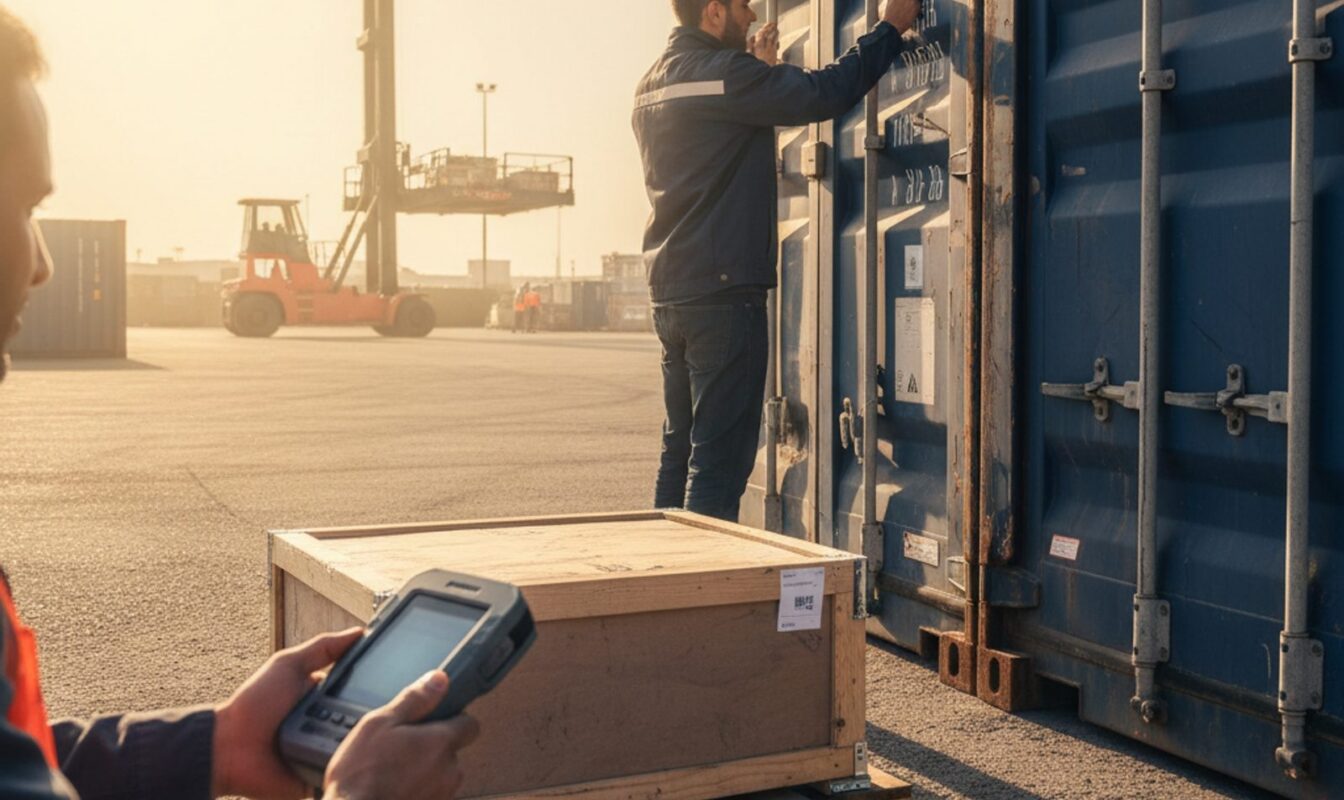
Top 7 GPS Stickers & BLE Smart Labels for Asset Tracking in 2026: Enterprise Rankings Compared


A foreman walks the job site at 6 a.m. and finds an empty spot where a $2,400 cordless tool kit sat the night before. No alarm, no witness, no dot on a map. By the time he files the loss, the gear is two counties away and the recovery odds have already collapsed.
That scene repeats across American construction sites, rental yards, and delivery fleets every day. The asset that vanishes is almost never big enough to justify bolting a bulky GPS box onto it, which is exactly the gap GPS stickers and BLE smart labels were built to close.
The numbers explain the rush. The smart tracker market is climbing from $0.81 billion in 2026 to $1.27 billion by 2031 at a 9.41% CAGR, inside a broader asset tracking market worth $32.45 billion in 2026. Falling sensor prices and dense smartphone relay networks have finally made it economical to track the small, mobile, high-value items traditional trackers always ignored.
This guide ranks the top 7 GPS stickers and BLE asset tags for 2026, explains how the technology recovers lost equipment, and shows you how to choose the right one for tools, trailers, fleet vehicles, medical devices, and in-transit shipments.
How Do GPS Tracking Stickers & BLE Smart Labels Work for Equipment Recovery?
A GPS sticker, also called a smart label or tracking tag, is a thin, adhesive-backed device that reports an asset’s location with no wiring, no mounting brackets, and no charging cradle. Despite the name, most modern stickers are not pure satellite GPS.
The best performers use Bluetooth Low Energy (BLE) to broadcast a secure signal that nearby smartphones, vehicles, and gateways pick up and relay to the cloud. Cellular GPS pucks still exist for wide-area outdoor tracking, but the sticker form factor has become the default for anything small enough to hold in one hand.
Here is the recovery workflow in plain terms:
- Peel and stick: The device attaches in seconds with an industrial adhesive rated for vibration, dust, oil, and temperature swings.
- Broadcast: The tag emits a low-power BLE signal at configurable intervals, with no SIM card to manage.
- Relay: Ambient receivers, meaning phones, forklifts, and fixed hubs, hear the signal and pass location and status into the platform.
- Recover: Software turns that stream into geofencing alerts, movement notifications, and predictive recovery workflows that route a response before the asset crosses the next county line.
Coverage is the whole game. Cellular GPS goes dark indoors because satellite signals do not penetrate concrete and steel. A BLE sticker riding a large ambient receiver network keeps reporting inside hospitals, multi-floor facilities, and yards where a satellite tracker would lose the asset entirely. That blend of indoor and outdoor visibility is what separates a real asset tracking sticker from a simple warning decal.
Eliminating “Ghost Inventory”: Why Enterprise Fleets Are Switching to Micro-Tracking in 2026
The shift is not about gadget appeal. It is about equipment shrinkage that finance teams can no longer wave away. In a high-interest-rate environment, writing off “ghost inventory” every quarter is a line item the CFO is now asked to defend, and the old answer no longer holds.
Ghost inventory is the gear your books say you own but nobody can locate. It hides in the wrong trailer, on the wrong floor, or in a thief’s truck. Micro-tracking exists to drag those assets back onto the balance sheet.
Consider the scale of the pain driving the switch:
- Theft losses: The National Equipment Register and the National Insurance Crime Bureau estimate construction equipment and tool theft drains $300 million to $1 billion from U.S. job sites every year, with recovery rates for stolen gear sitting below 25%.
- Search time: Field teams routinely lose dozens of hours a month hunting for shared tools, carts, and equipment that simply got moved.
- Duplicate purchases: When nobody can find an asset, the fast fix is to buy or rent another. Many facilities carry 15% to 20% more equipment than they need just to absorb chronic loss.
- Form factor failure: You cannot strap a four-inch GPS brick onto a hand drill, an infusion pump, or a returnable tote without ruining the tool or breaking the workflow around it.
The math at fleet scale closes the case. A contractor with 600 cordless tools at a $400 average value carries roughly $240,000 in exposure.
A 5% to 10% annual loss rate translates into $12,000 to $24,000 in walking inventory every year, before you count the delays, rentals, and rework. A flat per-asset micro-tracking subscription turns that uncertainty into proof, and the proof is what protects the budget.
The Best GPS Stickers & BLE Asset Tags Compared (2026 Enterprise Rankings)
We researched the leading GPS sticker and BLE asset tag providers serving U.S. businesses, weighing connectivity, battery life, durability, platform intelligence, and total cost across construction, fleet, healthcare, and in-transit logistics. The lineup spans paper-thin BLE smart labels, AirTag-style covert tags, and rugged cellular pucks so you can match the device to the asset.
1. GPX Intelligence: The Enterprise Standard for Sticker-Based Asset Visibility
As our flagship platform, GPX Intelligence leads the category by pairing the smallest sticker footprint on the market with the largest passive receiver network.
Two products anchor the lineup. The GPX Smart Label is a flexible, roughly 1 mm thick label with the battery, antenna, and chip laminated inside, turning an ordinary shipping label into a live tracker. The GPX AssetTag is roughly the size of an AirTag, installs in 30 seconds with peel-and-stick adhesive, and runs on a replaceable battery with a 4-year battery life, so there is no charging cradle and no service deposit.
What sets GPX apart is the network and the intelligence on top of it. Every tag connects to the GPX terrestrial gateway network of more than 3 billion ambient receivers across smartphones, vehicles, and fixed hubs, with optional anchor points inside facilities.
That stream feeds Scout AI, an agentic layer that answers plain-language questions and pushes predictive recovery alerts dashboards alone do not offer. For powered or wide-area assets, GPX AssetTrack adds cellular GPS, so one platform covers trailers, generators, fleet vehicles, hospital equipment, and individual hand tools, with CMMS integration available to sync asset records with maintenance systems.
Key Features:
- Smart Label at ~1 mm thickness and AssetTag at AirTag scale, both peel-and-stick with no wiring
- Replaceable battery with a 4-year battery life on the AssetTag
- 3 billion plus ambient receiver network for indoor and outdoor coverage
- Scout AI for natural-language queries, geofencing alerts, and predictive recovery
- Flat per-asset annual subscription with hardware included and no deposit
Drawbacks: BLE tags do not provide engine diagnostics or driver-behavior data, so powered fleet vehicles are best served by pairing AssetTrack with a covert AssetTag.
Best For: Construction fleets, rental yards, healthcare facilities, automotive operations, and in-transit shipment visibility at hundreds-to-thousands scale.
2. Apple AirTag 2: The Consumer Benchmark
Apple refreshed the AirTag in early 2026 with a louder speaker and 50% longer Precision Finding range using ultra-wideband (UWB), holding the $29 price and 12-plus months of battery life on a coin cell. Its real strength is the Find My network, now spanning more than 1 billion active relay devices.
Best For: Personal items and low-stakes single-item tracking, especially for teams inside the Apple ecosystem. It lacks the management dashboard, geofencing depth, and platform analytics a fleet needs.
3. Samsara AG51 and Asset Tag XS: Fleet Telematics Integration
Samsara extended its telematics platform with BLE asset tags built to ride alongside its vehicle gateways. The Asset Tag XS, launched in 2026, is an ultra-compact BLE tag with a 3-year battery aimed at assets that do not justify cellular GPS.
Best For: Large fleets already standardized on Samsara. Pricing typically runs $33 to $45 per device per month with a multi-year contract, a heavy commitment for low-value assets.
4. Tracki: Budget Cellular GPS
Tracki offers compact cellular GPS trackers with global coverage and a low monthly subscription, popular for vehicles and personal use.
Best For: Buyers who want outdoor cellular GPS at a low entry price near $10 per month. Battery life is short in active mode and indoor coverage is limited, so it is not a true peel-and-stick sticker.
5. LandAirSea: Magnetic Outdoor Trackers
LandAirSea builds rugged, weatherproof GPS trackers with strong magnets for vehicle and equipment tracking, backed by a real-time platform.
Best For: Outdoor vehicle and trailer tracking where a magnetic mount works. The form factor is a puck rather than a thin sticker, so it does not suit small tools or covert placement on flat surfaces.
6. Digital Matter: Long-Life Industrial Pucks
Digital Matter is known for low-maintenance trackers using LTE-M and NB-IoT, prioritizing long battery life and reliable outdoor performance for stationary assets.
Best For: Dumpsters, containers, and rental equipment that sit outdoors for long periods. These are hardware modules sold through integrators, not a self-serve sticker you deploy in seconds.
7. Lansitec B002 Bluetooth Label: Thin BLE Beacon
The Lansitec B002 is a thin, 1.5 to 2.5 mm flexible BLE label built on the iBeacon protocol, with a configurable advertising interval and optional motion-based alerts.
Best For: Organizations that already operate their own BLE gateway infrastructure and want a low-cost beacon. Without an ambient relay network of its own, coverage depends entirely on the gateways you install and maintain.
2026 GPS Sticker Comparison Table
The fastest way to narrow the field is to map each device against the asset you actually need to track. The figure below compares the seven options across the factors that drive real deployments.
| Provider | Type and Connectivity | Battery Life | Form Factor | Best For |
|---|---|---|---|---|
| GPX Intelligence | BLE smart label and AssetTag, plus cellular GPS via AssetTrack, 3B+ ambient network | Up to 4-year replaceable battery (AssetTag) | ~1 mm smart label and AirTag-size tag, peel-and-stick | Construction, fleet, healthcare, automotive, in-transit visibility |
| Apple AirTag 2 | BLE plus UWB, Find My network (1B+ devices) | 12+ months (coin cell) | Disc tag, no adhesive backing | Personal items, single-item consumer use |
| Samsara AG51 / XS | BLE tag tied to Samsara gateways | Up to 3 years | Compact BLE tag | Fleets already on the Samsara platform |
| Tracki | Cellular GPS, global SIM | Days to weeks depending on mode | Compact puck | Budget outdoor vehicle tracking |
| LandAirSea | Cellular GPS, magnetic mount | Weeks (rechargeable) | Weatherproof magnetic puck | Outdoor vehicles and trailers |
| Digital Matter | LTE-M and NB-IoT cellular | Years (low-frequency reporting) | Rugged industrial module | Stationary outdoor containers and rentals |
| Lansitec B002 | BLE iBeacon, requires your own gateways | Varies with advertising interval | 1.5 to 2.5 mm flexible label | Operators with existing BLE infrastructure |
GPS Stickers vs. BLE Tags vs. Cellular IoT Trackers: Which Connectivity Do You Need?
This is the question that trips up most first-time buyers, and the market labels do not help. Here is how the three approaches actually differ, and why most real deployments end up blending them.
- Cellular IoT trackers carry a SIM and a modem. They report wide-area location anywhere there is cell coverage, which makes them ideal for vehicles and trailers in motion. The trade-offs are recurring data costs, larger size, shorter active battery life, and near-zero coverage indoors.
- Bluetooth (BLE) tags and stickers broadcast a low-power signal that nearby devices relay. They are tiny, cheap to run, and excellent indoors and in dense areas. Their coverage depends on how many relay devices pass within range, so the ambient receiver network matters more than the chip itself.
- Hybrid platforms combine both, using BLE for indoor and last-yard precision, ultra-wideband (UWB) where centimeter accuracy is needed, and cellular GPS for open-road tracking, unified in one dashboard.
The practical takeaway is that connectivity is a coverage decision, not just a hardware spec. A standalone BLE tag is only as good as the network behind it.
A consumer tag like an AirTag leans on a phone network it does not control. An enterprise sticker on a 3 billion plus ambient network keeps reporting where it counts: inside the hospital wing, across the yard, and at the freight handoff point where cellular goes silent.
Core Pain Points Solved: Job Site Shrinkage, Tool Theft, and Labor Waste
Beyond raw theft prevention, the strongest return on a micro-tracking deployment usually comes from the quieter pain points that rarely make it into a board deck. Three hit hardest.
The domino effect of search time. The real cost of a missing $400 drill is not the drill. It is four highly paid workers standing around for 45 minutes looking for it, which delays the concrete pour, which pushes the project back a full day.
That opportunity cost dwarfs the hardware. Geofencing alerts and last-seen data collapse the daily tool hunt so crews keep working instead of searching.
Audit failures in healthcare and logistics. When an infusion pump or a controlled-access cart goes missing in a hospital, it is a compliance problem, not just a financial one. Regulators and accreditation bodies expect proof of where regulated equipment is at any moment.
Room-level BLE visibility keeps a facility audit-ready and turns a frantic search into a documented chain of custody. The same logic protects high-value, in-transit pharma and logistics shipments where custody must be proven, not assumed.
The cut-and-run vulnerability. Thieves in 2026 know exactly what a hardwired telematics box looks like and where it sits. They cut three wires, yank the unit from under the dash, and the dot on your map dies.
A paper-thin BLE sticker hidden under a battery housing or inside a tool case is functionally invisible to that attack. There are no wires to cut and no exposed antenna to trace, so the covert tag survives the theft that disables the visible one. The strongest strategy layers a visible decoy, a covert sticker, and an AI platform that routes recovery before the asset leaves the county.
How to Choose the Right GPS Sticker for Your Business
The right GPS sticker is the one that matches your asset profile, your environment, and your scale, not the one with the longest spec sheet. Work through these questions in order and the field narrows fast.
- How small and how many? Tracking hundreds or thousands of small tools, totes, or devices calls for a thin peel-and-stick label, not a puck. Form factor and per-asset cost dominate at scale.
- Indoor, outdoor, or mixed? Mostly indoor or mixed environments favor BLE on a large relay network. Pure open-road tracking favors cellular GPS. Most operations need both, so a hybrid platform avoids running two disconnected systems.
- How big is the relay network? For BLE, this is the single most important question. A tag is only as useful as the receivers that hear it, so ask how many ambient devices the network spans and whether you can add indoor anchor points.
- What does the battery really cost you? Look past the headline number to whether the battery is replaceable and whether the device needs a charging cradle or field service. A replaceable 4-year battery removes a recurring maintenance burden.
- Does the platform act, or just display? A dashboard tells you where things were. An agentic layer like Scout AI answers questions and triggers recovery before the asset is gone. That difference is where recovery rates actually move.
- What is the true total cost? Compare flat per-asset subscriptions with hardware included against multi-year contracts, hardware deposits, and per-shipment fees. At fleet scale, the pricing model matters as much as the device.
Run those six filters against your operation and the answer usually resolves to a simple principle: buy the thinnest tag that fits your assets, on the largest network that covers your environment, backed by a platform that acts on the data instead of just showing it.
Track Every Asset, Indoors and Out, with GPX Intelligence
If your losses are hiding in the assets too small for a traditional tracker, GPX was built for exactly that problem. The GPX Smart Label and AssetTag deliver peel-and-stick deployment, a replaceable 4-year battery, and coverage across a 3 billion plus ambient network, while Scout AI turns location data into predictive recovery and plain-language answers.
One platform covers tools, trailers, fleet vehicles, medical equipment, and in-transit shipments, with hardware included and no deposit. Talk to the GPX team to scope a deployment for your fleet and start turning ghost inventory into visibility.
Frequently Asked Questions (FAQs)
Do GPS stickers use cellular satellite tracking or Bluetooth Low Energy (BLE)?
Most modern GPS stickers use Bluetooth Low Energy (BLE), not pure satellite GPS. They broadcast a low-power Bluetooth signal that nearby phones, vehicles, and gateways relay to a cloud platform, which is what gives them indoor coverage where satellite GPS fails. Hybrid platforms like GPX add cellular GPS through devices such as AssetTrack for wide-area, open-road tracking, so one system covers both indoor and outdoor needs.
What is the average battery life of an industrial GPS tracking sticker?
It depends on the device and reporting frequency. Consumer coin-cell tags typically last around a year, while industrial BLE tags using deterministic pinging schedules can run several years. The GPX AssetTag uses a replaceable battery with a 4-year battery life, so there is no charging cradle and no field service cycle to manage across a large fleet.
Can GPS stickers work indoors where cellular GPS does not?
Yes, and this is the main reason businesses choose BLE stickers over cellular pucks for facility tracking. Satellite signals do not penetrate concrete and steel, so cellular GPS goes dark indoors. A BLE sticker on a large ambient receiver network keeps reporting room-level location inside hospitals, multi-floor buildings, and yards by relaying through nearby devices.
What is the smallest GPS tracker available for power tools?
For power tools and other small assets, the GPX Smart Label is among the smallest options available, at roughly 1 mm thick with the battery, antenna, and chip laminated inside a flexible label. That paper-thin form factor lets it hide under a battery housing or inside a tool case without adding bulk or interfering with the tool, while still reporting through the GPX ambient receiver network.
How much do GPS stickers cost for a business?
Pricing models vary widely. Consumer tags are a one-time hardware purchase, fleet telematics tags often run $33 to $45 per device per month with multi-year contracts, and budget cellular trackers start near $10 per month. Enterprise sticker platforms frequently use a flat per-asset annual subscription with hardware included and no deposit, which is what makes tracking thousands of low-to-mid value assets financially viable.
Are GPS tracking stickers worth the investment for construction fleets?
For most construction fleets, yes, and the math is straightforward. A contractor with 600 cordless tools at a $400 average value carries about $240,000 in exposure, and a 5% to 10% annual loss rate means $12,000 to $24,000 in walking inventory every year before delays and rentals. A flat per-asset sticker subscription with hardware included typically costs a fraction of that loss, and the geofencing alerts and recovery data also recover labor hours lost to searching, which often pays back the deployment on its own.
Are covert GPS stickers effective against theft?
They are, because they remove the weakness of hardwired trackers. A concealed BLE sticker has no wires to cut and no exposed antenna, so the cut-and-run attack that disables a dashboard-mounted unit does not work on it. The most effective 2026 theft strategy layers a visible decoy tracker with a hidden covert tag and an AI platform that routes recovery before the asset moves far.