
Quick answer
Pool when your network is complex, your volume swings by season, or capital is tight. You rent pallets, and the provider collects and repairs them. Own and track when containers run a closed, predictable loop for years. GPS and BLE tracking shows where every owned container sits, so fewer go missing.
Pallets and totes make up most of returnable packaging. The Reusable Packaging Association puts the global reusable transport packaging market at roughly $107 billion in 2023. Pallets accounted for about $65.6 billion of that, or 61%.
That value only holds while the assets come back, and tracking is what brings them back. Rehrig Pacific told Logistics Management that customers running an asset-management and RFID program on reusable packaging cut packaging losses 30% to 50% in the first year.
So operations leaders face one core decision for their returnable transport items (RTIs): rent from a shared pool, or own the fleet and track it.
Where Returnable Transport Item (RTI) Programs Go Wrong
- Supply chain shrinkage and ghost assets. Pallets and totes sit in partner yards, get mixed into other loads, or vanish. Many stay on the asset register as ghost assets, so the books show a fleet that no longer exists. Each lost unit has to be replaced to keep shipments moving.
- No view in transit. Without location data, nobody can say which customer, carrier, or supplier holds a container. You cannot recover what you cannot find.
- Long container dwell time. Containers parked at a customer dock for weeks drop out of the loop. At seasonal peak, that idle stock shows up as an artificial shortage, and teams buy containers they already own.
- Too many at one site, too few at another. Uneven stock between facilities drags down your asset utilization rate. Teams buy new containers to cover gaps that idle stock at another site already covers.
- Custody disputes with partners. Without a location history, charging the right party for a lost or late container turns into an argument.
- Sustainability reporting without proof. Seven US states have enacted Extended Producer Responsibility (EPR) packaging laws that require producers to report packaging data by material and weight. Without a trip history per container, you have no record to show that your reusables actually stay in a closed loop.
- Manual scans that do not scale. Paper logs, spreadsheets, and barcode scans eat labor hours and break down at peak volume.
Here is how a pooling provider compares with the main platforms for tracking owned RTIs.
| Platform | Model | Technology | Best For | Key Strength |
|---|---|---|---|---|
| GPX | Own and track | Cellular, BLE, GPS, WiFi | Owned containers in closed loops | Scout AI and 150 million terrestrial gateways |
| CHEP | Rent from a shared pool | UHF RFID tags and sensors | Multi-stop and seasonal networks | About 300 million pallets and containers in circulation |
| Tracworx | Track owned RTIs | RFID | Reusable plastic containers | Cloud status and location per asset |
| Sensolus | Track owned RTIs | GPS/GNSS, BLE, Wi-Fi, NB-IoT | Long-life deployments | Battery life up to 10 years |
| Wiliot | Track owned RTIs | Battery-free Bluetooth | Scan-free visibility | No batteries to replace |
GPX: Own and Track
GPX is a location intelligence company based in Kernersville, North Carolina. It builds the tags, the trackers, the network, and the Scout AI platform. Operators use GPX returnable container tracking to see where every owned container sits and which ones have gone idle.
- Location: Kernersville, North Carolina
- Model: Own your containers and track them
- Pricing: SmartLabel as low as $13; AssetTag Pro as low as $45/yr
- Connectivity: Cellular, BLE, GPS, WiFi
- Standout features: Scout AI, 3-year replaceable coin-cell battery on AssetTag Pro, access to 150 million terrestrial gateways, idle and dwell analytics
Highlights
- Access to 150 million terrestrial gateways, with nothing for the customer to install.
- AssetTag Pro hangs, sticks, or screws on, is rated IP67, and ships activated with no app pairing.
- Scout AI geofences every site in seconds and fires an instant alert on unauthorized movement.
- Idle and dwell analytics put under-used containers back to work and lift your asset utilization rate.
- Deployments go live in days, not quarters.
CHEP: Rent From a Pool
CHEP, part of Brambles, runs a pay-per-use pallet pooling model through its myCHEP portal. CHEP delivers the pallets and the customer ships on them. CHEP then collects, inspects, repairs, and returns them to the shared pool.
- Model: Rent from a shared pool
- Scale: About 300 million pallets and containers in circulation worldwide, per CHEP
- Technology: UHF RFID tags and sensors on pooled pallets
- Best for: Complex multi-stop networks and seasonal volume
CHEP states that pooling is only cost-effective when pallets return to circulation. That is why it added RFID tags and sensors to its pooled pallets to report location and condition.
Tracworx: RFID for Owned RTIs
Tracworx, based in Limerick, Ireland, builds an RFID-based tracking platform for returnable transport items and reusable plastic containers. According to Packaging Gateway, its tags send each asset’s status and location to a cloud server.
- Location: Limerick, Ireland
- Model: Track owned returnable transport items
- Technology: RFID
- Best for: Reusable plastic containers and returnable transport items
Sensolus: Cellular and BLE for Owned RTIs
Sensolus tracks returnable transport items with GPS/GNSS, BLE, Wi-Fi geolocation, and NB-IoT. The company states it tracks more than 1.5 million assets for 500 enterprises.
- Model: Track owned returnable transport items
- Technology: GPS/GNSS, BLE, Wi-Fi geolocation, NB-IoT
- Battery life: Up to 10 years
Wiliot: Battery-Free Tags
Wiliot makes battery-free Bluetooth tags that harvest energy from ambient radio signals. The tags attach to pallets and totes and report without manual scans, which turns standard totes into smart reusable packaging.
- Model: Track owned returnable transport items
- Technology: Battery-free Bluetooth tags
- Best for: Scan-free visibility on high-volume reusable items
Should a company rent and pool pallets (CHEP-style) or buy and track its own?
The shape of your supply chain decides it. The Reusable Packaging Association frames ownership as the better fit for long-duration, closed-loop, in-house use: five years or more on a simple network.
Pooling fits the opposite profile. Choose it for complex multi-stop networks, seasonal volume swings, limited capital, or a first move into reusables.
If you own, track. IoT pallet tracking protects the investment and shows the moment a container leaves the loop.
What happens, and who pays, when a pooled pallet goes missing?
A pooled pallet that never comes back is a cost to the pool. Brambles, CHEP’s parent company, has a public target of cutting its Irrecoverable Pooling Equipment Provision to 2% of sales by fiscal year 2028. That provision is the write-off for lost or unrecovered pooled equipment.
Your pooling contract sets who carries the loss on your side. Read the custody and lost-equipment terms before you sign. Then keep your own record of every handoff at the dock door.
Is pallet pooling worth it for a small or seasonal shipper?
Yes, when your peak runs well above your base volume. Buying a full fleet to cover a three-month peak leaves capital idle for the rest of the year. A pool scales supply up for the peak and back down after it.
The RPA guidance backs this up. Pooling suits seasonal volume swings, limited capital, and companies new to reusables. You rent for peak volume and skip the purchase, repair, and storage work of owning.
How do you track totes, kegs, cylinders or crates without CHEP-style dock-door reader infrastructure?
Swap fixed RFID portals for BLE tags and cellular trackers. Each tag broadcasts its position, and a nearby tracker or gateway relays it to the cloud.
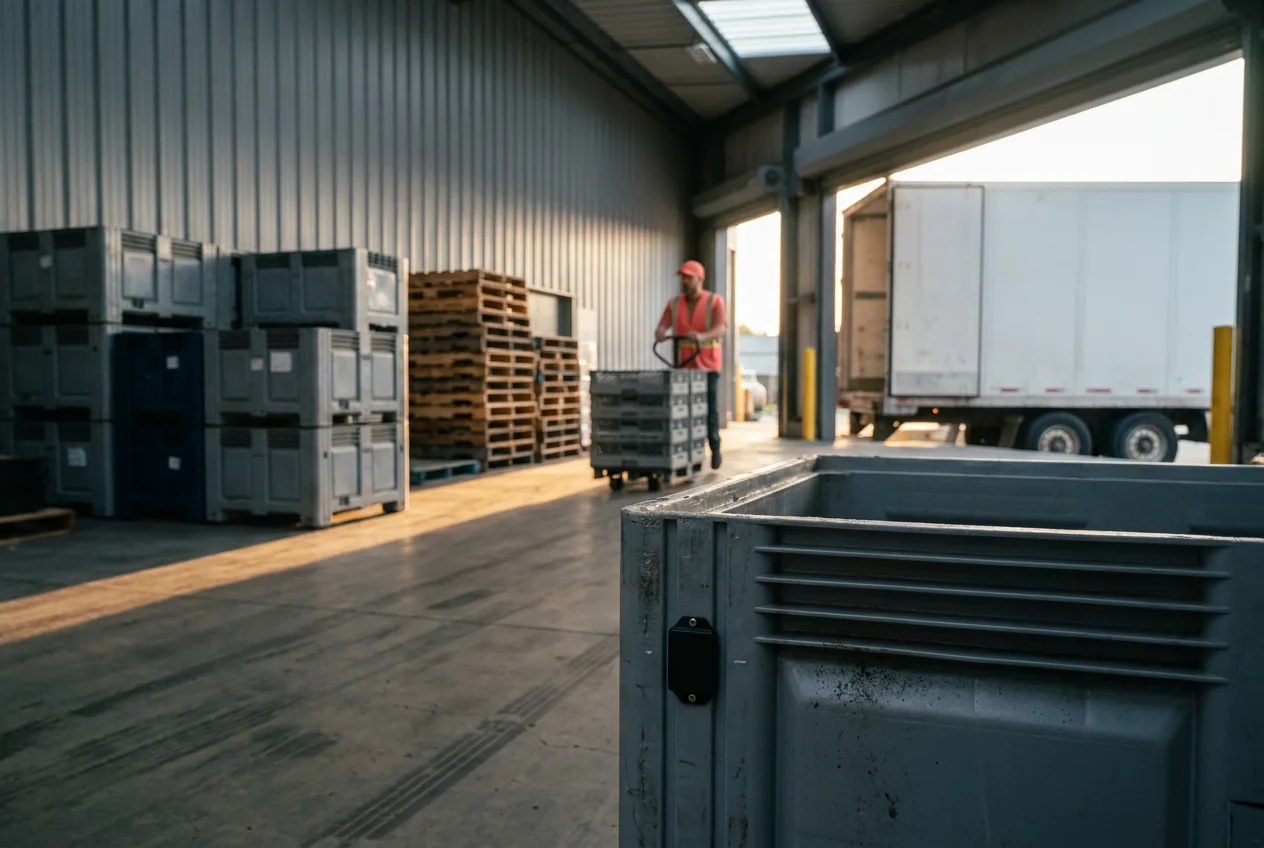
With GPX, AssetTag Pro hangs, sticks, or screws onto a tote, keg, cylinder, or crate and runs 3 years on a replaceable coin-cell battery. For bulk coverage, AssetTag Edge reaches 150 ft outdoors and 75 ft indoors.
A BLE RoadWired unit in a truck works as a mobile BLE gateway, tracking the vehicle and every tagged container around it. GPX also connects to 150 million terrestrial gateways, so there is nothing for the customer to install.
What is the real difference between a pooling fee model and owning and maintaining your own fleet?
Pooling is an operating expense. You pay per use, and the provider collects, inspects, repairs, and returns the pallets to the shared pool.
Owning is a capital purchase. You buy the containers, handle repairs, and run the return logistics yourself.
Ownership only pays off when containers come back, and tracking is what brings them back. That is the logic behind the first-year loss cuts Rehrig Pacific reports from asset-management programs.
Does GPS or BLE asset tracking work better than a pooling provider’s own system for a closed-loop, single-facility supply chain?
For a closed loop that one company controls, owned tracking is the stronger fit. You do not need a global pool to move containers between your own docks, lines, and yards.
Tags on your own containers put closed-loop supply chain visibility in your hands, not in a provider’s shared portal. Scout AI flags idle containers and unauthorized moves, so the loop stays tight. Modern logistics teams treat tracking as an intelligence layer, not a status page. For market context, see our breakdown of the returnable packaging market.
When GPX Is Not the Right Fit
GPX is built for businesses tracking 10 or more high-value assets, and for any fleet or enterprise operation. For one tracker on a family car or a pet, our sister brand Logistimatics is the better choice, and consumer tags such as Apple AirTag also cover that job.
GPX is also not a dashcam, a telematics suite, or an ERP. It answers three questions: where is it, is it safe, and is it working.
Pool, Own, or Own and Track: Make the Call for Your Network
- Pool if your network has many stops, volume swings by season, or capital is tight.
- Own if containers run a simple, closed loop for five years or more.
- Own and track if you already run 10 or more high-value containers and shrinkage, long dwell times, uneven stock, or custody disputes are costing you money.
Want to know where your containers are right now? Book a live demo and see GPX track returnables across your own sites.
Frequently Asked Questions (FAQs)
What are Returnable Transport Items (RTIs)?
RTIs are the pallets, totes, crates, kegs, cylinders, and bins that carry goods through a supply chain and come back for reuse. They make up most of the reusable transport packaging market, which the Reusable Packaging Association put at roughly $107 billion in 2023.
What is the difference between pallet pooling and pallet ownership?
Pallet pooling rents pallets from a shared pool on a pay-per-use basis, and the provider collects, inspects, repairs, and returns them. Pallet ownership means you buy the pallets and run repairs and returns yourself. RPA guidance favors ownership for simple closed loops of five years or more, and pooling for complex, seasonal, or capital-limited networks.
What does GPX cost per container?
GPX publishes two prices: SmartLabel as low as $13 and AssetTag Pro as low as $45/yr. AssetTag Pro is the usual fit for containers that come back. SmartLabel is a disposable label built for one-way freight.
Do I need RFID readers at every dock door?
No. GPX uses BLE tags and cellular trackers with access to 150 million terrestrial gateways. There is nothing for the customer to install.
Does tracking reduce returnable container losses?
Industry reporting says yes. Rehrig Pacific told Logistics Management that customers on an asset-management and RFID program cut packaging losses 30% to 50% in the first year.
What does Scout AI do for returnable containers?
Scout AI is the conversational supply-chain analyst inside the GPX platform. Ask it plain-language questions about your containers, get predictive disruption alerts, and geofence every site in seconds.