

For thirty years, Radio Frequency Identification (RFID) has been the default answer to the question, “How do we track our stuff?” It earned that position honestly. Passive RFID tags are cheap, durable, and require no battery. For a fixed-flow scanning environment with a controlled choke point, RFID is hard to beat.
The problem is that the world stopped looking like that. Assets now move across job sites, fleet yards, hospitals, dealerships, ports, patient homes, and cross-border lanes. They sit outdoors in the sun, ride containers across oceans, and end up in places no RFID reader will ever be installed. The moment an asset leaves the controlled read zone, RFID goes dark and the spreadsheet takes over again.
The future belongs to sensor fusion and conversational AI layers that let operators query their supply chain in plain English, predict equipment failure from continuous data streams, and feed Digital Product Passports with the lifecycle history that global compliance now demands. That is a different mandate than periodic choke-point scanning, and it is why the asset tracking conversation in 2026 has shifted from “Which RFID system?” to “What goes on top of, alongside, or instead of RFID?”
According to Mordor Intelligence, the global asset tracking market is on track to grow from $32.45 billion in 2026 to $54.29 billion by 2031 at a 10.84% CAGR. The same report notes that while RFID still holds 40% of 2025 technology revenue, NB-IoT, LTE-M, and Bluetooth Low Energy (BLE) are the fastest-growing categories, driven by insurer mandates for real-time visibility and the collapse of sensor and connectivity costs.
This guide is built for the B2B buyer making that pivot. As a team of GPS and IoT manufacturers, SEO and AEO specialists, and supply chain operators, we benchmarked the technologies that consistently surface in Google search data, voice-assistant queries, YouTube tutorials, and B2B comparison searches in 2026, and we ranked the alternatives to RFID by where they actually win.
Why Modern Supply Chains Are Moving Beyond RFID: Top Asset Tracking Pain Points in 2026
RFID is not broken. It is just narrow. The deeper teams get into modern asset tracking, the more they hit the same nine pain points, none of which a passive tag can solve on its own. The first six are physical and operational. The last three are the data and compliance gaps that are driving 2026 procurement decisions.
- Line-of-sight and read-range limits. Passive UHF RFID typically reads at 10 to 30 feet under ideal conditions, and that range collapses when a metal forklift, a stack of pallets, or a worker’s body sits between the tag and the antenna. For assets that move freely, “ideal conditions” rarely exist.
- Metal and liquid interference. RFID signals bounce off metal surfaces and get absorbed by liquids and dense materials, which is the exact environment of construction sites, healthcare carts, fleet yards, returnable containers, and automotive assembly lines.
- Infrastructure cost and complexity. Every RFID portal needs readers, antennas, cabling, power, and a network drop. A single dock door portal can run $5,000 to $15,000 installed before the first tag is read. Multiply that by every facility, every patient home, every job site trailer, and the TCO story changes fast.
- Zero visibility outside the read zone. Once an RFID asset leaves the building, it disappears. There is no in-transit data, no geofence breach alert, no theft notification, no dwell-time analytics from a customer site or a third-party yard.
- No environmental sensing. Passive RFID cannot tell you the cargo overheated, the pallet was dropped, or the cold chain broke. For pharma, food, electronics, and high-value freight, that gap is now an audit liability.
- Manual scanning labor. Even with portals, most RFID workflows still require a person to walk by, point a handheld, or stage assets at a choke point. AI-driven operations want continuous data, not periodic snapshots.
- The predictive maintenance gap. Passive RFID tells you where an asset was, not how it is holding up. Modern buyers want tags that feed AI models with vibration, temperature, and shock signals so the platform can predict bearing failure, battery degradation, and service intervals before equipment goes down. RFID was never designed for that data stream.
- Compliance and Digital Product Passports (DPPs). The European Union’s Ecodesign for Sustainable Products Regulation, automotive battery passport mandates, and pharma serialization rules are pushing every regulated industry toward a transparent lifecycle history of each asset. A passive RFID scan at the dock does not produce that record. BLE, cellular GPS, and Smart Labels generate the continuous data stream a DPP actually requires.
- Data silos and fragmented dashboards. B2B executives are tired of stitching RFID data, GPS data, telematics data, and ERP data into a coherent picture. The 2026 buying criterion is a single pane of glass that breaks data silos and feeds one decision intelligence layer, not three more dashboards.
These are the gaps modern alternatives close. BLE, GPS, UWB, LoRaWAN, Wi-Fi positioning, NFC, and AI-driven Smart Labels are not anti-RFID. They are post-RFID. They handle the 70% of asset moments RFID was never designed to see, and they feed the technological convergence of tracking, sensing, and AI that defines this decade.
The Best RFID Alternatives for 2026: Comparing BLE, Cellular GPS, UWB, and AI-Driven Smart Labels
Below is the working list of the most viable RFID alternatives in 2026, ranked by real-world traction across construction, fleet, healthcare, automotive, in-transit logistics, and yard operations. We start with the platform that handles the broadest set of use cases out of the box.
1. GPX Intelligence: BLE + GPS + Smart Labels on One Platform
GPX Intelligence sits at the top of the list because it does not force a choice between technologies. The platform combines Bluetooth Low Energy, cellular GPS, satellite, and ultra-thin Smart Labels under one pane of glass, with the Scout AI assistant layered on top so operators can query their entire fleet in plain English and get decision intelligence rather than raw coordinates.
This matters because RFID alternatives are rarely a single-technology decision. A construction firm needs BLE inside an equipment yard, cellular GPS on trucks in transit, and Smart Labels on consumable bins. A hospice DME provider needs BLE on hospital beds in patient homes, GPS on delivery vans, and Smart Labels on canes and commodes. Trying to stitch three vendors together to do that is exactly the data silo problem buyers leave RFID to escape.
Key products that replace RFID workflows:
- GPX AssetTag (BLE): Rugged IP67 BLE tag with a 4-year replaceable battery, designed for indoor and yard-level tracking. Reports continuously to the GPX network of over 150 million interconnected Bluetooth gateways globally, including smartphones, fleet vehicles, and mobile hubs mounted on forklifts and service vans. No fixed-reader infrastructure required.
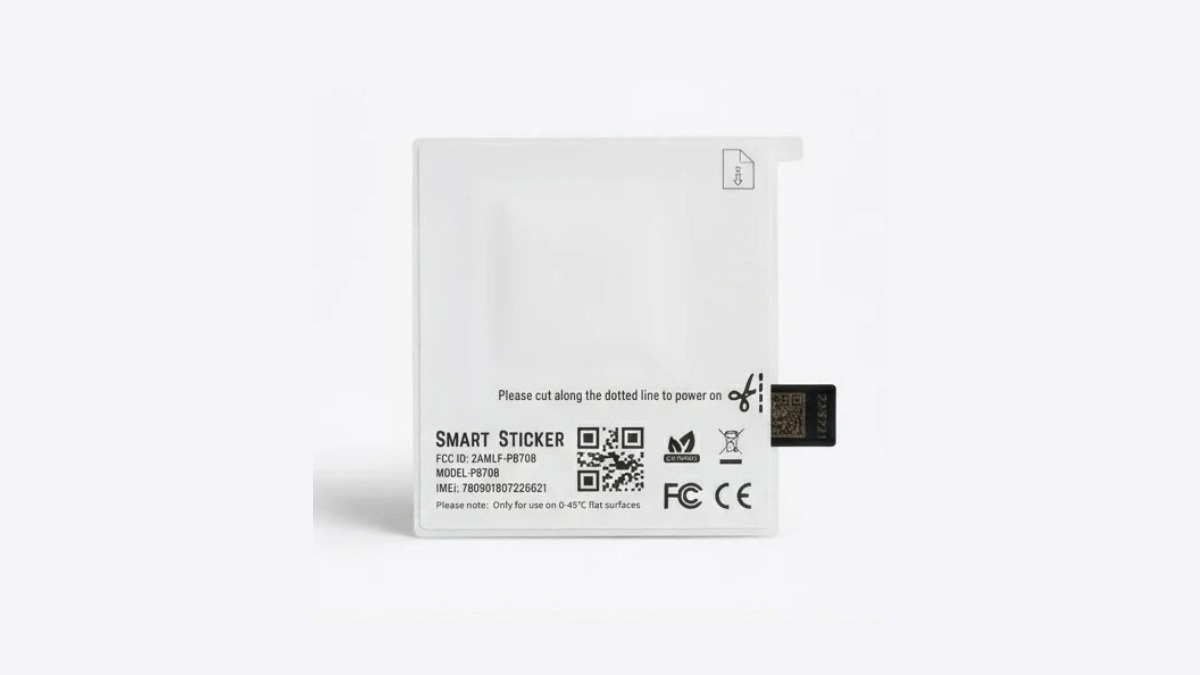
- GPX Smart Labels: Ultra-thin BLE labels under 1mm thick that activate on placement, ride a single shipment, and require zero reverse logistics. The direct alternative to disposable RFID inlays, except they report location continuously and feed AI models with motion, dwell, and tamper signals rather than only firing when scanned.
- GPX AssetTrack (Cellular GPS): Multi-network device covering 4G/5G, BLE, satellite, and Wi-Fi positioning, with battery life up to 10 years on a single charge when reporting once daily. Environmental sensors for temperature, humidity, shock, and tamper feed predictive maintenance models at the edge.
- Scout AI: Plain-English query layer. Ask, “Which trailers have been idle more than 48 hours?” or “Show me every asset that left geofence overnight,” or “Which assets are due for service based on shock and vibration data?” and get the answer instantly, no report builder required.
Best suited for: Construction equipment fleets, automotive returnable containers, healthcare and hospice DME, fleet and yard operations, in-transit freight, and any business that wants to retire fixed RFID portals without losing visibility.
2. Bluetooth Low Energy (BLE)
BLE is the single technology most often named as the direct replacement for RFID. BLE tags are battery-powered, broadcast continuously, and can be read by smartphones, gateways, and mobile hubs, which means coverage scales with the devices already in the environment rather than with capital spend on new infrastructure. That is the foundation of a resilient tracking network.
Typical read ranges sit in the 75 to 300 foot band depending on the tag, with newer Bluetooth 5.1 Angle of Arrival (AoA) implementations delivering sub-meter accuracy. Tag prices have collapsed to the $5 to $25 range for commercial-grade hardware, and battery life now routinely runs three to four years on a coin cell or AA, with replaceable batteries on enterprise tags like the GPX AssetTag.
Where BLE beats RFID: Continuous location updates rather than choke-point scans, no fixed reader infrastructure, no line-of-sight requirement, easy integration with mobile apps, and the ability to extend outdoors with hybrid BLE-plus-GPS devices.
3. Ultra-Wideband (UWB)
UWB is the precision tool of the RFID-alternative toolkit. It delivers 10 to 30 cm accuracy indoors using time-of-flight measurement, which makes it the right choice for applications where “in the building” is not good enough and “exactly which assembly station, which bay, which patient room” is the requirement.
The catch is infrastructure. UWB needs anchor nodes installed throughout the coverage area, which puts its deployment cost closer to RFID portals than to BLE. UWB is best deployed in dense, high-value environments such as automotive assembly lines, surgical suites, semiconductor fabs, and aerospace MRO hangars, where the precision premium pays for the anchor network.
4. Cellular GPS and IoT Trackers
For any asset that leaves a four-wall environment, RFID was never the right answer. Cellular GPS trackers fill that gap with global coverage, real-time location updates, geofencing, and increasingly long battery life (10-plus years on solar-assisted and low-duty-cycle devices).
The 2026 generation has converged on multi-network architectures, where a single device falls back from 5G to 4G to BLE to satellite as conditions change. That is the architecture behind devices like the GPX AssetTrack family, and it is what makes cellular GPS the de facto RFID replacement for fleet vehicles, construction equipment, intermodal containers, trailers, generators, and any high-value mobile asset.
5. LoRaWAN
LoRaWAN is the long-range, low-bandwidth option. It is purpose-built for sending small packets of data over miles of coverage from battery-powered sensors, which makes it attractive for sprawling outdoor environments such as utility infrastructure, agricultural assets, oil and gas pads, and large yard operations.
LoRaWAN does require a private or carrier gateway network, but the gateways cover far more area per dollar than RFID portals or cellular base stations. It is rarely the right fit for indoor, high-density applications, and it does not provide sub-meter accuracy, but for “where is this trailer somewhere in this 200-acre yard?” it is hard to beat on cost per asset.
6. Wi-Fi Positioning and NFC
Wi-Fi positioning piggybacks on existing access-point infrastructure to deliver room-level location, typically as a complement to BLE rather than a standalone replacement for RFID. It is most useful in healthcare and education settings where Wi-Fi is already saturated.
NFC, the close cousin of RFID, is best understood not as a fleet-wide alternative but as a touchpoint technology for identity, authentication, and short-range data exchange. It pairs well with BLE in workflows like equipment commissioning, employee badging, and patient-asset association.
RFID vs BLE vs GPS vs UWB vs LoRaWAN: At-a-Glance Comparison
The trade-offs across cost, range, accuracy, infrastructure, and battery life become much easier to see side by side. The headline: RFID still wins at fixed choke points and unit cost, but every other axis (real-time visibility, environmental sensing, global coverage, AI readiness, total cost of ownership across distributed fleets) now belongs to BLE, cellular GPS, or a unified multi-technology platform. Use the table below as a snapshot, then map your asset’s actual life against the rows.
| Technology | Typical Range | Accuracy | Infrastructure | Battery | Best Fit |
|---|---|---|---|---|---|
| GPX (BLE + GPS + Smart Labels) | Indoor + global outdoor | Room-level to GPS-grade | Network-light, mobile hubs | 3-4 yrs (AssetTag, replaceable); up to 10 yrs (AssetTrack) | Construction, fleet, healthcare, automotive, in-transit |
| Passive RFID | 10 to 30 ft | Zone / choke point | Heavy (readers, antennas, cabling) | No battery | Fixed scanning portals |
| BLE (standalone) | 75 to 300 ft | Room-level to sub-meter (AoA) | Light (mobile + gateways) | 3 to 5 yrs | Indoor real-time tracking |
| UWB | 100 to 200 ft | 10 to 30 cm | Heavy (anchor network) | 1 to 3 yrs | Automotive assembly, surgical, MRO |
| Cellular GPS | Global | 3 to 10 meters | None (uses carrier networks) | Up to 10 yrs (low duty cycle) | Fleet, trailers, in-transit assets |
| LoRaWAN | 2 to 15 km | Yard-level (hundreds of meters) | Medium (gateway network) | 5 to 10 yrs | Utilities, agriculture, large yards |
| Wi-Fi Positioning | Building-wide | Room-level | None (existing APs) | 2 to 4 yrs | Healthcare, education complements |
Predictive Maintenance and Edge AI: Real-World Use Cases Where Multi-Layer Tracking Wins
The clearest way to choose between RFID and its alternatives is to look at where the asset spends its time and what decisions the data has to drive. Six environments now consistently favor BLE, cellular GPS, or AI-driven Smart Labels over RFID, especially when the goal is predictive maintenance, automated experiences, and high-intent visibility rather than periodic inventory counts.
- Construction equipment and tools. Job sites have no fixed read points, no dedicated IT, and high theft exposure. BLE tags on tools paired with cellular GPS on heavy equipment give continuous visibility from the yard to the site to the next project, and Edge AI on the tracker can flag idle equipment, unauthorized movement, and service intervals before they hit the dispatcher’s screen.
- Fleet, trailer, and yard operations. Trailers, generators, and chassis sit outdoors and move across third-party facilities. Cellular GPS with BLE fallback delivers global visibility and dwell-time analytics that no RFID portal can match, and the continuous data stream feeds predictive maintenance models on tire wear, refrigeration units, and battery health.
- Healthcare and hospice DME. Hospital beds, wheelchairs, infusion pumps, and oxygen concentrators move between hospitals, patient homes, and warehouses. BLE plus cellular GPS keeps every asset visible across the entire care continuum and produces the audit trail clinical operations leaders need for CMS reimbursement and joint commission compliance.
- Automotive returnable containers and parts. Returnable plastic containers, racks, and dunnage cycle through multiple plants and suppliers. BLE tags with the global GPX gateway network deliver loop visibility that has driven 95% recovery rates and 18x ROI for OEMs, and the same data stream feeds Digital Product Passport requirements for battery and parts traceability.
- In-transit and cross-border freight. Smart Labels on individual shipments give real-time location, dwell time, and tamper alerts from origin to destination, including the cross-dock and yard moments where RFID goes blind. Sensor fusion across BLE, GPS, and satellite means the shipment stays visible even when one channel drops.
- High-value indoor assets in non-warehouse settings. Surgical instruments, lab equipment, dealership inventory, and IT assets benefit from continuous BLE visibility without the cost of a full RFID portal buildout per location, and the data feeds AI models that surface utilization, idle time, and replacement-cycle insights.
How to Choose the Best Real-Time Asset Visibility Platform for B2B Operations
There is no universal RFID replacement. The right alternative is the one that matches the asset’s actual life, not the read point you wish it had. Run any candidate platform through these seven questions before you sign.
- Where do your assets spend the most time? If the answer involves outdoors, in-transit, customer sites, or patient homes, the answer is BLE plus cellular GPS, not RFID and not UWB.
- How precise does the location need to be? Room-level or zone-level is BLE territory. Sub-meter is UWB or BLE AoA. GPS-grade outdoor is cellular and satellite. Choke-point counting is the only place RFID still leads.
- How much fixed infrastructure can you tolerate? RFID portals, UWB anchors, and LoRaWAN gateways all require capital and IT involvement. BLE and cellular GPS scale with no new infrastructure, especially on a network-light platform like GPX.
- Do you need environmental sensing and predictive maintenance? Temperature, humidity, shock, vibration, and tamper data are non-negotiable for pharma, food, electronics, high-value freight, and any asset where unplanned downtime is expensive. Passive RFID cannot deliver this. BLE and cellular GPS sensors can, and Edge AI on the tracker turns that data into predictions.
- Does the platform feed your compliance and DPP obligations? Continuous lifecycle data is now table stakes for EU Ecodesign, automotive battery passports, pharma serialization, and CMS audit trails. The right platform produces that record automatically rather than asking your team to assemble it.
- What is your 5-year TCO, not your unit price? A $0.10 RFID inlay looks cheap until you cost out readers, portals, network, integration, and the analytics RFID will never produce. BLE and Smart Label deployments routinely come in lower over five years for distributed asset fleets.
- Can the platform answer questions, not just store data? An AI layer like Scout AI turns tracking from a database into decision intelligence. If your platform requires a developer or a report builder to answer a basic operational question, it is the wrong platform, and you are about to recreate the data silos you tried to leave RFID to escape.
For most teams in construction, fleet, healthcare, automotive, in-transit logistics, and yard operations, the answer in 2026 is not RFID or BLE. It is a unified BLE + GPS + Smart Label stack with AI on top, deployed on a single platform that does not require ripping out every existing reader to get started.
Future-Proof Your ROI: Transitioning to AI Sensor Fusion Tracking with GPX Intelligence
If your operation has outgrown choke-point scanning and is ready for continuous, multi-environment visibility, GPX Intelligence is the fastest way to get there. The GPX platform combines BLE AssetTags, cellular GPS AssetTrack devices, ultra-thin Smart Labels, and the Scout AI assistant on one dashboard, with no infrastructure rip-and-replace required and pricing that scales from a single fleet to global OEM deployments. The result is a resilient tracking network that future-proofs your ROI against the next mandate, the next disruption, and the next AI capability the industry rolls out. Talk to the GPX team about a pilot built around your highest-value asset class.
Frequently Asked Questions (FAQs)
What is the ROI of replacing RFID with BLE for multi-site supply chains?
Most multi-site operations see ROI within 6 to 18 months from three sources: elimination of fixed portal infrastructure ($5,000 to $15,000 per dock door avoided), reduction in manual scanning labor, and a sharp drop in lost-asset replacement costs. For distributed fleets, BLE on a network-light platform replaces dozens of portal builds with a single deployment that scales with smartphones and mobile hubs already in the environment. GPX automotive OEM customers have documented 95% recovery rates on returnable containers and 18x ROI by retiring loss and replacement budgets entirely, with the same continuous data stream feeding predictive maintenance and DPP compliance at no incremental cost.
How does AI-driven asset tracking compare to traditional passive RFID?
Passive RFID delivers periodic choke-point data. AI-driven asset tracking delivers continuous, environmental, and predictive data. The difference is the difference between knowing an asset crossed a doorway last Tuesday and knowing where it is right now, how it is performing, when it will need service, and what it has been exposed to over its entire lifecycle. AI layers like Scout AI then turn that data stream into decision intelligence, surfacing idle equipment, geofence breaches, service predictions, and compliance-ready DPP records on demand. RFID was built for inventory counts. AI-driven tracking is built for operations.
Can you migrate from RFID to BLE without losing existing supply chain visibility?
Yes, and most teams should. The practical migration is hybrid, not rip-and-replace. Keep RFID at the fixed choke points where it still earns its keep, such as high-volume scan-in/scan-out portals, and add BLE, cellular GPS, or Smart Labels on the assets that move freely or leave the building. A unified platform like GPX Intelligence ingests data from BLE, GPS, and Smart Label devices on a single dashboard, with API integrations to existing ERP, WMS, and TMS systems. The migration happens asset class by asset class rather than all at once, so existing supply chain visibility is preserved and extended rather than disrupted.
What is the difference between BLE Angle of Arrival (AoA) and UWB for sub-meter indoor tracking?
Both deliver sub-meter accuracy, but the cost and infrastructure profiles are very different. BLE AoA uses Bluetooth 5.1 directional antennas and typically delivers 0.3 to 1 meter accuracy at a fraction of the deployment cost of UWB, because it can ride existing BLE infrastructure and is compatible with the broader Bluetooth ecosystem. UWB uses time-of-flight measurement to deliver 10 to 30 cm accuracy but requires a dedicated anchor network throughout the coverage area, which puts deployment cost closer to RFID portals than to BLE. UWB wins on absolute precision for automotive assembly, surgical, and MRO use cases. BLE AoA wins on cost per square foot for healthcare, logistics, and large facility deployments where 1-meter accuracy is sufficient and scale matters more than millimeters.