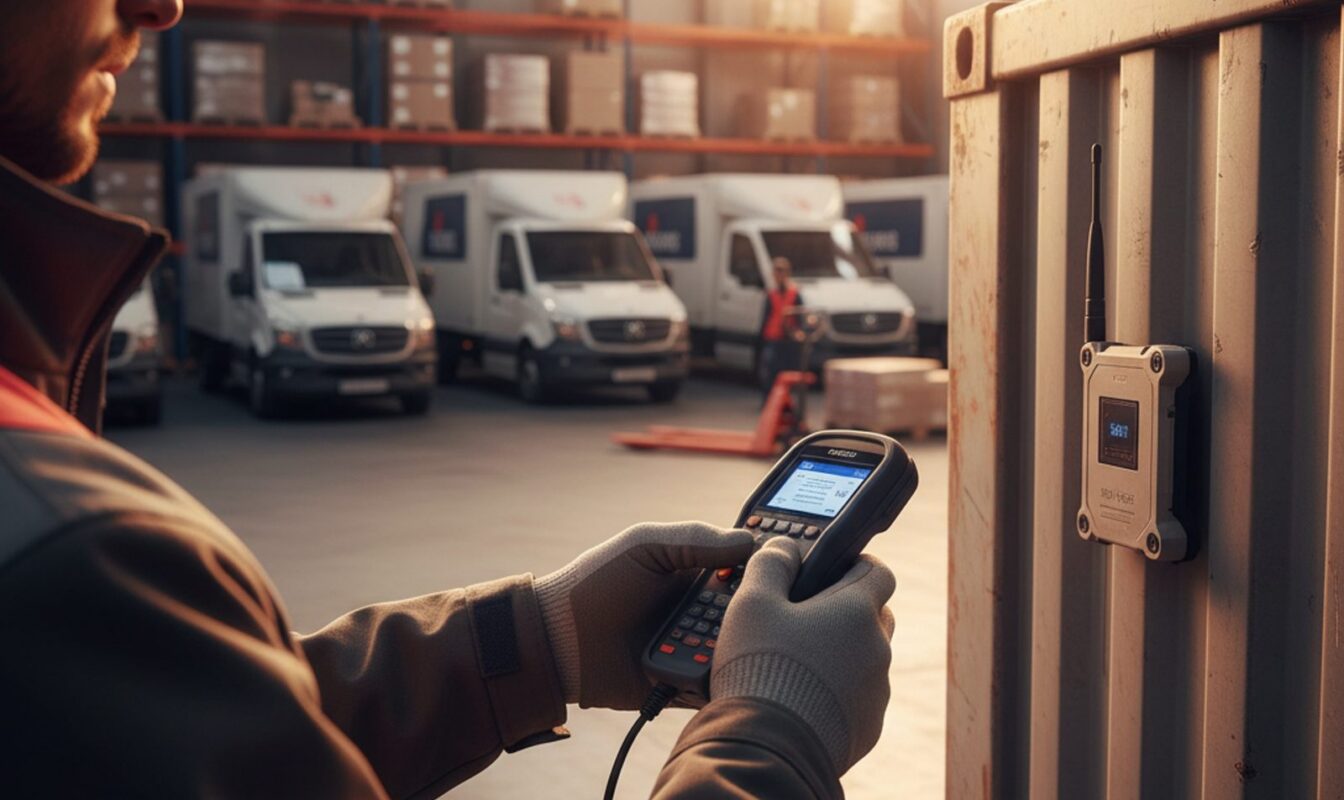
Supply Chain Logistics: How IoT, RTK GPS, BLE, RFID, and AI Power Real-Time Visibility
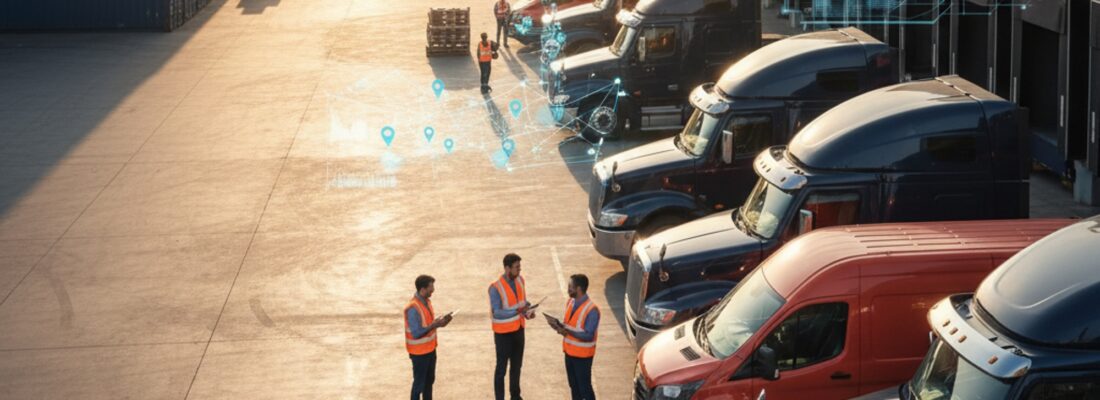

Every product on a shelf, every part on an assembly line, and every package on a doorstep arrives because a supply chain moved it there. Supply chain logistics is the engine that coordinates that movement, and it has become one of the most data-driven functions in modern business. The companies that win on cost, speed, and customer trust are the ones that can see exactly where their goods are at any moment and predict where they will be next.
This guide breaks down what supply chain logistics is, how it works end to end, and the advantages and trade-offs that come with it. It also explains how connected technologies, IoT fleet management with RTK GPS and telematics, RTLS with BLE and RFID, and predictive AI, combine to turn a blind, reactive supply chain into a transparent, predictive one.
What Is Supply Chain Logistics in the Age of IoT and Automation?
Supply chain logistics is the planning, execution, and control of how goods, information, and resources flow from raw-material suppliers to the final customer. It covers the physical movement of products and the data that travels alongside them. Logistics is the operational layer of the broader supply chain: where supply chain management sets the strategy, logistics carries it out on the ground.
In the age of IoT and automation, that definition now carries a second layer. Modern logistics runs on a continuous stream of sensor data, and connected devices report the location and condition of assets in real time. The discipline spans several connected activities:
- Procurement and inbound logistics: Sourcing materials and moving them into facilities.
- Inventory management: Tracking stock levels, locations, and condition across sites.
- Warehousing and fulfillment: Storing goods and preparing orders for shipment.
- Transportation: Moving freight across road, rail, air, and sea, including the last mile to the customer.
- Reverse logistics: Handling returns, repairs, and recycling.
At its core, supply chain logistics answers three questions for every asset and shipment: Where is it now? What condition is it in? When will it arrive? The quality of those answers determines the quality of the entire operation.
Supply Chain Logistics vs Supply Chain Management
The two terms are often used interchangeably, and they are not the same. Supply chain management is the broad, strategic framework that coordinates everything from product design and procurement to supplier collaboration and customer value. Logistics is the operational engine inside that framework, focused on moving and storing goods to meet customer requirements for time, place, and condition. Supply chain management sets the goal of competitive advantage, and logistics executes the movement that delivers it.
Inbound vs Outbound Logistics
Logistics splits into two directions of flow:
- Inbound logistics covers sourcing, receiving, and storing the materials and components a business needs to operate or produce.
- Outbound logistics covers picking, packing, and distributing finished goods to distribution centers, retailers, and customers.
Both directions depend on the same thing: accurate, real-time data about where goods are and what condition they are in.
How Supply Chain Logistics Works: From Sourcing to Last Mile
A modern supply chain moves through a series of stages, each one generating data that the next stage depends on. Understanding the flow makes it clear where tracking technology delivers the most value.
- Planning and demand forecasting: Teams forecast demand, set inventory targets, and plan capacity. Accurate forecasts reduce both stockouts and excess inventory.
- Sourcing and inbound transport: Suppliers ship raw materials and components. In-transit visibility here protects production schedules from upstream delays.
- Manufacturing and assembly: Materials become finished goods. Work-in-progress tracking keeps production lines fed and balanced.
- Warehousing and inventory control: Goods are received, stored, picked, and packed. Real-time location data cuts the time workers spend searching for items.
- Outbound transportation: Finished products move to distribution centers, retailers, or directly to customers. Fleet and shipment tracking keeps everyone informed of progress.
- Last-mile delivery: The final leg to the customer, the most expensive and most visible stage. Precise tracking drives on-time delivery and customer satisfaction.
- Reverse logistics: Returns and recalls flow back through the network and require the same visibility as outbound shipments.
The thread connecting all of these stages is data. When location, condition, and timing data flows cleanly between stages, the supply chain runs smoothly. When that data is missing or delayed, every downstream stage inherits the uncertainty.
The Pros and Cons of Modern Supply Chain Logistics
A well-run, technology-enabled supply chain delivers measurable returns, and it also introduces real complexity that leaders need to manage. Here is an honest look at both sides.
Advantages
- End-to-end visibility: Real-time tracking shows the location and status of every asset, which shortens response times and builds customer trust.
- Lower operating costs: Optimized routing, accurate inventory, and reduced asset loss cut waste across the network.
- Faster, more reliable delivery: Better data leads to fewer delays and higher on-time performance.
- Stronger resilience: Visibility into disruptions lets teams reroute and recover before problems cascade.
- Better customer experience: Accurate delivery estimates and proactive updates keep customers informed and loyal.
- Progress on sustainability goals: Optimized routing, less waste, and efficient reverse logistics lower emissions and support decarbonization and net-zero targets.
Trade-offs to manage
- Upfront technology investment: Tracking hardware, software, and integration require capital and planning.
- Data integration complexity: Pulling signals from many systems into one view takes engineering effort.
- Dependence on connectivity: Some tracking methods rely on cellular, satellite, or network coverage.
- Change management: Teams need training to act on new data rather than working around it.
- Security and privacy: Location and asset data must be protected with strong access controls.
The good news is that the trade-offs are manageable, and the right mix of tracking technologies addresses most of them directly. That mix usually combines RTK GPS, BLE, RFID, and AI.
IoT Fleet Management: How RTK GPS and Telematics Drive Freight Visibility
GPS (Global Positioning System) tracking pinpoints the location of vehicles, trailers, containers, and high-value assets across long distances. A GPS device communicates with satellites to calculate its position and transmits that location over cellular or satellite networks to a central platform. In fleet operations, GPS pairs with telematics, the broader set of data a vehicle reports, including speed, engine hours, fuel use, and driver behavior, to create a complete operating picture.
For applications that need centimeter-level accuracy, Real-Time Kinematic (RTK) GPS corrects standard satellite signals against a fixed reference station. RTK matters for automated yards, precision agriculture, and autonomous vehicle guidance where a few meters of error is too much.
GPS and telematics form the backbone of outdoor and in-transit visibility. They answer the “where is my shipment right now” question for freight moving across cities, states, and countries. Common uses include:
- IoT fleet management: Monitoring trucks and delivery vehicles in real time for routing, dispatch, and maintenance.
- Trailer and container tracking: Following high-value mobile assets across long hauls.
- Geofencing: Triggering alerts when an asset enters or leaves a defined zone such as a yard or job site.
- Route optimization: Feeding live location data into software that finds faster, cheaper, lower-emission routes.
GPS excels outdoors and over wide areas. Indoors, inside warehouses, distribution centers, and dense facilities, satellite signals weaken, which is where short-range Real-Time Location Systems built on BLE and RFID take over.
Warehouse Automation: RTLS Tracking with BLE Beacons vs RFID Tags
Inside the four walls of a facility, the goal shifts from wide-area location to precise, item-level tracking. Real-Time Location Systems (RTLS) deliver that precision, and they power warehouse automation along with asset tracking in construction, healthcare, and automotive settings. Two technologies dominate this space: Bluetooth Low Energy (BLE) and Radio Frequency Identification (RFID).
BLE Beacons
BLE uses small, battery-powered beacons that broadcast a signal to nearby readers or gateways. The system calculates location based on signal strength, delivering room-level or zone-level accuracy indoors where GPS struggles. BLE strikes a strong balance between range, accuracy, battery life, and cost, which makes it a popular RTLS choice for tracking tools, equipment, and inventory.
The GPX AssetTag is a BLE tracking solution built for exactly this use case. It delivers reliable indoor and short-range location tracking, and its battery is replaceable with a 4-year battery life, so teams avoid the cost of frequent hardware replacement. BLE tags like the AssetTag suit construction sites, healthcare facilities, automotive shops, yards, and supply chain visibility in non-warehouse environments as well as the warehouse floor.
RFID Tags
RFID uses tags that respond to a reader’s radio signal. Passive RFID tags carry no battery and activate only when scanned, which makes them inexpensive and ideal for high-volume inventory counts at fixed points like dock doors and checkout zones. Active RFID tags carry a battery and broadcast over longer ranges. RFID shines for fast, bulk identification, reading dozens or hundreds of tagged items in seconds.
BLE Beacons vs RFID Tags
BLE and RFID are complementary rather than competing. RFID counts and identifies items quickly at chokepoints, while BLE provides continuous location awareness for assets that move around a facility throughout the day. The strongest RTLS deployments use RFID for fast identification at fixed points and BLE for live tracking everywhere in between.
The Connected Supply Chain: IoT, Blockchain, and Digital Twins
GPS receivers, BLE beacons, and RFID tags are more than standalone trackers. Together they form the Internet of Things (IoT) sensing layer of the modern supply chain, the network of connected devices that continuously reports location, movement, and condition. Every tag becomes a data source, and that constant stream of real-world signals is what turns a supply chain transparent rather than reliant on guesswork.
The IoT layer connects to a wider technology stack that converts raw signals into trusted, shared insight:
- IoT sensors and trackers: Capture location, temperature, shock, and humidity in real time.
- Cloud computing: Centralizes the data so every stakeholder works from one version of the truth.
- Blockchain: Creates a tamper-resistant record of custody and transactions across trading partners.
- Digital twins: Build a virtual model of the supply chain to simulate scenarios before they happen.
- Automation and robotics: Act on the data to move, sort, and store goods with less manual effort.
Tracking hardware like the GPX AssetTag sits at the foundation of this stack. The quality of every downstream insight depends on the accuracy of the signals captured at the source, which is why reliable tags with a long, replaceable-battery life matter to the whole system.
Predictive Supply Chain Analytics: AI, Machine Learning, and Digital Twins
GPS, BLE, and RFID generate a continuous stream of location and condition data. Artificial intelligence and machine learning turn that raw data into decisions. Without AI, a tracking system tells you what happened. With predictive supply chain analytics, it tells you what will happen and what to do about it.
AI and machine learning deliver value across the supply chain in several ways:
- Demand forecasting: Machine learning models predict demand more accurately than traditional methods, which reduces both stockouts and overstock.
- Predictive ETAs: AI analyzes traffic, weather, and historical patterns to forecast arrival times with high precision.
- Anomaly detection: Models flag unusual patterns, a delayed shipment, an asset that left a geofence, or a temperature excursion, before they become failures.
- Route and load optimization: AI continuously recalculates the most efficient routes and loading plans as conditions change.
- Inventory optimization: Algorithms recommend where to position stock to balance service levels against carrying costs.
- Digital twin simulation: A digital twin lets teams model disruptions, capacity changes, and new routes in software before committing resources in the real world.
- Autonomous and assisted transport: AI powers route guidance, driver assistance, and emerging autonomous trucking that improves fuel efficiency and helps address driver shortages.
The most powerful supply chains layer predictive analytics on top of a strong tracking foundation. The hardware captures reality, and the intelligence acts on it.
RTK GPS vs BLE vs RFID vs AI: A Technology Comparison
Each technology earns its place by solving a different part of the visibility challenge. The table below compares them so you can see where each one fits.
| Technology | Best Use | Range | Accuracy | Power Source | Relative Cost |
|---|---|---|---|---|---|
| GPS / RTK GPS | Outdoor and in-transit tracking of fleets, trailers, and containers | Global, outdoor | A few meters standard, centimeter level with RTK | Battery or vehicle power | Medium to high |
| BLE (GPX AssetTag) | Indoor and short-range RTLS tracking of tools, equipment, and inventory | Short to medium, indoor and outdoor | Zone and room level | Replaceable battery, 4-year battery life | Low to medium |
| RFID | High-volume item identification at fixed points such as dock doors | Very short (passive) to long (active) | Point of scan | Passive (no battery) or active (battery) | Low per tag |
| AI / Machine Learning | Predictive analytics, ETAs, anomaly detection, and optimization | Software layer across all data | Depends on input data quality | Cloud or on-premise compute | Varies by scale |
The takeaway is that no single technology covers the whole supply chain. GPS and telematics own the open road, BLE and RFID own the facility floor, and AI ties the data together into action.
Building a Supply Chain Control Tower: Resilience Against Geopolitical Disruptions
Disruption is no longer a rare event. Recent years brought the COVID-19 pandemic, the Suez Canal blockage, Red Sea shipping diversions, port and labor strikes, and shifting tariffs, and each one rippled across global supply chains. Leaders have stopped treating disruption as an exception to plan around and started building supply chains that absorb shocks and keep moving. The control center for that effort is the supply chain control tower.
A supply chain control tower is a single, connected view that pulls GPS, telematics, RTLS, and AI data into one dashboard, so teams can see the whole network and act on it in real time. It is the industry-standard model for end-to-end visibility, and it builds resilience in three ways:
- Faster response: Live location and condition data lets teams catch a delay or a stranded asset and act before it becomes a failure.
- Greater agility: Accurate, current data supports rapid rerouting, resourcing, and replanning the moment geopolitical or weather events change conditions.
- Stronger decisions under pressure: AI turns control tower data into predictive alerts and digital twin scenarios, so leaders plan ahead instead of reacting.
Customer expectations raise the stakes further. The Amazon effect has trained buyers to expect constant tracking and accurate delivery estimates, and meeting that expectation depends on the same visibility that builds resilience. A control tower is no longer a back-office convenience. It is the difference between a supply chain that breaks under pressure and one that adapts.
Why Supply Chains Fail Without Real-Time Rerouting
Today’s supply chain directors are managing macroeconomic and regulatory pressures alongside day-to-day operations. Each challenge below maps to a tracking solution.
- Geopolitical routing disruptions: The Red Sea crisis, Suez Canal bottlenecks, and port strikes are destroying ETAs and forcing longer routes. GPS tracking and AI rerouting give teams the live data to redirect freight and protect delivery commitments when a lane closes.
- The global driver shortage: With fewer drivers available, getting more out of every existing vehicle is essential. AI route optimization and GPS telematics maximize fleet utilization, cut empty miles, and keep dispatch efficient.
- Cold chain and FSMA 204 compliance: The FDA Food Safety Modernization Act traceability rule raises the bar for recordkeeping on temperature-sensitive food, and a temperature excursion can mean a compliance failure, not just spoilage. IoT temperature and humidity sensors paired with GPS trackers create the continuous, time-stamped record that traceability rules require.
- Scope 3 emissions tracking: Companies now report the carbon footprint of their full supply chain. GPS and telematics data lets AI calculate and minimize idle time and fuel burn, turning route optimization into measurable progress toward net-zero targets.
- Lost or misplaced assets: Tools, equipment, and inventory disappear, which drives replacement costs and delays. BLE tags such as the GPX AssetTag give teams continuous location awareness so assets are found in seconds.
- Slow, manual inventory counts: Counting by hand is slow and error-prone. RFID reads many tagged items at once for fast, accurate counts.
Solving these challenges does not require ripping out existing operations. It requires layering the right tracking technology onto the stages where visibility is weakest.
How to Choose the Right Supply Chain Tracking Solution
The best tracking strategy starts with the question you most need to answer, not with the technology itself. Use this approach to match the solution to the need.
- Define what you need to track and where: Outdoor, long-haul assets point to GPS and telematics. Indoor tools, equipment, and inventory point to BLE RTLS. High-volume item identification at fixed points points to RFID.
- Set your accuracy requirement: Wide-area location calls for GPS, and centimeter-level guidance calls for RTK GPS. Zone-level indoor location calls for BLE. Point-of-scan identification calls for RFID.
- Account for condition monitoring: Temperature-sensitive or regulated freight calls for IoT sensors that capture temperature and humidity alongside location.
- Plan for battery and maintenance: Choose hardware built for long life. A BLE tag with a replaceable battery and a 4-year battery life, like the GPX AssetTag, keeps total cost of ownership low.
- Confirm platform integration: Make sure the tracking data flows into one control tower view so AI can act on it.
- Start with the highest-value stage: Deploy tracking first where lost visibility costs the most, then expand across the network.
The right solution is rarely one technology. It is a layered system where GPS, BLE, RFID, and AI each cover the part of the supply chain they handle best, all feeding a single source of truth. That combination is what separates a supply chain that reacts from one that predicts and performs.
Build a More Visible Supply Chain with GPX
GPX builds tracking solutions that give logistics teams the visibility they need across the facility and on the move. The GPX AssetTag delivers reliable BLE tracking with a replaceable battery and a 4-year battery life, built for construction, fleet, healthcare, automotive, and supply chain visibility in environments where assets move and timing matters. Connect with the GPX team to design a tracking solution that fits your operation and turns location data into faster, smarter decisions.
Frequently Asked Questions (FAQs)
How much does an IoT supply chain tracking system cost?
Cost depends on three things: the hardware you deploy, the number of assets you track, and the software platform that ties it together. BLE tags are the lowest-cost option per unit, GPS and telematics devices sit in the middle, and active RFID and RTK GPS systems cost more. Most operations control spend by starting with the highest-value stage and expanding, rather than tagging everything at once. A long, replaceable-battery life, like the 4-year life on the GPX AssetTag, lowers the total cost of ownership over time.
What is the best asset tracker for heavy construction equipment?
Heavy construction equipment usually needs two layers. GPS with telematics tracks machines across job sites and in transit between locations, while a rugged BLE tag like the GPX AssetTag tracks tools, attachments, and smaller equipment around the site, including indoor and sheltered areas where GPS signals weaken. The combination covers both wide-area location and on-site visibility, and a replaceable 4-year battery keeps maintenance low in the field.
Active RFID vs BLE beacons: which is better for warehouse tracking?
It depends on what you are tracking. Active RFID is strong for long-range identification and high-speed reads at fixed points. BLE beacons are better for continuous, zone-level location of assets that move around throughout the day, and they balance accuracy, battery life, and cost well. Many warehouse RTLS deployments use both: RFID at chokepoints for fast identification and BLE for live location everywhere else.
How do digital twins and AI improve supply chain resilience?
A digital twin is a virtual model of your supply chain that runs on live tracking data. AI uses it to simulate disruptions, a closed lane, a supplier delay, a demand spike, and test responses before committing real resources. That lets teams plan ahead, choose the best reroute, and recover faster when geopolitical or weather events hit, which is the core of resilience.
Can GPS trackers monitor temperature and humidity for cold chain freight?
Yes. GPS trackers can be paired with IoT temperature and humidity sensors so a single device reports both location and condition in real time. For cold chain freight in pharmaceutical and food logistics, this combination creates the continuous, time-stamped record needed to catch temperature excursions early and support traceability requirements such as FSMA 204.
What technologies work together to create a transparent, predictive supply chain?
IoT fleet management with RTK GPS and telematics, real-time location systems using BLE and RFID, and predictive AI combine to turn a blind, reactive supply chain into a transparent, predictive one.