
Losing track of trailers, containers, and high-value equipment drains revenue and stalls operations. An idle trailer in the wrong yard costs money every day it sits. A stolen one can shut down a job entirely. The risk keeps climbing: the NICB reported more than 1 million vehicles stolen across the US in 2023, up about 1% over the prior year, and commercial assets sit squarely in that risk pool. Cargo theft is climbing in lockstep: Verisk CargoNet logged 3,625 cargo theft incidents across the US and Canada in 2024, a 27% jump over 2023, with the average loss reaching $202,364 per event.
Knowing a trailer’s last location no longer cuts it. Modern operations run on real-time data, predictive insight, and one platform that tracks powered and non-powered assets alike. Picking the right tracker starts with a clear read on your operational needs, the technology on offer, and how a platform scales from raw location pings to real business intelligence.
| Platform | Primary Power Source | Key Differentiator | Best For | Connectivity Options |
|---|---|---|---|---|
| GPX Intelligence | Solar & long-life battery | AI-powered predictive analytics (Scout AI) | Universal asset & fleet tracking | GPS, Cellular (LTE-M/NB-IoT), Satellite, BLE |
| Samsara Asset Gateway | Solar & long-life battery | Unified platform with vehicle telematics | Existing Samsara fleet customers | GPS, Cellular (LTE), WiFi |
| Motive Asset Gateway | Solar & long-life battery | AI-powered dashcam integration | Fleets focused on safety and compliance | GPS, Cellular (LTE) |
| Phillips Connect | Harness-powered & solar | Smart-trailer sensor integrations | Fleets wanting deep trailer health data | GPS, Cellular, BLE |
| Spireon FleetLocate | Solar & battery | Strong focus on yard management | Large-scale dry van and intermodal fleets | GPS, Cellular (LTE-M) |
| Logistimatics | Rechargeable battery | Simplicity and affordability | Small businesses or individual asset owners | GPS, Cellular (4G LTE) |
1. GPX Intelligence: AI-Powered Visibility Beyond Dots on a Map
GPX runs an AI-powered asset tracking platform built for complex, enterprise-scale operations. It goes past traditional GPS by combining data from a multi-sensor array, including GPS, cellular, satellite, and BLE, into one operational picture. That data feeds Scout AI, an in-platform engine that delivers predictive ETAs, prescriptive maintenance alerts, and autonomous monitoring that catches problems before they hit your supply chain.
The hardware holds up in the harshest industrial settings. Rugged, long-life battery and solar-powered devices fit any trailer or non-powered asset. The platform scales to tens of thousands of assets, from trailers and containers to small, high-value equipment tagged with disposable Smart Labels. GPX turns operational data into automated workflows, better asset utilization, and stronger margins.
2. Samsara Asset Gateway
Samsara is a heavyweight in fleet management, known for one platform that ties together vehicle telematics, video safety, and asset tracking. The Samsara Asset Gateway (models like the AG26 and AG46) stretches that ecosystem to trailers and equipment. If you already run Samsara for your vehicles, it puts every asset on one screen.
- Best for: Companies already running Samsara for their vehicle fleet.
- Pricing: Custom quote based on hardware, software licenses, and contract term.
- Standout Features: Tight integration with Samsara’s vehicle telematics and dash cams, a clean interface, and strong reporting.
Pros:
One platform for vehicles and assets. Excellent interface and mobile app. Strong brand and support.
Cons:
Pricier than asset-only tools. More features than simple trailer tracking needs. Lighter on deep predictive AI than specialist platforms.
3. Motive Asset Gateway
Motive, formerly KeepTruckin, delivers a full fleet management suite with a heavy focus on compliance and driver workflows. The Motive Asset Gateway tracks trailers and equipment straight from the main platform. Its AI dashcams and safety tools reach across the whole fleet, including the assets in tow.
- Best for: Fleets that put safety, compliance, and an integrated driver experience first.
- Pricing: Custom quote, usually bundled with software subscriptions.
- Standout Features: Advanced AI dashcam integration, a strong driver app, and solid compliance tools.
Pros:
Tight integration across vehicle, driver, and asset data. Strong reputation for usability. Good fit for mixed fleets that need ELD compliance and asset tracking.
Cons:
Built first for fleet and driver management, with asset tracking as one piece. Not the most cost-effective for asset-only operations. Insight runs more operational than deeply predictive.
4. Phillips Connect
Phillips Connect specializes in smart-trailer technology. It reports GPS location, but its real strength is sensors that track trailer health and status: tire pressure, door open and close, cargo status, light-out detection, and ABS fault codes. That turns a standard trailer into a data-rich asset.
- Best for: Fleets that want the deepest insight into trailer health and status, not just location.
- Pricing: On request, based on the sensors and services selected.
- Standout Features: A broad sensor array for full trailer visibility, integration with trailer wiring harnesses for power and data, and strong trailer OEM partnerships.
Pros:
Deep detail on trailer health and diagnostics. Proactive maintenance alerts cut downtime. Open platform that feeds data into other systems.
Cons:
A more involved install than a slap-and-track device. The data volume overwhelms teams without a clear plan to act on it. Higher cost per trailer from advanced hardware.
5. Spireon FleetLocate
Spireon has deep roots in GPS tracking, and its FleetLocate line is a proven pick for trailer management. It offers solar-powered hardware and earns strong marks for yard management and cargo sensing. The focus stays on ROI through better asset utilization.
- Best for: Large trailer fleets, especially dry van and intermodal container tracking, that need strong yard management.
- Pricing: On request, usually hardware purchase plus a monthly software fee.
- Standout Features: Advanced yard check and inventory tools, multiple hardware options by trailer type, and a strong ROI focus on asset utilization.
Pros:
Deep expertise in trailer and asset management. Reliable hardware. Platform purpose-built for trailer fleets.
Cons:
The interface feels dated next to newer competitors. Lighter on a unified vehicle-and-asset view. Third-party integrations are less flexible.
Where Trailer Fleets Get Stuck Without a Central System
Fleets lose track of trailers, containers, and equipment for a few predictable reasons. The biggest is no central system, which pushes teams toward manual yard checks and scattered spreadsheets. Non-powered assets make it worse, since they carry no constant power source or driver.
Yard management is the other gap. Trailers get moved without documentation, creating ghost assets that are physically present but operationally lost. A solid tracking platform fixes this by centralizing data, automating inventory counts, and locating any asset fast, in the yard or across the country.
Three technical realities separate a stalled pilot from a fleet-wide rollout. The first is battery lifecycle at scale: recharging and replacing power across thousands of trackers inflates the total cost of ownership (TCO) unless devices carry multi-year power. A ruggedized asset tracker rated IP67 for dust and water survives the vibration, impact, and temperature swings of real trailer duty, and it holds up to the cargo security standards your shippers increasingly require. The second is integration: pushing location and status data into a legacy TMS or ERP without clean APIs stalls deployments, so TMS integration depth matters as much as the hardware. The third is data overload: thousands of pings a day mean nothing without an engine to turn them into action, which is why teams without dedicated analysts lean on AI to surface what needs attention.
What to Look for in a Scalable GPS Tracking Solution
A scalable tracking platform has to do more than ping locations. Start with hardware flexibility. Look for solar-powered, long-life battery, and wired options to match different asset types and duty cycles.
The platform also has to ingest and analyze data from thousands of devices without slowing down. Prioritize cloud-native architecture and open APIs that connect to your TMS, ERP, and maintenance systems. Real scalability means growing intelligence, not just more dots on a map, so demand richer insight, automated reports, and predictive analytics as you expand.
Tracking Non-Powered Assets: How to Monitor Equipment Without a Cab
Tracking trailers and heavy equipment without a cab is a core requirement, and specialist asset trackers own this job. Vehicle trackers lean on the truck’s power. Asset trackers run on their own.
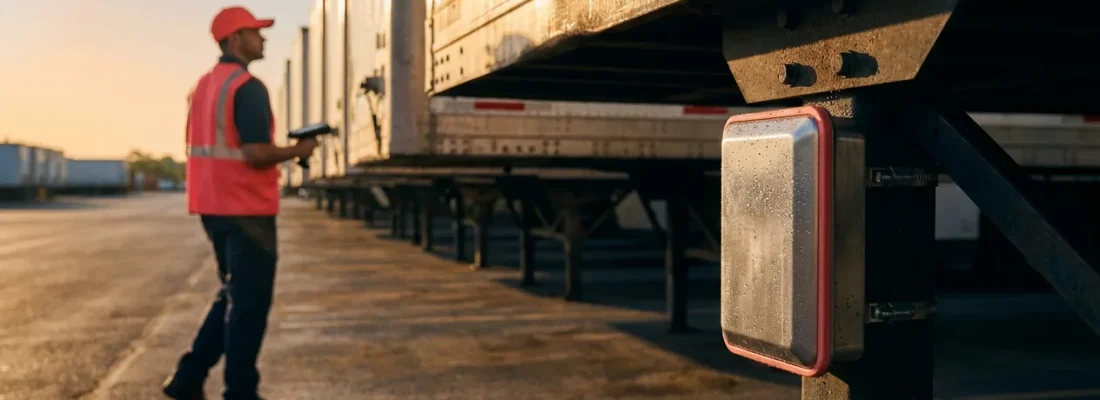
The best units carry long-life batteries, often good for 5 to 10 years, or a solar panel that keeps the battery charged. That means reliable location and status reporting for years with little maintenance. For construction equipment tracking, the same self-powered approach monitors excavators, generators, and light towers that sit idle for weeks between jobs. Across large sites like distribution centers or construction zones, pairing GPS with Bluetooth Low Energy adds real reach. A GPS gateway on a yard truck inventories hundreds of BLE-tagged assets as it drives past, with no tracker required on every item.
The Future of Trailer Tracking: From Location to Intelligence
Trailer tracking is moving from reactive location checks to predictive intelligence. Legacy systems told you where a trailer was. Modern systems show you where it is now.
The next step tells you what happens next and what to do about it. AI and machine learning drive it. Instead of flagging a stopped trailer, the platform reads traffic, driver hours, and history to predict a sharper ETA. Instead of a low-battery alert, it forecasts battery failure from voltage trends and conditions. That shift from data collection to a prescriptive, autonomous control tower defines the best trailer trackers going forward.
Matching Your Trailer Goals to the Right Platform
The right choice comes down to a clear read on your priorities. Define the primary goal first: theft prevention, better trailer utilization, automated yard checks, or deep diagnostics.
If you already run a fleet platform like Samsara or Motive, their asset trackers are the easy add-on. For the deepest trailer health data, Phillips Connect is a strong contender. For large, mixed-asset fleets that need a scalable platform built to turn data into action, an AI-powered system wins.
Judge vendors on hardware reliability, platform scalability, integration depth, and their roadmap for predictive analytics. The right partner sells you a platform for results, not just hardware.
GPX delivers the AI-powered visibility and predictive insight that complex trailer and asset fleets need at scale. See how our multi-sensor platform turns operational data into bottom-line results, and get a demo to map trailer tracking ROI to your own fleet.
For simpler consumer or small-business needs, budget GPS brands like Logistimatics or LandAirSea cover basic vehicle and personal tracking, though without the scale, multi-year battery life, and analytics that a business-grade platform provides.
Frequently Asked Questions (FAQs)
What are the best options for tracking non-powered assets like trailers?
The best options are self-powered devices with long-life batteries or solar charging. They run on their own for years with no vehicle connection. For large sites, pairing GPS gateways with low-cost BLE tags on individual assets scales cleanly and keeps costs down.
How can I track trailers in a yard?
Yard tracking works best with a mix of technologies. GPS gives you general location, and geofencing draws virtual perimeters around zones or parking rows. In high-density yards, automated inventory with BLE tags and mobile gateways locates every tagged asset in near real time.
How long does it take to deploy a trailer tracking solution?
Deployment time depends on the solution. Slap-and-track devices install in minutes per trailer. Sensor-integrated systems take longer. A GPX platform rollout runs in phases, with initial assets live within days and full fleet integration over a few weeks to match your operational cadence.
What is the typical ROI for a trailer tracking system?
Trailer tracking ROI comes from three levers: fewer stolen or lost assets, higher trailer utilization, and less labor spent on manual yard checks. Recovering even a handful of trailers a year, or trimming fleet size after utilization data exposes idle units, often covers the platform cost. Enterprise operators running AI-powered analytics see the strongest returns, because predictive utilization and automated inventory compound the savings across thousands of assets.