

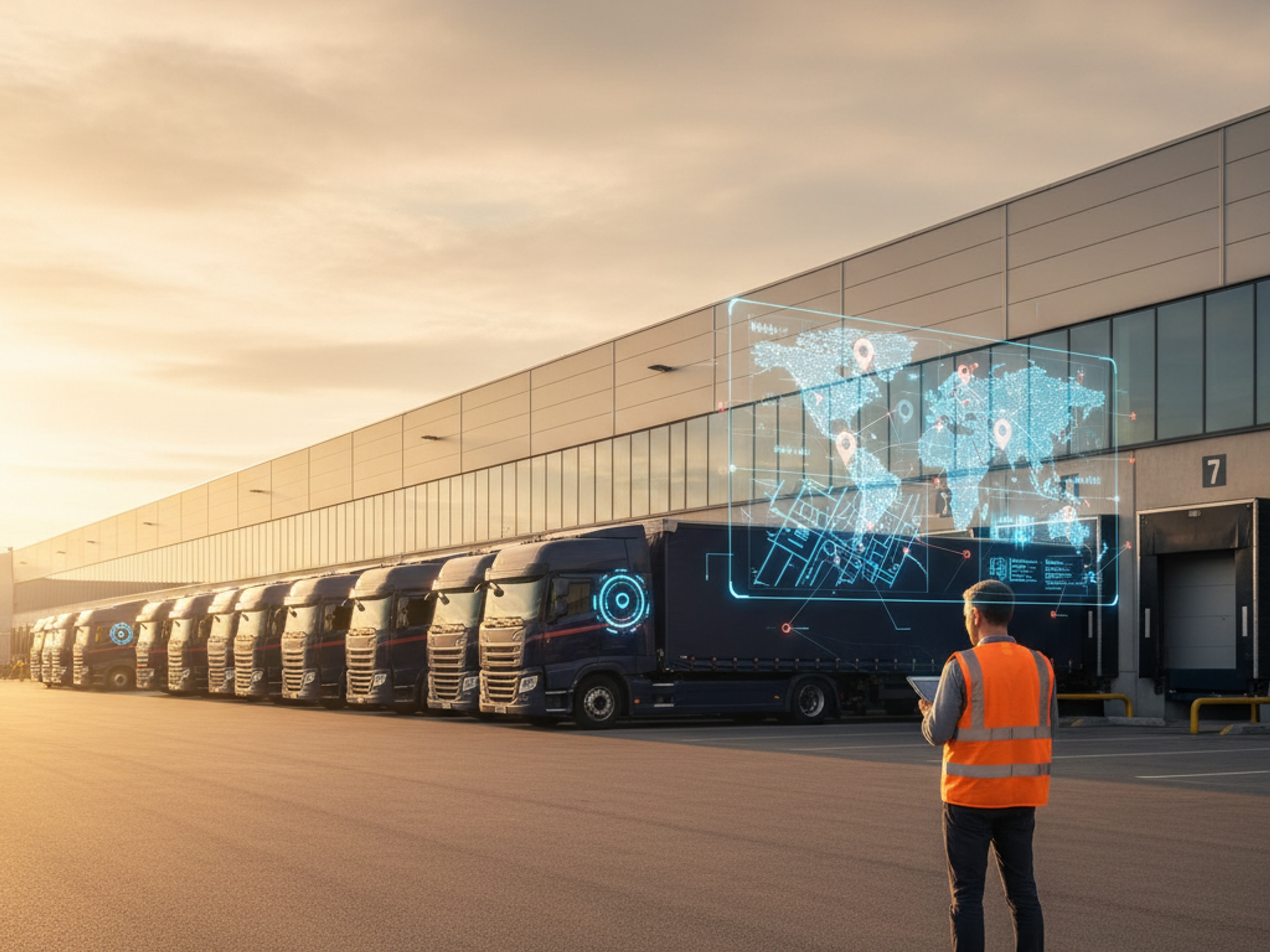
The era of treating supply chain stability as a default assumption is over. Major disruptions lasting a month or longer now strike every 3.7 years on average, and the typical enterprise absorbs roughly $184 million in annual disruption costs. Yet only 5 percent of companies have a comprehensive strategy to respond when conditions shift. That gap between confidence and capability is exactly what the agile supply chain model is built to close.
McKinsey research shows 93 percent of senior supply chain executives plan to make their networks markedly more flexible, agile, and resilient. The reason is direct: when 94 percent of companies report that disruptions hurt revenue, the ability to sense change early and respond fast becomes a competitive advantage rather than a back-office function.
This guide breaks down what an agile supply chain is, how it works, where it wins and where it strains, and how the physical technology layer of GPS, BLE, RFID, and AI turns the concept into measurable performance across construction, fleet, healthcare, and automotive operations.
Key Takeaways
- An agile supply chain senses demand and disruption in real time and reconfigures within hours rather than weeks, protecting service levels when conditions shift.
- It differs from lean (cost-focused) and resilient (redundancy-focused) models, and most enterprises now run a hybrid leagile strategy that blends all three.
- Real-time visibility is the foundation of agility, and GPS, BLE, RFID, and AI together form the IoT sensing and decision layer that makes it possible.
- Done right, agility lowers disruption costs, reduces asset loss and idle waste, and produces the data that ESG and Scope 3 reporting increasingly require.
What Is an Agile Supply Chain Strategy? (2026 Frameworks and Definitions)
An agile supply chain strategy is a network designed to sense demand and disruption in real time and reconfigure within hours. It treats flexibility as a core capability, rerouting shipments, switching suppliers, and reallocating assets to hold service levels steady while conditions shift around it.
Instead of locking into a single fixed plan, an agile model builds the speed to adapt directly into its design. A traditional supply chain optimizes for forecast accuracy and cost efficiency under stable conditions. An agile supply chain assumes conditions will not stay stable, so it runs on real-time data, modular sourcing, and the freedom to switch lanes, suppliers, or modes within hours rather than weeks.
Three ideas sit at the center of the model:
- Visibility: You cannot react to what you cannot see. Agile networks run on live data from assets, vehicles, inventory, and tier-one through tier-three suppliers.
- Velocity: Speed of decision matters as much as speed of movement. The faster a signal reaches the right person or system, the smaller the disruption.
- Flexibility: Multiple sourcing options, mode-agnostic logistics, and modular processes give the network room to flex without breaking. This is the foundation of a true demand sensing network.
Agile vs. Lean vs. Resilient Supply Chains: Which Model Dominates Post-Disruption?
Lean optimizes for cost and waste reduction in stable demand, agile optimizes for fast response in volatile demand, and resilient optimizes for risk buffers and redundancy. Post-disruption, hybrid leagile models dominate, applying lean where demand is predictable and agile where it is variable.
This is one of the most searched questions in supply chain strategy, and the answer shapes every technology decision that follows. Familiar examples make the contrast clear. Toyota built its reputation on a lean, just-in-time (JIT) model tuned for predictable demand. Zara and Amazon run agile networks built to react to fast-moving demand signals, restocking and rerouting in days rather than seasons. The lean versus agile logistics debate is really a just-in-time versus just-in-case question, and each approach fits the demand pattern it was designed for.
Lean and agile are not the only models on the board. A resilient supply chain prioritizes risk buffers and redundancy, and a green supply chain optimizes for sustainability and lower emissions. Agile overlaps most with resilient, since both are built for disruption. The practical takeaway is that lean keeps your cost base tight while agile keeps your service levels intact when the unexpected hits.
This is why most modern operations land on a leagile supply chain, a hybrid that applies lean discipline where demand is stable and agile responsiveness where it is variable or high-risk. Segmenting your network this way captures the cost advantage of lean and the speed advantage of agile in a single strategy, which is why the hybrid model now dominates post-disruption planning.
Structural vs. Operational Agility: Two Levels of Supply Chain Flexibility
Structural agility realigns the entire network, switching suppliers or sourcing regions when the market shifts. Operational agility optimizes the day-to-day, rerouting shipments and reallocating assets hour to hour. Structural agility counters long-term shocks, operational agility counters daily friction, and real-time tracking powers the operational layer.
Knowing the difference helps you target the right investment. Structural agility protects you against long-term shocks such as tariff changes or a supplier going dark. Operational agility protects you against the daily friction of delays, shortages, and misplaced assets. Real-time tracking technology is what powers operational agility, because you cannot reallocate or reroute what you cannot see. The strongest networks build both, using a clear network strategy at the structural level and live asset data at the operational level.
The Mechanics of Agility: How IoT Telematics and Predictive AI Drive Real-Time Logistics
An agile supply chain runs a constant loop. IoT telematics sense the live state of assets and shipments, predictive AI analyzes the data and flags risks early, teams and systems decide, and the network acts. The faster this loop runs, the more agile the network becomes.
The mechanics break down into five connected stages that run continuously rather than in scheduled cycles, the foundation of any modern supply chain control tower:
- Sense: IoT telematics and connected devices capture the live state of inventory, assets, vehicles, and demand signals across the network.
- Analyze: Predictive analytics and AI models interpret that data, flag anomalies, and forecast where shortages, delays, or theft are forming before they escalate.
- Decide: Planners and automated systems weigh options, reroute a shipment, pull from a secondary supplier, or shift a delivery mode.
- Act: The network executes the decision and updates every downstream system so the whole chain stays aligned.
- Learn: Each cycle feeds outcome data back into the models, sharpening future predictions and response times. Some advanced operations mirror this in a digital twin to test scenarios before acting in the real world.
The faster this loop runs, the more agile the network becomes. A chain that senses a port delay in real time and reroutes within the hour outperforms one that discovers the same delay three days later through a manual status email. This is why physical tracking hardware and predictive AI sit at the heart of any serious agile strategy.
Key Characteristics of an Agile Supply Chain
Agile supply chains share recognizable traits: real-time asset visibility, demand-driven planning, multi-sourcing, mode-agnostic logistics, collaborative data sharing, and decentralized decision-making. Strategists group these into five dimensions, namely accessibility, alertness, decisiveness, flexibility, and swiftness, which together turn live data into fast action.
If your operation has these traits in place, you are building real agility rather than just claiming it:
- Real-time asset visibility: Live location and status data for high-value equipment, inventory, and in-transit goods.
- Demand-driven planning: Plans adjust to actual signals rather than locking to a quarterly forecast.
- Multi-sourcing and modular supply: Pre-qualified alternative suppliers and flexible sourcing reduce single points of failure.
- Mode-agnostic logistics: The freedom to shift between truckload, intermodal, LTL, and air as cost and service conditions change.
- Collaborative data sharing: Partners and suppliers operate from a shared view of the network rather than isolated systems.
- Decentralized decision-making: Empowered, cross-functional teams act on real-time signals without waiting for layers of approval, which is what turns visibility into speed.
- Automated exception handling: AI agents handle routine alerts so human teams focus on the decisions that matter.
Supply chain strategists often group these traits into five dimensions of agility, a useful checklist for assessing how agile your network really is:
- Accessibility: Real-time data is available to the people and systems that need it.
- Alertness: The network detects changes and disruptions early.
- Decisiveness: Teams can make fast, confident calls on the data in front of them.
- Flexibility: Resources and routes can be reconfigured without breaking service.
- Swiftness: The whole network executes the response quickly.
Demand-driven planning is where many of these dimensions converge, and it rests on getting reorder timing right. A common starting formula is the SKU reorder point: reorder point = (average daily sales x lead time in days) + safety stock. When live tracking data sharpens your lead-time and demand inputs, that calculation gets more accurate, which means fewer stockouts and less capital frozen in excess inventory.
Pros and Cons of an Agile Supply Chain
The main benefits of an agile supply chain are faster disruption recovery, reduced loss and shrinkage, higher customer satisfaction, and better capital use. The trade-offs are higher upfront technology investment, stronger data governance demands, and the change management effort needed to act on real-time signals.
Agility delivers serious advantages, and it carries real trade-offs. Understanding both sides helps you decide where to apply it and where a leaner approach makes more sense.
Pros:
- Faster disruption recovery: Reroute, re-source, and re-prioritize within hours instead of days, protecting revenue and service levels.
- Reduced loss and shrinkage: Real-time visibility cuts theft, misplacement, and idle-asset waste across job sites and fleets.
- Higher customer satisfaction: Reliable delivery and accurate ETAs hold up even when conditions shift.
- Better capital utilization: Knowing exactly where every asset is reduces over-purchasing and rental redundancy.
- Competitive resilience: The ability to outperform competitors during disruption becomes a durable advantage.
Cons:
- Higher upfront technology investment: Tracking hardware, data platforms, and AI tools require capital and integration work.
- Data governance demands: Poor data hygiene undermines planning accuracy even when visibility tools are in place.
- Change management effort: Teams need new processes and training to act on real-time signals rather than legacy routines.
- Coordination complexity: Multi-sourcing and mode flexibility add moving parts that require strong oversight.
Why Supply Chain Visibility Fails Without Real-Time Data
The hardest challenges in supply chain visibility are limited upstream insight, fragmented data across systems, manual tracking that cannot keep pace, the bullwhip effect, safety-stock hoarding, 3PL and 4PL data silos, and asset theft. Each traces back to a lack of trustworthy real-time data.
Most agile transformations stall for the same reasons, and naming them early prevents costly rework. The barriers are rarely about ambition. They are about the gap between wanting visibility and actually having it.
- Limited upstream visibility: Roughly 45 percent of supply chain leaders report no visibility beyond their first-tier suppliers, which leaves them blind to risks forming two or three tiers deep.
- Fragmented data: Asset, fleet, and inventory data often live in separate systems that never talk to each other, so no single team sees the full picture.
- Manual tracking gaps: Spreadsheets and check-in calls cannot keep pace with a network that needs to respond in real time.
- Reactive rather than designed resilience: Scrambling during a disruption costs far more than building flexibility in advance.
- The bullwhip effect: Small swings in customer demand get amplified at each step up the chain, so minor forecast errors turn into large over-orders and shortages without live demand signals to dampen them.
- The just-in-case inventory trap: Companies moving off lean often panic-buy safety stock, which inflates inventory carrying costs. Real-time GPS and BLE data right-sizes safety stock based on actual lead times instead of hoarding it as a hedge.
- 3PL and 4PL data silos: Outsourcing logistics often means losing direct visibility. Independent tracking hardware acts as a single source of truth, bridging the gap when third-party carrier data arrives late or inaccurate.
- Scope 3 emissions and idle waste: In 2026, sustainability is a compliance issue rather than a public-relations one. Real-time routing reduces idle time and empty miles, directly lowering the carbon footprint of every shipment.
- Asset loss and theft: High-value equipment that goes missing on remote sites or in transit drains both capital and schedule.
Each of these traces back to one root issue: a lack of trustworthy, real-time data about where assets are and what condition they are in. That is precisely the gap that GPS, BLE, RFID, and AI are built to fill.
How Enterprise GPS Tracking and IoT Sensors Mitigate Supply Chain Disruptions
Enterprise GPS tracking is the wide-area backbone of supply chain visibility, showing where vehicles, trailers, and high-value assets are in transit in real time. Paired with IoT sensors, it lets teams catch delays the moment they form and reroute before disruptions cascade downstream.
GPS tracking tells you where your vehicles, trailers, containers, and high-value assets are across the country and in transit, with no manual check-ins required. For an agile network, this wide-area signal makes fast decisions possible. When a fleet manager can see a delayed truck the moment it stalls, they can dispatch a backup, notify the customer with an accurate ETA, and reroute the next load before the delay cascades. In construction and automotive logistics, GPS-tracked equipment and parts shipments mean dispatchers always know what is on site, what is en route, and what needs to move next.
The agility payoff is speed of response. Enterprise GPS tracking and in-transit monitoring turn a blind window into a live data stream, which is the difference between reacting to a problem after a customer complains and solving it before they ever notice.
BLE and RFID: The Backbone of Real-Time Asset Visibility
BLE and RFID deliver the close-range visibility GPS cannot. BLE tags track clustered equipment and tools on sites, in yards, and indoors, while RFID confirms inventory and throughput at fixed checkpoints. Together they cover the dense, short-range environments where agile operations gain or lose hours.
GPS excels over long distances, but it is not the right tool for tracking hundreds of tools, pallets, or devices clustered on a job site, in a yard, or inside a facility. That is where BLE (Bluetooth Low Energy) and RFID earn their place in the stack.
BLE asset tracking uses small, battery-powered tags that broadcast their presence to nearby gateways and mobile devices. BLE is ideal for tracking equipment on construction sites, medical devices moving between hospital departments, and high-value tools that walk off if no one is watching. The GPX AssetTag is a BLE device with a replaceable cell and a 4-year battery life, designed to deliver dependable indoor and yard-level visibility without the maintenance burden of frequent battery swaps.
RFID tracking uses tags read by fixed or handheld scanners, making it well suited to high-throughput checkpoints such as gates, dock doors, and inventory counts. RFID confirms what passed a given point and when, which keeps inventory records accurate without manual scanning.
Together, BLE and RFID provide the close-range, high-density visibility that GPS cannot, covering the indoor and yard environments where agile operations gain or lose hours every day.
How AI Turns Tracking Data Into Agile Decisions
AI turns raw tracking data into agile decisions. It predicts where delays, shortages, and theft are forming, automates routine alerts and updates, and recommends the best reroute or sourcing move based on live conditions, shortening the time between sensing a problem and acting on it.
Hardware generates data. AI turns that data into decisions, and that conversion is what makes a supply chain truly agile rather than merely instrumented. IDC predicts that by the end of 2026, 55 percent of large OEMs will redesign their service supply chains around AI to pre-position parts, schedule work, and prevent disruptions before they form.
In an agile context, AI works across three layers:
- Prediction: Machine learning models forecast where delays, shortages, or theft are likely to form, giving teams a head start on response.
- Automation: AI agents handle high-volume, repetitive work such as ETA updates and exception alerts, freeing people for the judgment calls that matter.
- Optimization: AI recommends the best reroute, the right secondary supplier, or the optimal asset reallocation based on live conditions rather than static rules.
The combination is powerful. GPS and BLE and RFID form the Internet of Things (IoT) sensing layer that supplies the live signal, predictive analytics and AI interpret it and recommend action, and the network executes faster than any manual process could. Some networks add blockchain to verify provenance and chain-of-custody on top of this data, but the core engine is the same: connected sensors feeding an intelligent decision layer. Automated mitigation has shifted from a future goal to a baseline requirement, with 72 percent of supply chain executives now calling it mandatory for managing modern disruptions.
GPS, BLE, RFID, and AI Compared: Which Technology Fits Where?
No single technology covers every gap. GPS handles wide-area, in-transit tracking, BLE handles site and yard assets, RFID handles checkpoint inventory, and AI turns all of it into decisions. An agile supply chain combines them into one layered visibility stack rather than choosing one.
The table below shows where each fits, with the GPX AssetTag highlighted as the BLE option built for site and yard environments.
| Technology | Best Range | Ideal Use Case | Agile Role | Power Profile |
|---|---|---|---|---|
| GPS Tracking | Wide-area, nationwide | Fleets, trailers, in-transit assets | Live location for routing and ETAs | Rechargeable or wired |
| GPX AssetTag (BLE) | Short-range, site and yard | Tools, equipment, indoor assets | High-density indoor and yard visibility | 4-year replaceable battery |
| RFID Tags | Checkpoint, very short range | Gate, dock, and inventory counts | Accurate throughput and inventory records | Passive (no battery) or active |
| AI Layer | Network-wide (software) | Prediction and automation | Turns live data into fast decisions | Cloud and edge compute |
Agile Supply Chain Use Cases Across Construction, Fleet, Healthcare, and Automotive
Agile supply chains prove their value most in construction, fleet, healthcare, and automotive, where assets move constantly and a missing item stops the operation. GPS tracks assets in transit, BLE and RFID cover site and indoor visibility, and AI coordinates the response across every function.
- Construction: Equipment and tools spread across multiple remote sites. GPS tracks machinery in transit while BLE tags keep tools and small assets accounted for on site, cutting theft and idle-rental costs. See our construction asset tracking solutions for more.
- Fleet and logistics: Real-time GPS visibility supports mode-agnostic routing, accurate customer ETAs, and fast rerouting when a lane is blocked or a load is delayed. Explore fleet tracking built for agile logistics.
- Healthcare: Mobile medical equipment moving between departments stays visible through BLE, reducing the time staff spend searching and the capital lost to missing devices.
- Automotive: Parts and components flowing through a multi-tier network benefit from RFID checkpoints and AI demand sensing, keeping production lines supplied without overstocking.
In every case, the pattern holds: combine wide-area GPS, close-range BLE and RFID, and an AI layer that turns the resulting data into action faster than any disruption can spread.
Agility also applies across the core functions inside each of those industries:
- Procurement: Pre-qualified backup suppliers, fully onboarded and ready to activate, so a single source going dark does not stop the line.
- Production and scheduling: Plans that flex to live demand and asset availability rather than a fixed quarterly schedule.
- Distribution and logistics: Mode-agnostic routing that shifts between carriers and modes as cost and service conditions change.
- Forecasting: Demand sensing that updates from real signals, tightening reorder points and cutting both stockouts and excess inventory.
How to Choose the Right Agile Supply Chain Technology Stack
To choose the right agile supply chain technology, match the tool to how your assets move: GPS for wide-area transit, BLE and RFID for clustered site assets, and AI to turn the data into action. The strongest networks layer all three on a clean data foundation.
Building agility is not about buying every available tool. It is about matching the right technology to the way your assets actually move. Use these questions to choose the stack that fits your operation.
- Where do your assets travel? Wide-area movement calls for GPS. Clustered, indoor, or yard-based assets call for BLE and RFID. Most operations need both.
- How fast do you need to react? If hours of delay translate into lost revenue, prioritize real-time data feeds and an AI layer that flags problems early.
- What is your data foundation? Tracking hardware only delivers value when the data is clean, unified, and accessible to the teams that act on it.
- Will it fit your existing systems? API-first tracking hardware feeds live data into your current ERP and logistics platforms, so you upgrade visibility without a rip-and-replace migration.
- Can your team act on the signal? The best technology fails without the processes and training to turn alerts into decisions.
- Will it scale? Choose hardware with low maintenance, such as long-life replaceable batteries, so visibility holds as your network grows.
The right answer is rarely a single device. It is a layered stack where GPS, BLE, RFID, and AI each cover the visibility gap the others cannot, working together to make your network sense faster and respond sooner than the disruptions it faces.
Build a More Agile Supply Chain With GPX
An agile supply chain runs on visibility you can trust, and visibility starts with knowing exactly where every asset is. GPX Intelligence delivers the GPS and BLE tracking technology that gives construction, fleet, healthcare, and automotive operations real-time control over their highest-value assets, with hardware built for the field and battery life built to last. Talk to the GPX team to map the right tracking stack to your network and turn live asset data into faster, smarter decisions.
Frequently Asked Questions (FAQs)
What is the difference between agile, lean, and resilient supply chains?
A lean supply chain optimizes for cost and waste reduction in stable demand, an agile supply chain optimizes for fast response in volatile demand, and a resilient supply chain prioritizes risk buffers and redundancy. Most operations blend them into a hybrid leagile model, applying each where it fits best.
How does IoT (GPS, BLE, and RFID) reduce supply chain disruption costs?
IoT tracking using GPS, BLE, and RFID catches delayed shipments and missing assets early, before they halt a production line or trigger penalty clauses. By turning blind in-transit windows into live data, it helps enterprises avoid the costly disruptions that can run into millions of dollars per event.
How do I transition from a legacy ERP to a real-time agile network?
You do not have to rip and replace your ERP. API-first tracking hardware such as the GPX AssetTag feeds live location data directly into existing legacy systems, acting as an instant visibility upgrade. This lets you build agility incrementally without a disruptive full-system migration.