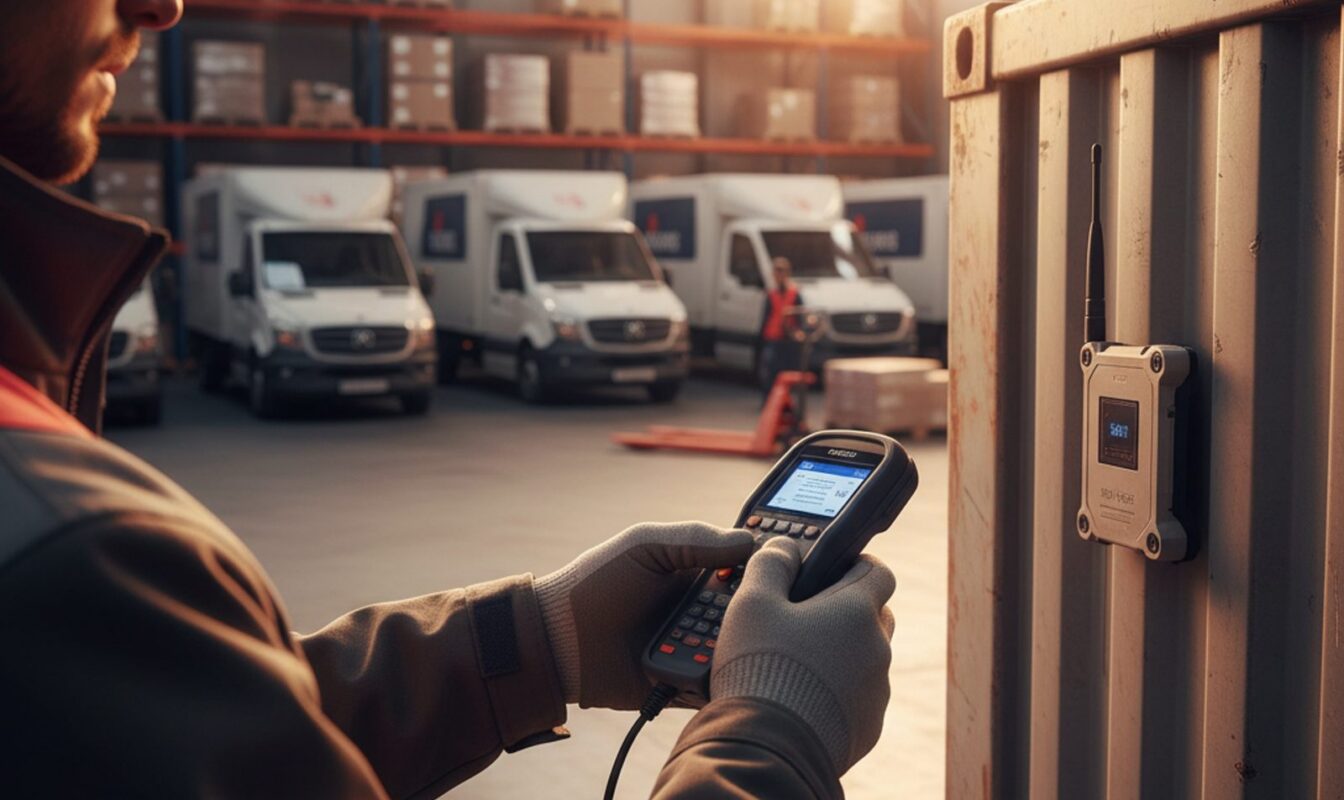
Indoor GPS Tracking Stickers: Eliminating Warehouse and Facility Blind Spots

A warehouse supervisor at a 500,000 square foot distribution center walks to the shipping dock at 6:00 AM with a customer escalation in hand. A high-priority pallet of medical supplies needs to ship in two hours, and the cellular GPS report says it is “somewhere on the property.” The tracker went silent the moment the pallet rolled under the steel roof. A two-person team now has 90 minutes to walk every aisle scanning barcodes by hand.
This is the daily reality inside facilities that depend on traditional cellular GPS for indoor visibility. The signal stops where the satellite line of sight ends. The Real-Time Location System market is responding fast: it is projected to grow from $6.68 billion in 2025 to $15.67 billion by 2030, according to MarketsandMarkets, with the indoor segment growing at the highest CAGR of 11.8% from 2026 to 2030. Indoor visibility is no longer a niche capability. It is becoming infrastructure.
The shift driving this growth is a different architecture for indoor tracking: peel-and-stick BLE tags that operate on terrestrial networks instead of searching for satellites. This article explains why cellular GPS fails inside a building, how indoor tracking stickers solve it using terrestrial BLE, and what high-density facility visibility looks like in a hospital, distribution center, or yard.
The Signal Dead Zone: Why Cellular GPS Fails Indoors
Cellular GPS trackers depend on two things: a clear line of sight to GPS satellites orbiting at 12,500 miles altitude, and a strong cellular signal back to the network. Both fail the moment an asset enters a structure with steel decking, concrete walls, or multi-story construction.
Inside a typical distribution center, hospital, or manufacturing facility, the GPS signal degrades sharply or disappears within the first 20 to 50 feet of penetration. Cellular signal does better but still drops in basement levels, equipment rooms, and large open-bay warehouses with metal-clad roofs. When a tracker cannot fix its position and cannot reach the cellular network, it goes dark. The dashboard shows the last known outdoor coordinate, often the loading dock or the front gate, and stays there until the asset rolls back outside.
For a forklift driver, a charge nurse looking for a respirator, or a yard manager trying to locate a specific pallet inside a 500,000 square foot facility, the result is the same: minutes lost per search, multiplied across thousands of searches per month, multiplied across every shift. This is the indoor blind spot that no satellite-based tracker resolves, no matter the price point.
How Indoor Tracking Stickers Use Terrestrial BLE Networks
Indoor tracking stickers solve the dead zone by reversing the network architecture. Instead of searching upward for a satellite, a Bluetooth Low Energy (BLE) sticker broadcasts a short signal outward to whatever is nearby on the ground: a smartphone in a worker’s pocket, a forklift moving down an aisle, a Wi-Fi gateway on the ceiling, or a fixed BLE anchor mounted near a dock door.
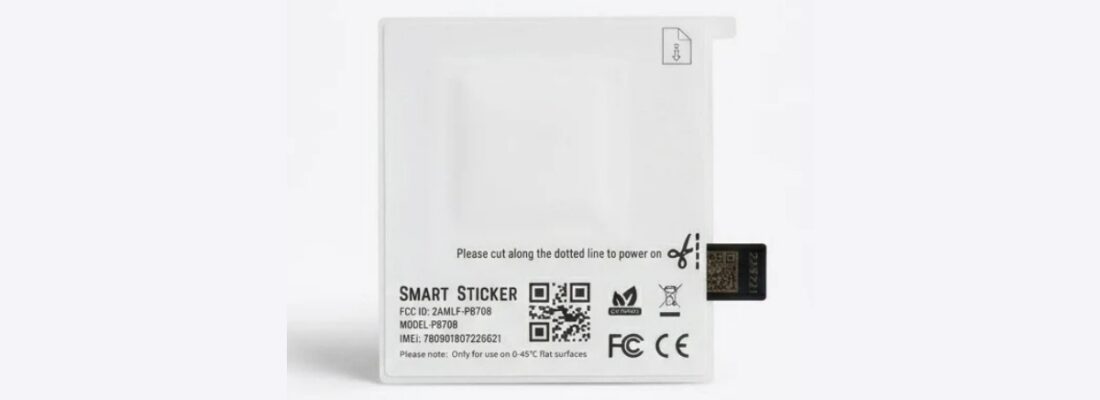
The GPX AssetTag is purpose-built for this terrestrial model. The tag is IP67-rated, runs on a replaceable watch battery for 3 to 4 years, and transmits its identifier on a low-power schedule. Any GPX-aware device that hears the broadcast logs the tag’s location and timestamp to the platform. The result is automatic indoor visibility without dedicated gateway hardware at every dock or aisle.
The mobile coverage layer is what makes this approach practical at scale. The GPX BLE RoadWired is a hardwired BLE hub installed on forklifts, yard trucks, and service vehicles. As those vehicles move through a facility, they continuously update the location of every nearby BLE-tagged asset. A pallet does not have to find the network. The network drives past the pallet every few minutes. When fixed anchors at known reference points combine with mobile hubs on forklifts, plus the smartphones that workers already carry, the result is continuous indoor coverage at a fraction of the cost of a full RFID or UWB infrastructure deployment.
This is the same crowdsourced principle that consumer trackers rely on, except built for commercial environments and supported by a purpose-built network of over 3 billion BLE gateways globally rather than nearby iPhones.
Indoor Tracking Approaches Compared
Different facility tracking technologies solve the indoor visibility challenge in very different ways. Total cost, infrastructure burden, and accuracy vary significantly across approaches.
| Approach | Indoor Accuracy | Infrastructure Required | Battery Life | Best Fit |
|---|---|---|---|---|
| Indoor BLE Stickers (GPX AssetTag) | Aisle-level, 75 to 150 feet | Mobile hubs on forklifts plus existing smartphones | 3 to 4 years on replaceable battery | Warehouses, hospitals, yards, multi-floor facilities |
| Passive RFID | Doorway-level, event only | Fixed readers at every chokepoint | None, passive | High-throughput retail backrooms |
| Wi-Fi RTLS | Room-level, 15 to 30 feet | Dense Wi-Fi access point coverage | 2 to 3 years | Hospitals with mature Wi-Fi infrastructure |
| Ultra-Wideband (UWB) | Sub-meter | Dedicated UWB anchors throughout facility | 1 to 2 years | Manufacturing cells requiring centimeter precision |
| Cellular GPS | None indoors | Cellular network | 5 to 10 years | Outdoor fleet and long-haul transit only |
The terrestrial BLE sticker approach wins on time-to-deploy and ongoing labor cost while still delivering aisle-level accuracy for the vast majority of facility tracking use cases.
High-Density Visibility for Hospitals and Distribution Centers
The economics of indoor BLE tracking become obvious in two environments: hospitals and large distribution centers.
In a hospital, biomedical equipment teams routinely lose 10 to 20 percent of mobile medical assets each year, much of it through misplacement rather than theft. A respirator, an infusion pump, or a portable ultrasound that vanishes between floors costs $5,000 to $80,000 to replace, and search time pulls clinical staff away from patient care. With BLE indoor tracking stickers attached to every mobile device, a charge nurse opens the platform, types “infusion pump on floor 4,” and gets the exact room in seconds. According to recent industry research, 65% of U.S. hospitals already use real-time location systems, reducing search time by 52% on average.
Proof Point
18x ROI · $2.1M Annual Savings
A major automotive OEM deployed GPX BLE indoor tracking across 246,000 returnable containers, achieving a 95% recovery rate, eliminating container loss, and saving $2.1 million per year in replacement orders.
In a distribution center, the math is similar but at higher density. A 500,000 square foot facility holds tens of thousands of pallets across 60-foot-tall racking. Manual cycle counts and barcode-walking inventory checks consume hundreds of labor hours per week. With indoor tracking stickers on every pallet plus BLE RoadWired hubs on the forklift fleet, every pallet movement is logged automatically. Inventory becomes searchable in plain English through Scout AI, the GPX natural-language analytics layer: “Show me every pallet idle longer than 30 days in zone B” returns the answer in seconds, without a single barcode scan. The same pattern extends to construction yards, automotive plants, aerospace facilities, and pharmaceutical cold chains.
From Indoor Visibility to Autonomous Facility Operations
The deeper shift here is not just better search inside a warehouse. It is the foundation for autonomous facility operations. Once every asset broadcasts its location continuously and every forklift, smartphone, and gateway listens, the platform stops being a dashboard and starts being a control tower. Geofence-triggered alerts flag a respirator leaving a sterile floor before the door closes. Idle-time analytics surface the 18 percent of forklift fleet that sits unused while procurement orders three more units.
This is where indoor tracking data becomes operationally agentic. Scout AI detects an idle high-priority pallet and automatically fires a webhook to the Warehouse Management System, generating a retrieval task on the nearest forklift driver’s tablet without a manager ever making a radio call. The same integration pattern extends across the enterprise stack: location data flows directly into Manhattan Associates, Blue Yonder, and SAP EWM for warehouse orchestration, into NetSuite and SAP S/4HANA for ERP-level inventory accuracy, and into Epic or Cerner for hospital systems that need real-time equipment availability surfaced inside the Electronic Health Record. The location layer stops being a separate dashboard and becomes a signal that drives every system the operations team already runs.
The asset tracking market is on track to reach $28.97 billion in 2026 with a 15% CAGR. The operations teams winning that growth are not the ones running paper clipboards or expensive RFID chokepoints. They are the ones who turned every steel roof into a covered network, every facility into a self-reporting system, and every shift into a stream of structured data feeding the WMS, ERP, and EHR layer. Indoor visibility is no longer the destination. It is the foundation for autonomous logistics, predictive maintenance, and macro-resilience against the next port shutdown, labor strike, or freight reroute.
For teams ready to map indoor tracking stickers to their facility, the GPX AssetTag product page outlines deployment specifics, or request a quote to start tagging high-value mobile assets before the next inventory cycle.
Frequently Asked Questions (FAQs)
Do GPS stickers work inside buildings?
Standard cellular GPS stickers do not work reliably inside buildings because GPS satellite signals cannot penetrate steel decking, concrete walls, or multi-story construction. Indoor GPS tracking stickers solve this by using Bluetooth Low Energy (BLE) instead of satellite signals. A BLE sticker like the GPX AssetTag broadcasts its location to nearby smartphones, forklift-mounted hubs, and fixed gateways, providing continuous indoor visibility where cellular GPS goes dark.
How do I track pallets inside a warehouse?
The most cost-effective approach is to attach a BLE indoor tracking sticker to each pallet and equip the forklift fleet with mobile BLE hubs such as the GPX BLE RoadWired. As forklifts move through the warehouse, they automatically update the location of every nearby tagged pallet, eliminating the need for manual barcode scanning or fixed RFID chokepoints. Workers query inventory in plain English through Scout AI, returning aisle-level location data in seconds.
How do indoor tracking stickers compare to RFID for hospital equipment tracking?
RFID requires fixed reader infrastructure at every doorway and pinch point, which drives high installation cost and ongoing maintenance. Indoor BLE tracking stickers work with the BLE-enabled smartphones, tablets, and Wi-Fi infrastructure that hospitals already operate, so deployment cost is significantly lower. BLE also provides continuous location updates rather than only logging an event when an asset crosses a reader gate, which makes it better suited for tracking a respirator or crash cart moving freely between floors.
What is the ROI of switching from manual scanning to indoor tracking stickers?
ROI usually appears in three places: reduced search labor (52% faster equipment location in hospital deployments), reduced asset loss (10 to 20 percent of mobile medical equipment goes missing each year without tracking), and reduced expendable purchases. One automotive OEM running GPX BLE indoor tracking on returnable containers reported an 18x ROI and $2.1 million in annual savings by eliminating container loss and reducing replacement orders.