

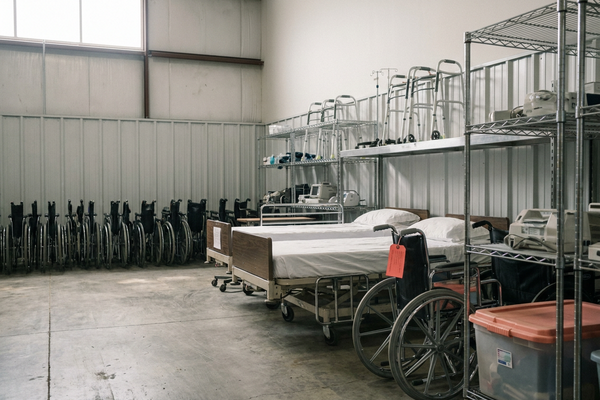
The U.S. hospice market reached an estimated $32.72 billion in 2026 and is forecast to grow to $49.51 billion by 2035 at a 4.71 percent CAGR. At the same time, roughly 55 percent of hospice patients now receive care at home, which means a hospital bed, an oxygen concentrator, a wheelchair, or a patient lift has to arrive at a residential address, often within hours of admission, often in a stressful clinical situation, and very often after business hours.
That is the operational reality behind every hospice DME (Durable Medical Equipment) program in the country. The right equipment in the wrong place is the same as no equipment at all. And in 2026, with CMS tightening the FY2027 proposed rule, HOPE quality reporting expanding, and margin compression hitting almost every hospice agency, DME tracking has graduated from a back-office concern to a clinical, financial, and compliance issue all at once.
This guide covers what hospice DME is, why real-time DME tracking now defines operational quality, the challenges hospice teams hit when they rely on paper logs and spreadsheets, how modern Bluetooth Low Energy (BLE) and GPS tracking actually works, and how to choose the right hospice DME tracking solution for an agency operating across patient homes, skilled nursing facilities, inpatient units, warehouses, and field vehicles.
Key Takeaways
- Hospice DME tracking is a real-time location system (RTLS) that uses BLE, GPS, and smart labels to monitor durable medical equipment inventory across patient homes, facilities, vehicles, and warehouses.
- Medicare Hospice Benefit compliance hinges on time-stamped proof of delivery for every piece of DME. Modern RTLS platforms produce audit-ready records that protect against CMS recoupment risk.
- Equipment loss runs 10 to 20 percent annually in healthcare environments. Under the Cost Per Patient Day (PPD) bundled-payment model, every lost wheelchair or oxygen concentrator hits the hospice’s own margin, not the payer’s.
- GPX Intelligence brings the BLE network, AssetTag (4-year replaceable battery), Smart Labels, AssetTrack GPS family, and Scout AI together into one healthcare-ready platform purpose-built for distributed hospice operations.
- The right solution covers indoor plus outdoor plus in-transit visibility on one pane of glass, integrates with existing DME vendor networks and EMR systems, and delivers proof of delivery for CMS reimbursement cycles.
What Is Hospice DME Tracking Software & RTLS?
Hospice DME tracking is a real-time location system (RTLS) that uses Bluetooth Low Energy (BLE), GPS, and smart labels to monitor durable medical equipment inventory across patient homes, facilities, vehicles, and warehouses. To understand why hospice agencies need an RTLS at all, it helps to start with what hospice DME actually is.
Hospice Durable Medical Equipment is the category of reusable, medically necessary equipment supplied to a hospice patient to manage symptoms, support mobility, and maintain comfort during end-of-life care. CMS defines DME under the Medicare Hospice Benefit, and qualifying equipment must meet four specific criteria:
- Withstands repeated use across multiple patients
- Serves a primarily medical purpose (not general daily-living convenience)
- Is appropriate for use in a home or hospice setting
- Has a typical life expectancy of at least three years
Unlike disposable supplies (gloves, dressings, incontinence products), DME is rented or owned by the hospice and circulates between patients, warehouses, driver vehicles, and the field. Every piece of equipment is a balance sheet asset that has to be cleaned, repaired, recertified, and redeployed across a constantly changing patient census.
Hospice DME vs. Adaptive Equipment: Medicare Billing Differences
Hospice operations teams routinely face this question from new staff and family caregivers. The distinction matters for billing, tracking, and clinical documentation. DME is strictly for medical purposes: managing a clinical condition, delivering oxygen, supporting safe transfer, or reducing pressure injury risk. Adaptive equipment, by contrast, supports activities of daily living more broadly (reachers, dressing aids, modified utensils, communication aids). Adaptive equipment is generally not covered under the Medicare Hospice Benefit, while DME is. From an asset-tracking perspective, DME is the higher-value, higher-mobility category that justifies a real-time tracking investment.
The most common hospice DME categories include:
- Hospital beds with adjustable height, side rails, and pressure-relief mattresses
- Oxygen equipment, including concentrators, portable tanks, and conserving regulators
- Wheelchairs and transport chairs, both manual and powered
- Patient lifts and slings for safe transfers
- CPAP and BiPAP machines for respiratory symptom management
- Ventilators for advanced respiratory support
- Bedside commodes, shower chairs, and over-bed tables
- Pressure-reducing bedding and specialty mattresses
- Suction machines and nebulizers
Every one of these items has a serial number, a CMS billing code, a maintenance log, and, in 2026, an expectation that the hospice agency knows exactly where it is at any moment.
Solving Margin Compression & Lost Medical Equipment in 2026
Hospice DME used to be a quiet line item. It is not quiet anymore. Three forces have pushed it to the front of the operations conversation.
Margin compression. Medicare reimburses hospices under a Cost Per Patient Day (PPD) model, which means the agency receives a fixed daily payment per patient regardless of how much DME that patient actually consumes. The CMS FY2027 proposed rule continues a pattern of low-single-digit payment updates while operating costs rise faster. DME is one of the largest controllable costs in a hospice budget, sitting alongside staffing and pharmacy. Per diem charges, non-formulary spend, and the hidden administrative overhead of placing orders, confirming deliveries, and chasing pickups all hit the same P&L.
Clinical quality reporting. The HOPE (Hospice Outcomes and Patient Evaluation) framework now ties symptom management outcomes to operational performance. A patient whose oxygen concentrator is delayed, whose hospital bed never arrived, or whose suction machine is broken is a patient whose clinical scores will reflect that gap. DME process quality is quickly becoming a quality reporting issue, not just a logistics one.
Equipment loss. Healthcare facilities routinely lose 10 to 20 percent of their mobile medical equipment per year to misplacement, hoarding in clinical workrooms, and equipment that leaves a patient’s home and never makes it back. For a hospice agency running 300 hospital beds, a 15 percent annual loss rate is roughly 45 beds that have to be replaced, recertified, or written off every year.
Real-time hospice DME tracking attacks all three at once. It cuts unnecessary purchases, shortens delivery cycles, supports surveyor-ready documentation, and frees clinical staff from chasing equipment instead of caring for patients.
How Healthcare IoT Works: BLE, GPS & Smart Labels for DME
Modern hospice DME tracking is not a single technology. It is a stack of complementary tracking layers, each suited to a different segment of the patient and equipment lifecycle.
- Bluetooth Low Energy (BLE) tags. Small, battery-powered tags fixed to each piece of equipment. BLE tags ping a network of fixed gateways (in warehouses, branch offices, inpatient units) and mobile hubs (mounted on delivery vehicles), reporting location, dwell time, and motion in real time. BLE is the workhorse for indoor and proximity tracking.
- GPS trackers. Cellular GPS devices on higher-value equipment and on delivery vehicles. GPS handles the outdoor and in-transit segment, the time between the warehouse and the patient’s home.
- Smart Labels. Ultra-thin peel-and-stick BLE tags for high-volume, lower-cost items. They require no wiring, no charging, and no reverse logistics, which is ideal for one-way deliveries and consumable-adjacent DME.
- RFID and barcode. For high-volume warehouse check-in and check-out, especially during cleaning, recertification, and redeployment cycles.
- Cloud platform and AI layer. The data layer that pulls every signal together, geofences patient homes and facilities, triggers alerts when equipment leaves an authorized zone, and feeds dashboards used by operations, billing, and clinical leadership.
The combination matters. Cellular GPS alone is blind inside a home, a skilled nursing facility, or a multi-story branch warehouse. BLE alone is blind on the highway between a warehouse and a patient. Smart Labels alone do not justify the cost of cellular hardware on a $25 cane. A real hospice DME tracking platform blends them and routes the data into one operational picture.
Where Hospice DME Programs Lose CMS Reimbursement
The hospice agencies still running on spreadsheets, phone calls, and clipboard inventory hit the same set of recurring challenges. These are the patterns most often surfaced in operations reviews.
- Audit anxiety and CMS recoupment risk. Without time-stamped proof of delivery on every DME shipment, a hospice exposes itself to Medicare recoupment when surveyors ask how delivery timeframes were met. BLE arrival events and GPS delivery confirmations act as a bulletproof audit shield that paper logs and memory cannot match.
- Nurse and clinical staff burnout. Clinical staff routinely spend hours each week calling warehouses, paging vendors, and physically searching facilities for missing oxygen tanks, infusion pumps, or hospital beds. Real-time DME tracking is a staff retention tool. It returns nurses to the bedside and removes the friction that drives hospice turnover.
- Family caregiver stress and inbound call volume. Picture a family waiting in a living room for a hospital bed to arrive for a dying relative. Without delivery visibility, that family makes frantic inbound calls to the hospice agency every fifteen minutes. GPS routing visibility, similar to a rideshare or Uber-style tracker, drops that call volume and protects the family’s emotional bandwidth at the worst possible moment.
- After-hours delivery gaps. Most DME issues surface evenings, weekends, and holidays, exactly when manual processes are weakest. A patient admitted Friday at 7 p.m. cannot wait until Monday morning for a hospital bed.
- Equipment hoarding inside facilities. Inpatient units and skilled nursing facilities frequently hold onto hospice equipment as a backup for their own supply gaps. Without RTLS or BLE visibility, the hospice agency only learns about it weeks later, when a pickup request goes unanswered.
- Lost equipment after patient discharge or transition. Family members, in the middle of a grief event, are rarely focused on returning a wheelchair. Equipment sits in homes for weeks, gets moved to garages, gets donated, or quietly disappears.
- Manual paperwork and double data entry. Drivers fill out paper delivery tickets, branch coordinators key them into the billing system, and ordering staff re-key the same data into the formulary platform. The labor cost adds up, data quality erodes at every step, and nursing staff get pulled off the bedside to chase delivery confirmations and missing equipment.
- HOPE and CMS survey exposure. When a CMS surveyor asks how an agency ensures DME is delivered within its required timeframe, the answer needs to come from a system, not a person trying to remember.
- Unplanned capital spend. Without visibility, agencies buy replacement equipment they actually already own. A growing fleet of “phantom” assets sits in the wrong patient home, the wrong facility, or the wrong driver’s vehicle.
- Driver routing and dwell time. Without GPS visibility on the delivery vehicle, dispatch cannot prioritize the next admission, cannot prove on-time delivery, and cannot optimize routes around traffic and patient acuity.
The thread connecting all of these is the same: every minute without visibility is a minute that costs the hospice money, exposes it to compliance risk, or degrades the patient experience.
GPX Intelligence: The Premier B2B Hospice Asset Tracking Platform
GPX Intelligence brings a healthcare-ready asset tracking platform built for exactly this kind of distributed, high-mobility environment. The architecture matches the way hospice DME actually moves.
The GPX BLE network. GPX operates one of the largest commercial BLE gateway networks in North America, with billions of daily BLE pings across fixed gateways, mobile hubs on vehicles, and connected smartphones. For a hospice agency, that means BLE-tagged equipment is visible inside warehouses, inside branch offices, on delivery vehicles, and across most populated service areas, without the hospice having to build the network from scratch.
GPX AssetTag (BLE). A rugged, IP67-rated BLE tag with a 4-year replaceable battery. Adhesive, screw, or zip-tie mounting on hospital beds, oxygen concentrators, wheelchairs, patient lifts, suction machines, and ventilators. AssetTags report room-level proximity, dwell time, motion, and unauthorized exits from a geofenced zone.
GPX Smart Labels. Sub-millimeter, peel-and-stick BLE labels at a price point that makes per-item tracking economical even for canes, walkers, commodes, and over-bed tables. No charging, no SIM, no reverse logistics burden.
GPX AssetTrack GPS family. Cellular GPS trackers for delivery vehicles and the highest-value DME (ventilators, powered wheelchairs, complex respiratory equipment) where in-transit and outdoor visibility matter most. Up to 10-year battery life, multi-network coverage (4G/5G, BLE, satellite), and environmental sensors for shock and temperature.
Scout AI. GPX’s AI assistant lets operations staff and branch leaders ask plain-English questions across the entire asset fleet (“Which oxygen concentrators have been at the same address for more than 14 days after discharge?”) without writing reports or pulling exports. For agencies under HOPE reporting pressure, Scout AI compresses what used to take a dedicated analyst into a one-line query.
Proof of delivery for CMS reimbursement. Every BLE arrival event and GPS delivery confirmation is time-stamped and tied to a specific asset and address. That data becomes the audit-ready proof of delivery that CMS, payers, and surveyors expect, and it eliminates the manual back-and-forth between billing and field staff during reimbursement cycles.
Integration with existing DME vendor networks. GPX does not replace a hospice’s DME vendors or formulary. The platform layers visibility on top of the existing supply relationships, so an agency working with national DME providers, regional partners, or its own owned fleet can track every asset through one operating picture.
The combination supports the full hospice DME lifecycle: warehouse intake and recertification, dispatch and delivery, in-home visibility, transition between care settings, pickup, and clean-recycle-redeploy.
Comparing Hospice DME Tracking Solutions: RTLS vs. Manual
Hospice operations leaders evaluating a DME tracking upgrade typically compare three options. Here is how they stack up across the criteria that matter most for an agency.
| Capability | GPX Intelligence (BLE + GPS + Smart Labels) | Manual Spreadsheets & Paper Logs | Cellular GPS Only |
|---|---|---|---|
| Indoor visibility (patient home, facility, warehouse) | Room-level via BLE + Smart Labels | None | None (cellular fails indoors) |
| In-transit visibility (warehouse to home) | Continuous via AssetTrack GPS + mobile BLE hubs | Driver phone calls only | Vehicle level, not asset level |
| Battery life | 4-year replaceable AssetTag battery | Not applicable | 12 to 36 months (sealed cell) |
| Cost per low-value asset (cane, commode) | Smart Label tracking economical at fleet scale | Effectively untracked | Too expensive to justify |
| Dwell time and geofence alerts | Automated alerts on unauthorized exit or extended dwell | None | Limited to vehicle geofence |
| HOPE / CMS audit documentation | Time-stamped delivery and pickup records | Manual paper, prone to gaps | Vehicle data only, no asset proof |
| AI-driven operational queries | Scout AI plain-English search | None | Limited reporting |
| Scalability across census growth | Linear and low-cost per added asset | Breaks past 50 to 75 active patients | Costly to scale to small assets |
The pattern is consistent. Manual tracking is free until it is expensive, and cellular-only GPS solves one segment of the lifecycle and leaves the rest dark. A blended BLE plus GPS plus Smart Label platform is the only architecture that covers warehouse, vehicle, patient home, and inter-facility transitions on the same pane of glass.
Ensuring HIPAA & CMS HOPE Compliance with Asset Tracking
Hospice DME tracking touches three distinct compliance surfaces, and a credible platform has to handle all of them.
HIPAA. Asset location data is not Protected Health Information on its own. The risk comes when location data is linked to patient identifiers, addresses, or care records. A HIPAA-aware tracking platform separates asset metadata from patient identifiers, uses encryption in transit and at rest, supports SOC 2 controls, and provides access logs for auditors.
CMS HOPE reporting. HOPE collects structured data on symptom management and care quality. DME availability and timing are directly tied to symptom outcomes. Time-stamped delivery records, pickup records, and exception reports provide the documentation that backs up an agency’s HOPE submissions and survey responses.
Medicare Hospice Benefit and FY2027 rule. Medicare Part B covers DME when both the ordering provider and the equipment supplier are enrolled in Medicare. Once a patient elects hospice, DME related to the terminal diagnosis is bundled into the per diem payment, which makes equipment recovery, redeployment, and right-sized formularies the largest controllable lever an administrator has. Tracking data drives formulary right-sizing, vendor performance benchmarking, and recovery of equipment that would otherwise be replaced. The proposed FY2027 payment rule continues to compress margins, which raises the stakes even further.
Payer and insurance value. The value of real-time DME tracking extends beyond the hospice agency itself. Insurance carriers, Medicare Advantage plans, and value-based care partners benefit from fewer fraudulent claims, lower replacement costs, accurate utilization audits, and stronger care-coordination data. Hospices that bring tracking and proof-of-delivery data into their payer conversations often unlock better contract terms and cleaner reimbursement cycles.
Hospice operations leaders should evaluate every DME tracking platform against this triple test. A platform that solves logistics but ignores compliance is solving half the problem.
Predictive AI & Agentic Workflows in Hospice Logistics
The next chapter of hospice DME tracking is moving from real-time visibility to predictive and autonomous operations. Three shifts are already underway in 2026 and are accelerating into 2027.
- Predictive restock. AI models trained on census, diagnosis mix, and historical DME utilization predict equipment demand by branch, by zip code, and by week. Warehouses pre-stage the right mix instead of reacting to admissions.
- Agentic operations. AI agents handle routine DME workflows end-to-end, including pickup scheduling after discharge, formulary substitution when a primary item is unavailable, and route optimization across same-day admissions.
- Ambient sensing. BLE tags evolve into multi-sensor devices that report not just location but also motion, temperature, and basic usage signals. An oxygen concentrator that has not moved or vibrated in 72 hours is a different operational signal than one in active use.
- AEO and answer-engine readiness. Operations leaders increasingly ask questions of their data in natural language. The hospice agencies that win the next five years will be the ones whose data is structured for AI agents and answer engines, not for static dashboards.
This is not science fiction. It is the direction the platform layer is already moving, and the agencies that build on a tracking foundation today are the ones that will be able to plug those AI capabilities in without a rip-and-replace.
A Buyer’s Guide to Choosing Hospice DME Tracking Vendors
Selecting a hospice DME tracking platform is not a hardware decision. It is a clinical, financial, and operational decision that the agency will live with for years. The framework below is the one that holds up in every serious evaluation.
- Map the lifecycle, then map the technology. Diagram every place a piece of DME lives during a typical patient journey: warehouse intake, driver vehicle, patient home, inpatient unit, skilled nursing facility, pickup, cleaning, redeployment. A platform that does not cover all of those segments is not a platform, it is a point solution.
- Insist on indoor plus outdoor plus in-transit coverage. Cellular GPS alone is blind indoors. BLE alone is blind on the highway. Look for a platform that runs both, plus Smart Labels for low-cost items, on one pane of glass.
- Verify the BLE network density in your service area. A BLE tag is only as useful as the gateways and mobile hubs that hear it. Ask for ping density data in your markets, not a national heat map.
- Battery economics over a 4-year horizon. A sealed cell that lasts 18 months means a fleet-wide rip-and-replace in year two. A 4-year replaceable battery (like the GPX AssetTag) keeps the total cost of ownership predictable.
- Compliance posture. SOC 2, HIPAA-aware data handling, encryption, audit logs, and time-stamped records that hold up to a CMS surveyor question.
- AI and answer-engine readiness. Plain-English query interfaces (such as Scout AI), open APIs, and structured data exports for HOPE reporting and finance integration.
- Real customer references in healthcare. Ask specifically for hospice, DME supplier, or home-health customers. Construction or freight references are not the same operating environment.
- Total cost across the fleet, not the headline device price. A $9 Smart Label and a $45 BLE tag and a $200 GPS tracker each have a place. The right platform mixes them so the cost matches the asset value.
An agency that walks through those eight points will quickly separate the platforms built for hospice DME from the ones retrofitting a general fleet product into a healthcare environment.
Bring Real-Time Visibility to Every Piece of Hospice DME
Hospice DME tracking is no longer a back-office task. It is the connective tissue between clinical quality, financial margin, and CMS compliance. The agencies that win the next three years are the ones that bring real-time visibility to every hospital bed, oxygen concentrator, wheelchair, and patient lift, and that pair it with AI and agentic workflows on top of a foundation that scales. GPX Intelligence brings the BLE network, the AssetTag and Smart Label hardware, the AssetTrack GPS family, and Scout AI together into one healthcare-ready platform built for exactly this kind of distributed, high-mobility, high-stakes operation. Operations leaders ready to retire the spreadsheet should start by mapping the lifecycle and pressure-testing it against the eight-point framework above.
Frequently Asked Questions (FAQs)
Is hospice DME covered by Medicare?
Yes. Medicare Part B covers Durable Medical Equipment when ordered by a Medicare-enrolled provider and supplied by a Medicare-enrolled supplier. Once a patient elects hospice, DME related to the terminal diagnosis is bundled into the per diem (Cost Per Patient Day) payment made to the hospice agency. That bundled-payment model is exactly why hospice operations leaders care so much about tracking: every lost wheelchair, hospital bed, or oxygen concentrator comes out of the hospice’s own margin, not the payer’s.
What is the difference between RFID and BLE for medical equipment?
Passive RFID requires a handheld scanner to pass within inches of a tag to register a read, which means a person has to walk by and scan every asset to update its location. Bluetooth Low Energy (BLE) tags broadcast continuously to a network of fixed gateways and mobile hubs, so location, dwell time, and motion update automatically without manual scanning. For hospice DME spread across patient homes, branches, and delivery vehicles, BLE delivers continuous visibility while RFID is better suited to high-throughput warehouse choke points like loading docks.
How much does hospice DME tracking cost per asset?
Cost varies by hardware tier and value of the asset being tracked. GPX Smart Labels (ultra-thin BLE labels for canes, walkers, commodes, and lower-value items) start in the single-digit dollars per asset. AssetTag BLE devices, with a 4-year replaceable battery and IP67 rugged housing, sit in the mid-range for higher-value hospital beds, oxygen concentrators, and patient lifts. Cellular GPS trackers in the AssetTrack family are reserved for the highest-value DME (ventilators, powered wheelchairs, complex respiratory equipment) and for delivery vehicles where in-transit visibility justifies the device cost. A well-designed deployment mixes all three so the cost of tracking matches the value of the asset.
Does DME tracking software integrate with Homecare Homebase or MatrixCare?
A modern hospice DME tracking platform should expose REST APIs and webhooks that let it exchange data with the EMR or EHR in use at the agency. GPX Intelligence integrates with hospice and home-health systems including EMRs, billing platforms, and ERP systems via API. Agencies running Homecare Homebase, MatrixCare, or similar should confirm the specific integration pattern during scoping, but the architecture supports them, and the platform is designed to layer onto existing operational software rather than replace it.
How do GPS trackers on medical equipment maintain HIPAA compliance?
GPS and BLE asset location data is not Protected Health Information on its own. The HIPAA risk emerges when location data is linked to patient identifiers, addresses, or care records. A HIPAA-aware tracking platform separates asset metadata from patient PHI, encrypts data in transit and at rest, supports SOC 2 controls, restricts access via role-based permissions, and maintains audit logs. Every hospice should validate the vendor’s specific compliance posture during procurement and confirm a Business Associate Agreement (BAA) is in place before deployment.