
Managing equipment across job sites, logistics networks, and yards is a control problem. Without real-time visibility, companies bleed money to theft, idle assets, and unplanned downtime. Construction equipment theft alone costs U.S. businesses $300 million to $1 billion every year, according to the National Insurance Crime Bureau and National Equipment Register.
Recovery odds make it worse. Fewer than 1 in 5 stolen machines is ever recovered, so most theft becomes a total loss that hits project timelines and insurance premiums. The right equipment tracking software turns assets from passive objects into connected data sources you protect, deploy, and service on schedule.
Choosing a platform is the hard part. Operations managers face dozens of options, each strong in a different area. You need one system that tracks powered and non-powered assets together, deploys without a months-long rollout, and delivers decisions instead of dots on a map. Get it right and you gain operational control, pass audits, and stop paying for lost equipment and stalled projects.
| Platform | Network | Best For | Starting Price | Key Strength |
|---|---|---|---|---|
| GPX | Gateway-less terrestrial + BLE | Mixed fleets & non-powered assets | Free hardware, $45/year | AI-powered tracking with multi-network connectivity |
| Logistimatics | 4G Cellular | Consumers & small businesses | From $12.50/month | Simple, no-contract tracking |
| Samsara | Cellular | Large vehicle fleets, ELD compliance | Quote Only | AI dash cams & driver safety |
| Tenna | GPS, Bluetooth, QR Codes | Mixed construction fleets | Quote Only | Construction-specific platform |
| Verizon Connect | Cellular | Large enterprise fleets | Quote Only | High-frequency data updates |
| Motive | Cellular | Trucking & ELD compliance | ~$25/month (est.) | User-friendly app & spend management |
| Trackunit | GPS, Bluetooth, CAN bus | OEMs & mixed-fleet rentals | Quote Only | Deep OEM integrations |
| Teletrac Navman | Cellular | Regulated enterprise fleets | Quote Only | Strong compliance & maintenance tools |
Top Challenges Solved by Equipment Tracking Software
Before you compare platforms, get clear on the problems you need to solve. Every operation is different, but the same core issues show up again and again. Location alone no longer cuts it. A modern platform built on industrial IoT (IIoT) connectivity has to deliver intelligence that drives efficiency and profit.
- Rampant Equipment Theft: High-value machines, tools, and materials are constant targets on open sites and in transit. Replacement costs run high, and the low recovery rate turns most thefts into total losses. Every stolen asset delays a project and raises your premiums.
- Poor Asset Utilization: Without hard data on run time versus idle time, you cannot allocate equipment well. Crews rent extra machines while owned assets sit unused at another site, which wastes cash and drags down ROI.
- Reactive Maintenance: Manual logs and calendar reminders miss service windows. That drives surprise breakdowns, project delays, and expensive emergency repairs that stall the whole operation.
- Failed Audits and Compliance Gaps: Many industries require proof of an asset’s location, history, and maintenance record. Without a reliable digital system of record, audits become a scramble and non-compliance penalties become a real risk.
- No Real-Time Visibility: When managers cannot see where equipment is, decisions slow down. Crews waste hours hunting for tools, heavy machines sit in the wrong place, and customers get guesses instead of accurate ETAs.
- Worker Safety and Accountability Gaps: When you cannot see who operated a machine or where a lone worker is on a hazardous site, safety oversight breaks down and accountability disputes follow. Location and usage records close that gap and protect crews in regulated environments.
- Billing Disputes and Job-Costing Errors: Without automated data on engine hours and time on site, rental billing and project cost allocation rely on guesswork. That drives disputes, revenue leakage, and hours of administrative rework.
- In-Transit Blind Spots: Assets moving between sites or through the supply chain drop out of view, leaving operations exposed to delays and expedited shipping costs. Continuous in-transit visibility keeps moving equipment accountable end to end.
1. GPX
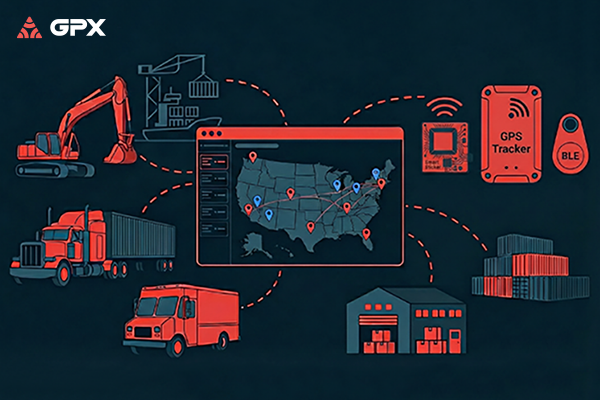
GPX runs an AI-powered asset tracking platform built for industrial and commercial operations. It moves past simple location pings to deliver predictive insights and operational intelligence, and it manages powered and non-powered assets on one screen. The flagship AssetTag Pro is a self-contained tracker for equipment, trailers, and containers. It delivers a multi-year sealed battery and reports position 20 to 30 times a day across GPX’s gateway-less terrestrial network, so large deployments run without SIM cards or dedicated gateways. Built-in sensors track temperature, humidity, and shock, giving you a full read on asset health and condition.
- Location: USA
- Best for: Scalable tracking of mixed-asset fleets, especially non-powered equipment, tools, and returnable containers.
- Pricing: Hardware is free with a subscription, starting at $45/year per device.
- Connectivity: A gateway-less terrestrial network with BLE for infrastructure-light sites, no SIM and no cellular fees.
- Standout features: AI-driven predictive ETAs, utilization monitoring, geofence alerts, impact and temperature sensing, and sealed, multi-year-battery asset tags.
Pros
- One platform covers every asset type, from heavy equipment to small tools.
- Scout AI turns raw data into prescriptive insights that lift utilization and flag issues early.
- Free hardware plus a low annual subscription cuts upfront capital costs.
- Sealed long-life batteries run for years without a maintenance cycle.
- Condition sensors add value past location, protecting sensitive cargo and equipment.
- A full portfolio of equipment tracking hardware matches the right device to every asset, including returnable container tracking for reusable assets.
2. Logistimatics
Logistimatics is GPX’s consumer and small-business sibling brand. It focuses on straightforward, affordable GPS tracking for individuals and SMBs. The mobile app and web interface stay simple, so users get running fast without complex onboarding. The lineup includes small battery-powered magnetic trackers and hardwired units for personal vehicles, light equipment, and valuables.
- Location: USA
- Best for: Individuals, families, and small businesses that need simple, affordable real-time tracking.
- Pricing: Hardware sold separately; monthly plans start around $15/month with no contract.
- Connectivity: 4G cellular across North America.
- Standout features: Easy mobile app, live audio on select devices, and flexible pay-as-you-go service.
Pros
- Fast to set up and simple to use, even for non-technical users.
- Affordable hardware and flexible monthly plans with no long-term contract.
- Responsive support focused on core real-time tracking.
Cons
- Lacks the advanced analytics, reporting, and integrations large enterprises need.
- Not built to manage large, mixed fleets of industrial equipment.
- Features center on location and basic alerts, not deep utilization or maintenance insight.
3. Samsara
Samsara is a major name in connected operations, best known for its platform for large on-road vehicle fleets. It combines real-time GPS tracking, AI dash cameras, ELD compliance, and driver-safety workflows in one system. The modern software and rugged hardware give fleet managers deep visibility into vehicles and drivers, with a strong focus on safety and efficiency.
- Location: San Francisco, CA, USA
- Best for: Large on-road vehicle fleets focused on ELD compliance, driver safety, and AI dash cameras.
- Connectivity: Cellular.
- Standout features: AI dash cameras, ELD and HOS compliance, driver-safety scorecards, and fuel and energy monitoring.
Pros
- Extensive, modern software interface that reviewers rate highly.
- Best-in-class for vehicle fleet management, especially large over-the-road fleets.
- Strong driver-safety focus with AI analytics and coaching tools.
- Hardware built to withstand harsh operating conditions.
Cons
- Pricing is not public and requires a custom quote.
- Requires a minimum 3-year contract, with the full balance due on early termination.
- Focused on vehicles and drivers more than heavy equipment or non-powered assets.
- Hardware options for construction equipment are limited next to specialized providers.
4. Tenna
Tenna built its equipment tracking platform specifically for construction. It unifies a mixed fleet on one screen, from heavy iron and on-road vehicles down to small tools and attachments. Tenna delivers deep utilization and maintenance analytics, so contractors know which machines sit idle, when service is due by engine hours, and where every asset sits across job sites. It also integrates with popular construction management software.
- Location: New Hope, PA, USA
- Best for: Mixed construction fleets, from heavy equipment and vehicles down to small tools and attachments.
- Connectivity: GPS, Bluetooth, and QR codes.
- Standout features: Unified mixed-fleet platform, utilization analytics, maintenance scheduling, and Procore and Viewpoint integrations.
Pros
- Purpose-built for the construction industry.
- Praised for strong customer service and hands-on support.
- Field staff find the mobile app easy to use.
- Wide range of hardware trackers for different asset types.
Cons
- Pricing is not published and is quoted by asset count.
- Implementation can run several weeks.
- Some users report device reliability and connectivity issues in the field.
- The breadth of features overwhelms teams that only need basic GPS tracking.
5. Verizon Connect
Verizon Connect runs a scalable fleet management platform backed by its national network. It is known for high-frequency data updates that give dispatch and field-service teams near-real-time visibility. The platform covers GPS tracking, AI dashcams, field service management, and asset tracking for trailers and equipment. It is a solid all-in-one choice from an established provider.
- Location: Atlanta, GA, USA
- Best for: Large, scalable fleet management for companies that need high-frequency data and broad reporting.
- Connectivity: Cellular.
- Standout features: Real-time GPS fleet tracking with high-frequency updates, AI dashcams, field service and dispatch, and ELD compliance.
Pros
- Highly scalable for large, enterprise-level fleets.
- Broad feature set beyond tracking, including dispatch and scheduling.
- High-frequency updates deliver a true real-time view of operations.
- Backed by Verizon’s reliability and support infrastructure.
Cons
- Pricing is not public and requires a custom quote.
- Customers typically sign 36-month contracts with early-cancellation penalties.
- The desktop interface feels more dated than some competitors.
- Costs climb with hardware and feature add-ons.
6. Motive
Motive, formerly KeepTruckin, built its name on an easy ELD compliance tool for trucking. It has since grown into a broader fleet platform with AI smart dashcams, real-time GPS tracking, and a corporate card for spend management. Fleets often weigh Motive against Samsara for its intuitive app and more flexible contract terms.
- Location: San Francisco, CA, USA
- Best for: Trucking and logistics companies focused on ELD compliance, driver safety, and integrated operations.
- Pricing: Starts around $25 per vehicle/month (estimated).
- Connectivity: Cellular.
- Standout features: FMCSA-registered ELD, AI smart dashcams, IFTA fuel-tax automation, and a corporate spend card.
Pros
- Highly rated for an easy-to-use interface and mobile app.
- Often more competitive pricing and flexible terms, including 1-year options.
- The AI Omnicam adds 360-degree camera coverage for safety and visibility.
Cons
- Official pricing is not public and requires a custom quote.
- Some users report weaker support after the initial sale.
- Auto-renewal clauses have drawn customer complaints.
- Primarily built for trucking and compliance, so it fits heavy construction equipment less well.
7. Trackunit
Trackunit is a global company focused on off-highway equipment telematics, aimed at OEMs and mixed-fleet rental companies. Its platform collects and standardizes data across many machine makes and models using the AEMP 2.0 standard. Deep CAN bus access delivers detailed insight into machine health, usage, and maintenance needs. It also adds keypad access control for security and Bluetooth tracking for smaller attachments.
- Location: Aalborg, Denmark
- Best for: OEMs and mixed-fleet rental companies that need strong connectivity and machine data across many machine types.
- Connectivity: GPS, Bluetooth, CAN bus.
- Standout features: OEM integrations (AEMP 2.0), CAN bus machine-health data, keypad access control, and predictive analytics.
Pros
- Excellent at connecting mixed fleets and standardizing data across machine brands.
- Deep insight into machine usage, idle time, and operating hours.
- Forward-thinking company that keeps shipping new industry solutions.
- Strong fit for monitoring machines at global scale.
Cons
- Some users report the hardware drains machine batteries when equipment sits unused for several days.
- Support draws mixed reviews, with some users citing slow response times.
- The volume of data gets complex and costly to turn into custom, actionable output.
- Some users report data inaccuracy and tracking updates that lag.
8. Teletrac Navman
Teletrac Navman offers a fleet and asset management platform for enterprise fleets, with a strong emphasis on compliance, safety, and maintenance. It fits regulated industries like construction and transportation, with integrated ELD, HOS, and DVIR. Advanced vehicle maintenance and diagnostics help fleets stay ahead of repairs. AI-powered cameras handle driver monitoring, and second-by-second GPS updates give an accurate, real-time view of fleet activity.
- Location: Northbrook, IL, USA
- Best for: Enterprise fleets in regulated industries that need strong compliance, maintenance, and driver-safety tools.
- Connectivity: Cellular.
- Standout features: Integrated ELD, HOS, and DVIR; advanced vehicle maintenance and diagnostics; AI cameras; second-by-second GPS updates.
Pros
- Strong compliance and regulatory readiness for DOT-regulated fleets.
- Granular vehicle maintenance and diagnostic tools.
- AI insights and natural-language search make data easier to reach.
- Unified view of vehicles, equipment, and drivers on one platform.
Cons
- Pricing is not public and requires a custom quote.
- The interface feels less intuitive than newer competitors.
- Customer service draws mixed reviews.
- The system runs complex, and some users want a better mobile app.
How to Choose the Right Equipment Tracking Software
The best equipment tracking software depends on your operation. A platform built for long-haul trucking rarely fits a construction firm running a mixed fleet of non-powered assets. Weigh these five factors before you commit.
- Asset Type and Mix: Decide whether you track powered vehicles, non-powered gear like trailers and containers, or small tools. Pick a provider with a full hardware range (hardwired, battery-powered, Bluetooth tags) and one platform to manage it all. GPX targets exactly these mixed-asset environments.
- Core Business Problem: Pin down your main goal: cut theft, raise utilization, automate maintenance, or ensure compliance. Match the platform’s strengths to that goal. For ELD compliance, a vehicle-first platform like Motive or Samsara fits best. To cut theft and boost utilization on non-powered assets, long-life battery trackers win.
- Total Cost of Ownership: Look past the monthly fee. Add up hardware, installation, contract length, and early-termination penalties. GPX bundles free hardware to lower the upfront spend and shift cost to a predictable operating expense.
- Data and Integration Needs: Decide whether you need basic location data or deeper insight from engine hours, sensor readings, and utilization reports. Confirm the software connects to your ERP, project management, and accounting systems through a solid asset tracking API and pre-built integrations.
- Scalability and Support: Pick a platform that grows with you. Check the provider’s support reputation and onboarding process. A complex setup delays your time-to-value, and weak support turns a small issue into a big one.
Map your requirements to each provider’s strengths, and you move from repeat operational failures to predictable performance built on real data. Modern operations teams treat tracking as an intelligence layer, not a status page.
Ready to see how an AI-powered platform delivers total visibility over your equipment? Get started with GPX and turn your asset data into decisions.
Frequently Asked Questions (FAQs)
How does AI asset tracking differ from traditional GPS?
Traditional GPS tells you where an asset is: a dot on a map. AI-powered asset tracking goes further, analyzing location data, sensor inputs, and historical trends to deliver predictive and prescriptive insight. It predicts arrival times, flags underutilized assets, and warns you about theft or maintenance needs before they become problems.
What is the typical cost for equipment tracking software?
Pricing models vary widely. Some charge a monthly fee per device plus upfront hardware. Others, like GPX, bundle the hardware free with an annual subscription that starts at $45 per year per device. Enterprise platforms like Samsara or Verizon Connect require a custom quote and long-term contracts.
What happens if an asset tracker loses cellular signal?
Cellular-only trackers go dark in dead zones, warehouses, and remote yards. GPX uses multi-network connectivity across BLE, cellular, GPS, and satellite, so an asset stays visible even when one network drops. BLE gateways and satellite fallback keep location data flowing where single-network competitors lose the signal.
Can I track both powered and non-powered assets on one platform?
Yes. The most versatile equipment tracking platforms handle mixed fleets. They offer hardwired units that draw power from an engine plus long-life battery trackers for trailers, containers, and tools. You see every asset in one unified view.
What kind of return on investment can I expect?
Strong ROI comes from several places: less theft and equipment loss, lower insurance premiums, better utilization that cuts rental costs, and lower maintenance costs from proactive servicing. Many companies reach a positive ROI within the first year by preventing the loss of just one or two valuable assets.