

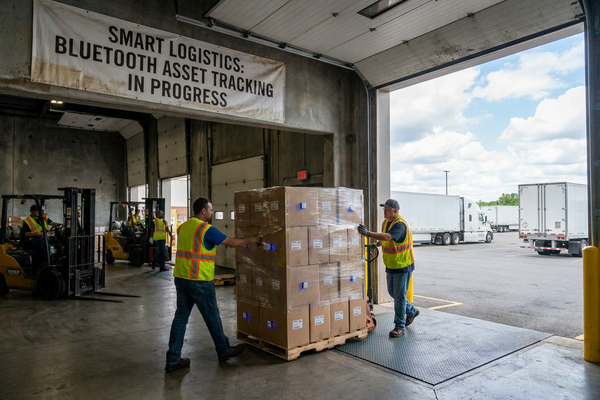
Knowing where your assets are, and what shape they’re in, is a daily operational problem. Tools wander off job sites. Returnable containers vanish into the supply chain. Every blind spot costs you time and money.
Cargo theft alone costs U.S. businesses an estimated up to $35 billion a year. Disruptions long enough to matter now strike the average company every 3.7 years and erase the equivalent of 45% of one year’s profits over a decade. For years, closing that gap meant expensive GPS hardware or a costly grid of fixed gateways.
Bluetooth Low Energy (BLE) changed that. It locates assets indoors and out at low cost and low power, with no fixed infrastructure to install. BLE rewrote the economics of enterprise-wide visibility.
| Technology | Typical Range | Power Use | Infrastructure Needs | Best For |
|---|---|---|---|---|
| GPX Multi-Sensor | Global (fused) | Years (mode-dependent) | None to Minimal | Total operational visibility |
| Bluetooth Low Energy (BLE) | 10-100 meters | Very Low (Years) | Minimal (Mobile Network) | Low-cost, high-volume assets |
| GPS | Global | High | None (Satellite) | Outdoor vehicle and high-value assets |
| Active RFID | Up to 100 meters | Medium (Months-Years) | High (Readers/Chokepoints) | Real-time chokepoint monitoring |
| Passive RFID | Up to 10 meters | None (Passive) | Very High (Readers) | High-speed, bulk inventory scanning |
| Wi-Fi Positioning | 50-150 meters | High | High (Access Points) | Using existing Wi-Fi indoors |
What is Bluetooth Low Energy (BLE) and Why Is It Ideal for Asset Tracking?
Bluetooth Low Energy, or BLE, is a wireless protocol built for short-range communication on minimal power. It shares the Bluetooth name but differs from the “Classic” Bluetooth in your headset. BLE sends small data packets at intervals, so a coin-cell battery powers a tag for years.
That efficiency makes BLE the right fit for large-scale tracking. Tags are small, light, and cheap enough to deploy across thousands of assets, from power tools to shipping containers. GPS trackers need frequent recharging. BLE tags run for years, which cuts maintenance and total cost of ownership.
Gateway-less Tracking: How BLE Finds Assets Without Fixed Infrastructure
Older Bluetooth systems depended on fixed gateways. You had to install, power, and connect this hardware across a facility or yard. It was expensive and inflexible. An asset that moved out of reader range simply disappeared.
Modern bluetooth asset tracking platforms drop the dedicated gateways entirely. The BLE tag was never the problem. It just needed a wide, mobile network to hear it. So this model swaps fixed hardware for a distributed network of scanning devices, including:
- Smartphones running a simple app, carried by drivers and employees.
- GPX multi-sensor trackers mounted in vehicles, forklifts, and other mobile equipment.
- Partner network devices already moving through the global supply chain.
When a mobile scanner passes a BLE-tagged asset, it relays the tag’s ID and its own location to the platform, securely and anonymously. That builds a crowdsourced network with location updates from almost anywhere: a warehouse, a customer site, or a highway in transit. This is the core of a gateway-less BLE asset tracking system.
How BLE Asset Tracking Works: A Step-by-Step Breakdown
Locating an asset with BLE is simple and reliable. It runs automatically in the background through a few clear steps.
Step 1: Tagging the Asset
Attach a small, battery-powered BLE tag to the asset you want to monitor. Screw it on, stick it with adhesive, or drop it inside a container. Each tag broadcasts its own unique identifier.
Step 2: The Broadcast Signal (Advertising)
Once active, the tag transmits a small “advertising packet” at set intervals, often once a second. The packet carries the tag’s unique ID and little else. That minimalism is why the battery lasts up to 5 to 10 years.
Step 3: Signal Detection and Data Relay
A nearby BLE device acts as a scanner and detects the packet. In a gateway-less system, that scanner is mobile: a phone in a worker’s pocket or a GPS/BLE tracker on a truck. It records the tag’s ID, the signal strength (RSSI), and its own GPS coordinates.
Step 4: Data Processing in the Cloud
The scanner sends the packet, tag ID plus scanner location, timestamp, and signal strength, to a secure cloud platform. The software turns the scanner’s GPS coordinates into the asset’s last-known location. Signal strength (RSSI) gauges proximity, so you know if you’re close or far when hunting for an item.
Step 5: Visualization and Insights
The platform delivers the data through a web or mobile app. Managers see every tagged asset’s last-known location on one map. GPX goes further. It triggers geofence alerts, builds inventory reports, and analyzes utilization and dwell time.
Can BLE Track Assets Both Indoors and Outdoors?
A modern bluetooth asset tracking system works across environments that defeat single-technology tools like GPS.
Indoor Positioning Systems (IPS)
Roofs and walls block GPS, so it fails indoors. BLE thrives there. Mobile scanners like phones and forklifts, or a handful of low-cost fixed scanners, map indoor locations accurately. That means finding equipment fast in a warehouse, locating devices in a hospital, or tracking work in progress on a factory floor.
Outdoor and In-Transit Visibility
Outdoors, the gateway-less model delivers. Mobile scanners in trucks and service vehicles detect tagged assets as they move. Now you can track assets that never justified their own GPS tracker, like returnable pallets, totes, and containers. Confirm a shipment arrived at a customer site, or find equipment left on a job.
Where GPS Battery Life and RFID Cost Break Down
Companies adopt asset tracking to solve costly operational problems. A well-built BLE system tackles the most common ones head-on.
- High battery drain: GPS trackers need large batteries and frequent charging, which rules them out for many assets. BLE tags run for years on one coin cell and cut maintenance labor sharply.
- Heavy infrastructure cost: Active RFID and Wi-Fi tracking demand a dense, pricey network of readers or access points. A gateway-less BLE system removes that capital expense and install complexity.
- No indoor visibility: GPS fails indoors and leaves a blind spot across warehouses, plants, and distribution centers. BLE returns accurate location data inside any structure.
- Tag size and cost: Bulky, costly trackers only make sense on top-value assets. Cheap, compact BLE tags and disposable trackers like GPX’s Smart Labels make tracking almost anything affordable, down to granular inventory.
- Integration with core systems: Tracking data trapped in a silo helps no one. A platform-agnostic system feeds live location into your ERP, EAM, WMS, and TMS, so asset data reaches the tools your teams already run.
- Scaling without re-architecting: Pilots that work for 200 assets often break at 20,000. A gateway-less model scales on a network that already exists, so growing from hundreds to tens of thousands of tags adds no new infrastructure.
- Data security from tag to cloud: Location data is sensitive. A SOC 2 compliant platform encrypts the signal from tag to cloud and relays tag IDs anonymously, which clears the bar IT and security stakeholders set.
- Mass deployment logistics: Tagging thousands of assets sounds daunting. Peel-and-stick Smart Labels and quick-mount tags cut provisioning to minutes per asset, and a gateway-less network means no readers to install first.
The Future of Asset Tracking: AI, Sensor Fusion, and BLE
Location alone isn’t enough. You need an asset’s condition, status, and context. BLE anchors a broader multi-sensor approach. Advanced trackers fuse BLE with GPS, accelerometers for motion, and sensors for temperature, humidity, and light.
All that data is where AI like GPX’s Scout AI earns its keep. It analyzes sensor data to move past dots on a map. It forecasts arrival times, flags assets at risk of being left behind, and catches temperature excursions in a cold chain. That shift from reactive lookups to proactive intelligence is how leading companies turn visibility into advantage.
Narrowing Down to BLE, GPS, or RFID
The right solution depends on your operations and your assets. One size rarely fits all. Weigh these factors before you invest:
- Asset environment: Will the asset sit indoors, outdoors, or move in transit? If it spans all three, you need a multi-sensor platform that pairs GPS and BLE.
- Required precision: Do you need the exact room (high precision), or just the facility (zonal precision)?
- Asset volume and value: For high-volume, lower-value assets like pallets and totes, low-cost BLE tags are the only viable option. For high-value machines or vehicles, a GPS/BLE combo tracker adds security and data.
- Power availability: Does the asset supply power, or does it need a battery tracker? BLE gives unpowered assets the longest life.
The most future-proof choice is a platform that ingests data from many sensor types. You match the right tracker to each asset and manage it all in one interface.
Ready to see how gateway-less BLE and AI-powered intelligence reshape your operations? Talk to our team and move beyond dots on a map toward total asset visibility.
Frequently Asked Questions (FAQs)
What is the typical cost and ROI for a BLE asset tracking system?
Cost depends on asset volume and tracker type. GPX Smart Labels start as low as $13 per label, well below traditional GPS hardware. Because one platform tracks both high-volume and high-value assets, returns climb as you tag more of your operation: fewer lost containers, less time spent searching, and lower replacement spend.
How is BLE different from RFID for asset tracking?
RFID is a bulk-scanning technology for inventory counts at fixed chokepoints, and it needs expensive, powerful readers. BLE is real-time location tracking. It uses low-cost tags and a distributed scanner network for continuous visibility across a wide area, not just at gates and doorways.
Do I need to install special gateways for BLE tracking to work?
No. With GPX, you install no fixed gateways. The system uses a mobile network of smartphones and GPS devices as a gateway on the move, which cuts cost and complexity while widening coverage.
How does gateway-less BLE compare to traditional fixed-gateway BLE systems?
Traditional BLE needs fixed gateways installed, powered, and wired across every facility, so coverage stops where the readers stop. Gateway-less BLE replaces that hardware with a mobile network of smartphones and GPS-equipped vehicles already in motion. You get wider coverage, no capital install cost, and visibility that follows your assets beyond your own walls.
How long do the batteries in BLE tags last?
BLE tag batteries typically last 3 to 10 years. The low-power protocol drives that lifespan. You deploy the tag and move on, with little maintenance for charging or replacement.
How costly are supply chain blind spots for U.S. businesses?
Cargo theft and supply-chain disruptions cost U.S. businesses an estimated $15 billion to $35 billion a year. Significant disruptions strike the average company every 3.7 years and erase the equivalent of 45 percent of one year’s profits over a decade.
Why does BLE outperform GPS for indoor asset tracking?
GPS hardware is expensive and satellite signals struggle indoors. BLE locates assets indoors and outdoors at low cost and low power with no fixed infrastructure to install, which rewrote the economics of enterprise-wide asset visibility.