

On a modern plant floor, the most expensive question is often the simplest one: where is it? Where is the work-in-process pallet that the next station has been waiting on for two hours? Where is the forklift, the returnable rack, the calibration cart, the trailer of finished goods that was supposed to leave the yard at noon? When those answers live in a foreman’s head or on a clipboard, the cost shows up everywhere except the line where the part went missing.
The numbers are sobering. Unplanned downtime now costs industrial manufacturers an average of roughly $260,000 per hour, and for tightly coupled automotive plants that figure can climb past $2 million per hour. Siemens estimates that the world’s 500 largest companies collectively lose close to $1.4 trillion a year to unplanned stoppages, equal to about 11 percent of revenue. A meaningful slice of that loss is not broken machinery at all. It is poor visibility: the part that could not be found, the asset that was bought twice because nobody could locate the first one, the trailer that sat in the wrong yard slot for a day.
This is where GPS tracking and asset intelligence earn their keep. The right platform turns a fleet of forklifts, a sea of returnable containers, and a stream of in-transit shipments into a live map you can act on, not a spreadsheet you reconcile after the fact. In a modern Industry 4.0 operation, that visibility is the foundation for everything from predictive maintenance to true end-to-end supply chain visibility. Below are the top 7 GPS tracking solutions for manufacturing in 2026, what each one does best, and how to choose the one that fits your operation.
Key Takeaways
- Visibility is the hidden cost center. A large share of the roughly $260,000-per-hour cost of unplanned downtime traces not to broken machines but to assets that cannot be found, including spares, tools, work-in-process (WIP), and returnable containers.
- No single technology wins. GPS covers the yard and the road, while Real-Time Location Systems (RTLS) using BLE, UWB, and RFID handle indoor positioning. The strongest manufacturing deployments blend both under one platform.
- GPX Intelligence leads for whole-operation tracking. It combines GPS, BLE, and condition sensors with Scout AI and low-cost Smart Labels, covering vehicles, plant-floor assets, returnable assets, and in-transit goods in a single system, with Smart Labels starting around $4 per month.
The ROI of Supply Chain Visibility: How Poor Asset Tracking Drains Manufacturing Margins
Before comparing platforms, it helps to name the pain points that GPS and asset tracking solve. Most manufacturers feel these costs without ever assigning them to a line item, which is exactly why they persist year after year.
- Downtime that traces back to missing assets: Equipment failure drives about 42 percent of unplanned downtime, but a hidden multiplier is the time spent locating the spare, the cart, or the tool needed to make the repair. A two-hour fix becomes a two-day shutdown when the right part cannot be found.
- Duplicate purchasing: When teams cannot see what they already own, they reorder it. Organizations with real-time inventory visibility report a 25 to 30 percent reduction in duplicate and unnecessary tool purchases, money that was being spent purely because of blind spots.
- Lost work-in-process (WIP): On a large floor, partially finished goods get staged, moved, and misplaced. Every hour a WIP unit is unaccounted for is an hour of stalled throughput and unreliable scheduling.
- Returnable asset shrinkage: Reusable totes, racks, gaylords, and dunnage walk off site or vanish into a customer’s facility. Replacing them is a recurring tax on the operation that most plants underestimate.
- Yard and in-transit blind spots: Trailers sit in the wrong slot, shipments stall between dock and customer, and detention fees pile up because nobody can confirm where the load actually is.
- Forklift and powered-equipment misallocation: Plants do not just lose pallets, they misuse forklifts and powered carts. Without shop-floor location mapping, lift trucks cluster in some aisles and starve others, creating traffic bottlenecks, idle operators, and safety incidents where pedestrians and vehicles cross paths. Knowing where every lift is in real time smooths flow and reduces near-misses.
- Cold chain and environmental spoilage: For chemical, pharmaceutical, and food manufacturers, the threat is not only where an asset is but the condition it is in. A temperature or humidity excursion during transit can spoil an entire batch, and without condition monitoring the loss is only discovered when the customer rejects the shipment. Tracking that pairs location with environmental sensors catches the excursion while there is still time to act.
- Compliance and audit drag: Manual asset audits eat days of labor and still produce errors. Auditors, insurers, and quality systems all want a verifiable record of where regulated or high-value equipment has been.
The throughline is simple. Visibility is not a nice-to-have dashboard. It is the difference between reacting to problems after they cost money and catching them while they are still cheap to fix.
7 Essential Features of an AI-Driven Manufacturing Asset Tracking Platform (2026)
GPS tracking for a long-haul fleet and asset tracking for a plant floor are related but not identical problems. The best manufacturing solutions handle both the outdoor and indoor sides of the operation. As you evaluate vendors, weigh these seven criteria:
- Indoor and outdoor coverage: GPS works in the yard and on the road, but it does not work inside a steel-framed building. Look for platforms that pair GPS with Bluetooth Low Energy (BLE) or a Real-Time Location System (RTLS) so you can follow an asset from the loading dock to the back of the plant, a capability often described as an Indoor Positioning System (IPS).
- The right hardware for each asset class: A trailer, a calibration tool, a returnable tote, and a temperature-sensitive batch each need a different tracker. Disposable adhesive labels, rugged battery tags, hardwired devices, and environmental sensors should all live under one platform.
- Battery life and total cost of ownership: Swapping batteries across thousands of tags is real labor. Multi-year battery life, replaceable cells, and low per-unit hardware cost keep the program affordable as you scale.
- Real-time alerts and geofencing: Movement, geofence breaches, temperature excursions, and unexpected dwell times should trigger alerts automatically, not require someone to be staring at a screen.
- AI-driven analytics and predictive maintenance: The most modern platforms let you query tracking data in plain language and surface utilization, idle time, and loss patterns without a data analyst in the loop. The same usage data feeds predictive maintenance, turning passive location history into a forecast of which assets need service before they fail.
- Integration with existing systems: Tracking data is most powerful when it flows into your ERP, MES, TMS, or maintenance system (CMMS/EAM) through clean APIs rather than living in a silo. The tracker captures the location; the platform you already run turns it into a work order, a maintenance trigger, or an audit record.
- Scalability and connectivity: Multi-network cellular and flexible gateway options keep coverage reliable across sprawling campuses and multiple sites.
A useful rule of thumb when deciding what to tag first: prioritize any mobile asset valued at roughly $5,000 or more, plus any returnable item you replace on a recurring basis. Those are the assets where loss, idle time, and duplicate purchasing quietly add up to the largest recoverable savings.
Comparison Table: Top 7 GPS Tracking Solutions for Manufacturing at a Glance
Here is a side-by-side view of how the leading platforms stack up across the criteria that matter most to manufacturers. The table scrolls horizontally on mobile.
| Solution | Best For | Tracking Type | Connectivity | Standout Strength | Starting Price |
|---|---|---|---|---|---|
| GPX Intelligence | Universal asset and fleet tracking | GPS + BLE + sensors | Multi-network cellular + BLE | AI-powered tracking with Scout AI | From ~$4/month |
| Samsara | Connected fleet and equipment operations | GPS + telematics | 4G/5G cellular | Equipment monitoring and safety cameras | Contact for quote |
| Geotab | Large fleet telematics at scale | GPS telematics | Cellular | Open data platform with Ace AI | Contact for quote |
| AirFinder (Link Labs) | Indoor work-in-process visibility | BLE phase-ranging RTLS | BLE + LoRaWAN gateways | Sub-meter indoor location | Contact for quote |
| Zebra Technologies | RFID and RTLS plant visibility | RFID + UWB RTLS | On-prem readers and gateways | Enterprise MotionWorks RTLS | Contact for quote |
| Tive | In-transit shipment tracking | GPS + condition sensors | 5G/cellular + cloud | Real-time location and condition data | Contact for quote |
| Litum | Worker safety and asset RTLS | UWB / BLE RTLS | On-prem RTLS infrastructure | Personnel safety and contact tracing | Contact for quote |
GPS vs. RTLS (RFID, BLE, UWB): Choosing the Best Indoor Positioning System (IPS) for Your Factory Floor
Picking a vendor is only half the decision. Underneath every platform is a tracking technology, and each one trades cost against accuracy against range. There is no single best technology, only the right one for the asset and the question you are answering. The big divide is between GPS, which owns the outdoors, and Real-Time Location Systems (RTLS), the family of indoor technologies that act as an Indoor Positioning System (IPS) where satellite signals drop out. Many of the strongest manufacturing deployments blend two or three. Here is how the main options compare.
- Barcodes and QR codes: Simple, inexpensive, and easy to scale, which is why they remain everywhere. The catch is that they require a manual line-of-sight scan and offer no real-time location, so an asset is only “tracked” the moment someone scans it.
- RFID: Offers broader read range than barcodes and tiny, low-cost tags, making it the workhorse for high-volume item and inventory counts at fixed choke points like dock doors. It still leans on readers at known points rather than delivering continuous, live location across an open floor.
- GPS: The gold standard outdoors and in the yard or on the road, accurate to within a few meters. It does not work reliably inside steel-framed buildings, which is why it pairs naturally with an indoor technology.
- Bluetooth Low Energy (BLE): Affordable, widely standardized, and capable of real-time location to within several feet using fixed beacons. It is the practical sweet spot for tracking large fleets of tools, totes, and WIP units indoors without breaking the budget.
- Ultra-Wideband (UWB): The most precise option, accurate to within inches, with strong resistance to interference. The trade-off is higher cost and more infrastructure, so it is best reserved for high-value assets and processes that genuinely need pinpoint accuracy.
| Technology | Real-Time Location | Typical Accuracy | Relative Cost | Best Fit |
|---|---|---|---|---|
| Barcode / QR | No (manual scan) | Scan point only | Lowest | Low-cost, scan-based inventory |
| RFID | Near read points | Zone-level | Low to moderate | High-volume item counts at gates |
| GPS | Yes (outdoor) | Within a few meters | Moderate | Yard, fleet, and in-transit assets |
| BLE | Yes (indoor) | Within several feet | Low to moderate | Tools, totes, and WIP at scale |
| UWB | Yes (indoor) | Within inches | Highest | High-value, precision-critical assets |
This is exactly why a multi-technology platform matters. A manufacturer that standardizes on GPS plus BLE under one system can follow an asset from the highway into the yard and onto the plant floor without changing vendors or dashboards, and add UWB or RFID only where the precision is worth the cost. Unified location data is also what feeds a digital twin of the operation, the live virtual model of your floor that Industry 4.0 leaders use to simulate flow and spot bottlenecks before they happen.
1. GPX Intelligence: AI-Powered Asset Tracking Built for the Whole Operation
GPX Intelligence earns the top spot because it solves the manufacturer’s real problem, which is rarely just one asset class. Most plants need to track vehicles in the yard, returnable containers between sites, tools and carts inside the building, and temperature-sensitive batches in transit, all at once. GPX brings every one of those under a single AI-powered platform rather than forcing you to stitch together three vendors.
The hardware breadth is the differentiator. GPX offers a deep lineup of form factors so each asset gets the tracker it actually needs:
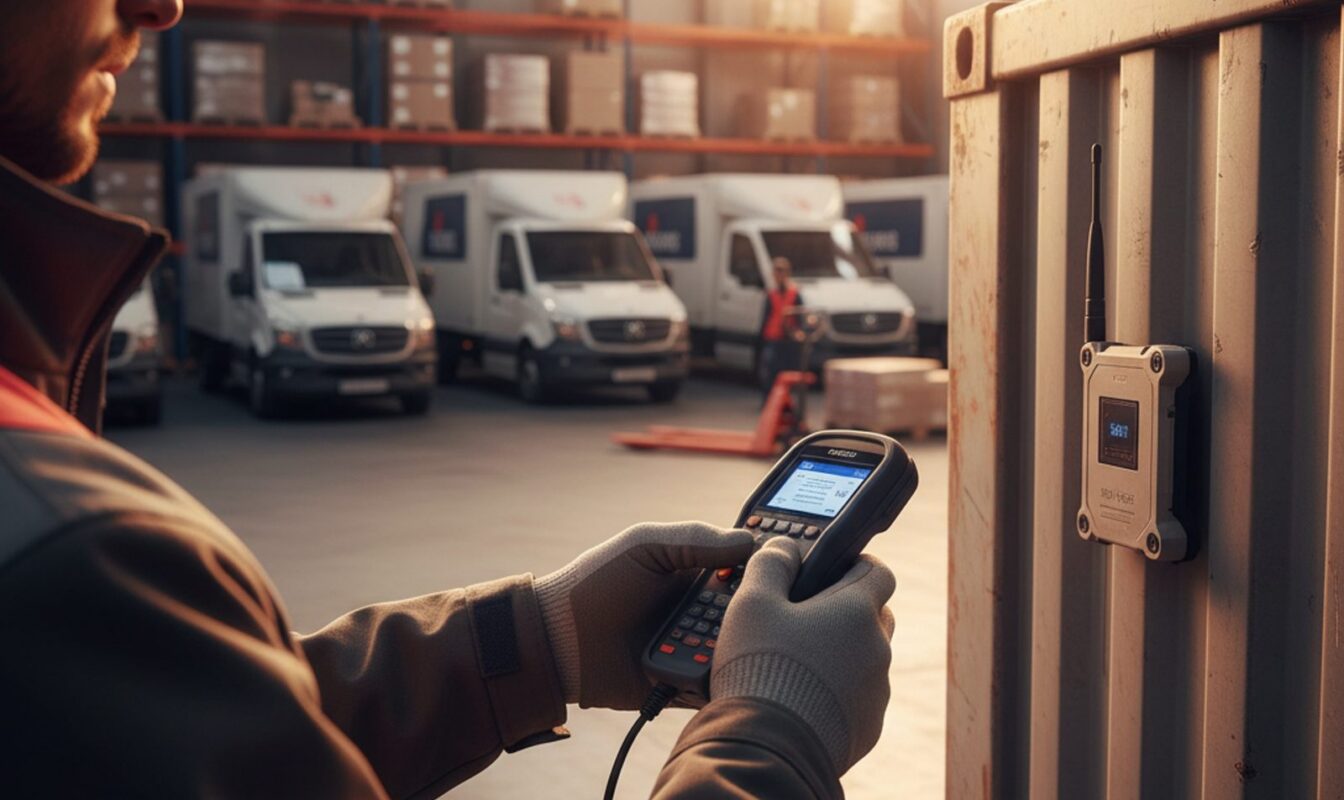
- Smart Labels: peel-and-stick BLE trackers thin enough to apply like a shipping label, ideal for returnable totes, cartons, and WIP units where a bulky device is impractical and a low per-unit cost matters.
- GPX AssetTag: a rugged BLE tag with a replaceable cell and a 4-year battery life, built for long-term tracking of tools, racks, and durable plant-floor assets without constant maintenance.
- GPS trackers and hardwired devices: for forklifts, yard trucks, trailers, and powered equipment that need continuous outdoor location.
- Environmental sensors: for temperature, humidity, and shock monitoring on sensitive materials and finished goods.
Tying it together is Scout AI, GPX’s built-in analyst that lets a plant manager ask questions in plain language, such as which assets sat idle last week or which trailers breached a geofence, and get answers without writing a query or pulling a report. Multi-network cellular plus BLE keeps coverage reliable across large campuses and the gaps where a single carrier would drop out.
Two capabilities make GPX especially strong for manufacturers and OEMs. The first is closed-loop asset management. Returnable containers, racks, and dunnage that cycle between your plant and your suppliers or customers are notoriously hard to keep accountable, and replacing them is a recurring cost. GPX tracks these reusable assets across the full shipping loop, cutting cycle times and shrinkage by making every container’s location and dwell time visible. The second is environmental monitoring: pairing Bluetooth sensors with the trackers lets GPX flag temperature, humidity, or shock events that could damage sensitive parts in transit, so a quality problem surfaces before the goods reach a customer.
On the practical side, GPX is built for fast adoption. Devices install quickly, including on older equipment through wired and battery-powered options, and the platform integrates with the ERP, TMS, and maintenance systems you already run so tracking data becomes work orders and audit records rather than a separate silo. Beyond location, the trackers capture operating data like engine hours, idle time, and usage that feeds predictive maintenance and supports labor and compliance recordkeeping.
Best for: Manufacturers that want one platform for mixed assets, vehicles, returnable containers, and in-transit goods, with affordable hardware and AI-driven analytics. With Smart Labels starting around $4 per month in service terms, GPX is also one of the most cost-effective ways to put visibility on thousands of low-value, high-volume assets. You can get started with GPX to scope a pilot for your floor.
2. Samsara: Connected Operations and Equipment Monitoring
Samsara is a strong choice for manufacturers whose biggest exposure is powered equipment and vehicle fleets. Its connected operations cloud combines GPS telematics, equipment monitoring, and AI dash cameras, giving operations leaders a unified view of vehicle health, driver safety, and powered-asset utilization.
Where Samsara shines is the heavy, mobile, engine-driven side of a manufacturing operation: yard trucks, generators, reach stackers, and over-the-road fleets. Sensor integrations surface engine diagnostics and runtime hours that feed directly into predictive maintenance programs.
- Best for: Plants with significant powered-equipment and fleet exposure that want telematics and safety in one system.
- Watch-out: Coverage is built around cellular and powered assets, so tracking large volumes of small, passive items like returnable totes is less of a natural fit.
3. Geotab: Open Telematics at Enterprise Scale
Geotab is one of the most established names in commercial telematics, and its strength is data openness. The platform ingests a wide range of vehicle and engine data and exposes it through a marketplace of integrations, which makes it appealing to large manufacturers that already run analytics teams and want to fold fleet data into their own systems.
Geotab’s Ace AI assistant adds natural-language querying on top of the telematics data, and the open architecture means you are not locked into a single hardware path. For a manufacturer running hundreds of vehicles across multiple sites, that flexibility is meaningful.
- Best for: Large, multi-site fleets that prioritize open data and deep integration over plug-and-play simplicity.
- Watch-out: The platform is fleet-and-vehicle centric, so indoor asset and WIP tracking typically requires pairing it with another system.
4. AirFinder by Link Labs: Indoor Visibility for Work-in-Process
When the question is “where is it inside the building,” GPS alone cannot answer it, and that is exactly the gap AirFinder fills. Link Labs uses BLE phase-ranging RTLS to deliver sub-meter indoor location, which is precise enough to tell you which station or aisle a WIP unit is sitting in, not just which building.
For manufacturers fighting WIP loss, bottlenecks, and the daily hunt for staged materials, this indoor precision is the core value. The system uses fixed location beacons and gateways to triangulate tag positions across the floor, and its OnSite product tracks assets through the full production cycle: raw materials, equipment and tools, work-in-process, and finished goods. Link Labs also offers a proprietary Xtreme Low Energy (XLE) mode that pushes tag battery life up to around seven years even with frequent updates, which keeps maintenance low on large deployments.
- Best for: Operations focused on indoor WIP visibility and granular plant-floor location accuracy.
- Watch-out: RTLS requires installing and maintaining fixed infrastructure, and the indoor focus means outdoor and in-transit tracking need a complementary solution.
5. Zebra Technologies: RFID and RTLS Plant-Floor Intelligence
Zebra is the heavyweight in RFID and enterprise RTLS, and for high-volume discrete manufacturing it remains a default consideration. Its MotionWorks platform combines passive and active RFID with ultra-wideband (UWB) RTLS to track everything from individual components moving through assembly to high-value tooling.
The strength here is throughput and ecosystem depth. Zebra’s readers, printers, and handhelds are ubiquitous, and the platform is built for environments where thousands of items per hour need to be read accurately at choke points like dock doors and assembly gates.
- Best for: High-volume manufacturers that need RFID-grade item tracking and a mature hardware ecosystem.
- Watch-out: A full RFID and UWB deployment is an infrastructure-heavy, capital-intensive project better suited to large operations than lean ones.
6. Tive: Real-Time In-Transit Shipment and Condition Tracking
For manufacturers, the asset risk does not stop at the dock door. Tive specializes in real-time in-transit visibility, combining GPS location with condition sensors for temperature, humidity, shock, and light. That makes it a fit for plants shipping sensitive, high-value, or regulated goods where a damaged or delayed load is a costly event.
Tive’s trackers ride along with the shipment and stream location and condition data continuously, so a quality excursion or a stalled load triggers an alert while there is still time to intervene rather than after a customer rejects the delivery.
- Best for: Manufacturers shipping perishable, fragile, or high-value goods that need end-to-end in-transit condition monitoring.
- Watch-out: Tive is purpose-built for the in-transit leg, so on-site asset and yard tracking will rely on a separate platform.
7. Litum: RTLS for Worker Safety and Asset Location
Litum rounds out the list with an RTLS platform that pairs asset tracking with workforce safety, a combination that resonates in heavy and hazardous manufacturing environments. Using UWB and BLE, Litum tracks both equipment and personnel, enabling geofenced safety zones, evacuation mustering, and contact tracing alongside traditional asset location.
For plants where forklift-pedestrian incidents and restricted-zone compliance are top concerns, the safety layer is a genuine differentiator that pure asset trackers do not offer.
- Best for: Industrial environments that need to unify asset tracking with worker safety and zone compliance.
- Watch-out: As an on-premise RTLS system, it is optimized for indoor sites and requires fixed infrastructure to operate.
What Decides the Right Platform for Your Plant
There is no single best platform, only the best fit for your assets, your floor, and your budget. The fastest way to narrow the field is to start with the question you most need answered, then match it to the technology that answers it.
- If you need to find assets inside the building, prioritize indoor RTLS or BLE precision (AirFinder, Zebra, Litum, or GPX with Smart Labels and BLE tags).
- If your exposure is powered equipment and vehicles, lead with telematics (Samsara or Geotab).
- If the risk follows the product out the door, invest in in-transit condition tracking (Tive, or GPX environmental sensors).
- If you need all of the above under one roof, a unified, multi-technology platform avoids the cost and headache of stitching vendors together.
For most manufacturers, the practical answer is breadth plus affordability. You rarely have just one asset problem, and you rarely have an unlimited budget to solve each one with a separate system. That is the case for starting with a platform like GPX Intelligence, which combines GPS, BLE, and sensor tracking, an AI analyst in Scout, and low-cost Smart Labels under a single pane of glass. Begin with one high-pain asset class, prove the return, and expand. The best program is the one you actually deploy, and the cost of staying blind is far higher than the cost of starting small. Ready to map your plant floor? Talk to the GPX team to scope a pilot.
Frequently Asked Questions (FAQs)
What is the difference between GPS tracking and RTLS in manufacturing?
The main difference is that GPS tracking relies on satellites for outdoor visibility across yards and fleets, while RTLS (Real-Time Location System) uses fixed beacons and tags such as BLE, UWB, and RFID for indoor positioning where GPS signals drop. GPS is accurate to within a few meters outdoors; indoor RTLS can reach inches with UWB. Modern manufacturing logistics typically require a hybrid of both for end-to-end supply chain visibility, which is why platforms that combine GPS and indoor tracking are now the standard.
How does asset tracking reduce unplanned downtime?
A large share of downtime cost is not the failure itself but the time spent finding the spare part, tool, or cart needed to fix it. Real-time asset tracking lets technicians locate critical equipment instantly, ensures spares are where they should be, and surfaces utilization data that feeds predictive maintenance. The result is faster repairs and fewer failures that turn into extended shutdowns.
Can I track returnable containers and work-in-process with the same system?
Yes, if you choose a platform with the right hardware range. Low-cost adhesive BLE Smart Labels are well suited to returnable totes, racks, and WIP units, while rugged tags suit durable assets. A unified platform lets you manage all of these asset classes, plus vehicles and in-transit shipments, from a single dashboard rather than separate systems.
What is the typical return on investment for manufacturing asset tracking?
Organizations implementing asset tracking software commonly report first-year ROI in the range of 200 to 500 percent, driven by reduced loss and theft, fewer duplicate purchases, faster audits, better asset utilization, and lower insurance premiums. The most reliable path is to start with one high-cost pain point, measure the savings, and scale from there.