Top 7 Real-Time Inventory Tracking Software, Platforms, and Systems for 2026


Inventory used to be a back-office concern. In 2026, it is a board-level number, and the platforms that keep stock counts honest in the moment have moved from “nice to have” to “non-negotiable.” When a single stockout can lose a customer for life and a single overstock can torpedo a quarter, the gap between businesses that see their inventory in real time and the ones that find out the next morning is the gap between growth and slow decline.
The math is brutal and well-documented. According to IHL Group’s 2025 inventory distortion study, the global retail industry hemorrhages roughly $1.73 trillion every year to the combined cost of out-of-stocks and overstocks, a number equivalent to South Korea’s entire GDP. The customer-side math is just as ugly: Square’s 2025 Future of Retail report found that 63% of shoppers who encounter a stockout will buy from a competitor, or not at all. And no one is immune. Cisco famously wrote off $2.25 billion in raw materials in a single year due to forecasting failures, a cautionary tale that still gets cited in inventory war rooms.
At the same time, Future Market Insights projects the global inventory management software market will expand from $2.7 billion in 2026 to $9.4 billion by 2036 at a 13.1% CAGR, driven almost entirely by the shift from manual tracking to AI-powered, cloud-based, real-time platforms. Per the same Square 2025 report, 70% of retail leaders expect AI and automation to materially improve their inventory operations within the next 12 months.
This guide cuts through the noise. As a team of GPS/IoT manufacturers, SEO and AEO specialists, and supply chain operators, we benchmarked the platforms that consistently surface in Google search data, voice-assistant queries, YouTube tutorials, and B2B buyer comparison searches. Below are the top 7 real-time inventory tracking software platforms and systems for 2026, what each does best, who they fit, and how to pick the right one for your operation.
Why AI-Driven Real-Time Inventory Tracking is a Mission-Critical Supply Chain Solution in 2026
Before the platform comparison, it helps to be honest about the problems these systems actually solve. Most inventory pain is not caused by lazy teams or bad spreadsheets. It is caused by latency. The longer the gap between when stock moves and when the system knows about it, the more decisions get made on stale data, and the more money quietly leaks out of the business.
The pain points we hear most often from supply chain, operations, and finance leaders in 2026:
- Stockouts and overstocks running in parallel. Most companies aren’t short on inventory in total. They’re short on visibility into where inventory actually is across locations, trucks, yards, and partner sites.
- Inventory shrinkage and “phantom inventory.” Items that the system says exist but cannot be physically located on demand. The average retail shrinkage rate sits at roughly 2%, and theft, misplacement, mis-scans, and write-offs compound silently across every facility.
- Cash flow trapped in unseen inventory. Linnworks reports that 43% of small businesses do not actively monitor their inventory – leaving working capital frozen in stock they cannot see, sell, or reorder against. For a category where most failed businesses cite cash flow as the root cause, this is a silent killer.
- Multi-location and multi-channel desynchronization. A sale on Shopify, a transfer between facilities, and a return at a counter, if these don’t all hit the same system in real time, the picture is already wrong.
- In-transit and yard blind spots. Goods moving between sites, sitting in trailers, or staged in outdoor yards are some of the most expensive inventory a business owns, and traditional barcode-only systems lose sight of them the moment they leave a fixed scanner.
- Indoor visibility gaps where GPS dies. Inside facilities, hospitals, manufacturing floors, and equipment depots, GPS alone is not enough. BLE, RFID, and Wi-Fi positioning have to fill the gap.
- Disconnected ERP, WMS, POS, and TMS stacks. Inventory data lives in too many systems, and reconciliation is mostly manual.
- Hardware-to-software integration friction. Legacy WMS platforms were not built to speak fluently with modern BLE gateways, cellular GPS tags, or IoT sensors. Open APIs, REST endpoints, and webhook-based data flows separate platforms that integrate in weeks from those that take a year and an army of system integrators.
- Cybersecurity and the supply chain attack surface. Every new IoT device, every API connection between WMS and ERP, every cloud-based inventory feed expands the attack surface. SOC 2 compliance, encryption in transit and at rest, role-based access controls, and isolated tenancy are not “nice-to-haves” in 2026. They are table stakes for any platform handling real-time operational data.
- Decision latency across global teams. When operations stretch across time zones, traditional governance forces planners to wait for synchronous handoffs that kill response speed. Agentic AI interfaces, like GPX’s Scout AI and Microsoft Copilot, let teams in Asia, EMEA, and the Americas independently query the same real-time inventory truth in plain English, removing the need to schedule a call to surface what the data already says.
- No predictive layer. Knowing what you have right now is table stakes. Knowing what you’ll have in 14 days, given current sell-through and supplier lead time variance, is where margin is won or lost.
The platforms below address these pain points with different technical strategies and at very different price points. The right answer depends almost entirely on the shape of your inventory, where it lives, how often it moves, and how much of it is mobile.
Top 7 Real-Time Inventory Tracking Software & IoT Asset Visibility Systems (2026 Market Leaders)
1. GPX Intelligence, Real-Time Inventory and Asset Visibility Across Every Location
For organizations whose inventory doesn’t sit politely on shelves, equipment that moves between job sites, returnable containers that cycle through plants, medical devices that travel across floors, parts shipped across the country – GPX Intelligence consistently surfaces as the platform that handles the hard cases other inventory systems hand off to spreadsheets.
GPX is purpose-built for real-time, multi-modal tracking across indoor, outdoor, and in-transit environments. Rather than trying to be an ERP or a POS, it functions as the visibility layer underneath them, connecting physical assets and inventory to the systems where business decisions get made. The platform combines BLE, GPS, cellular (4G/5G), Wi-Fi positioning, and satellite connectivity, so a single inventory item can be tracked from a manufacturing line through a yard, into a trailer, across the country, and onto a customer’s loading dock without ever falling off the map.
Key real-time tracking capabilities:
- Smart Labels: Peel-and-stick BLE tags starting at $9.75, sub-1mm thick, with no SIM, no wiring, no charging, and no reverse logistics. Ideal for one-way shipment tracking and high-volume inventory items where retrieving hardware isn’t practical.
- AssetTag and AssetTag Edge: Rugged IP67 BLE trackers with up to 4-year battery life (replaceable) and 75-150 ft indoor precision. Adhesive, screw, or zip-tie mounting for tools, containers, and high-value mobile inventory.
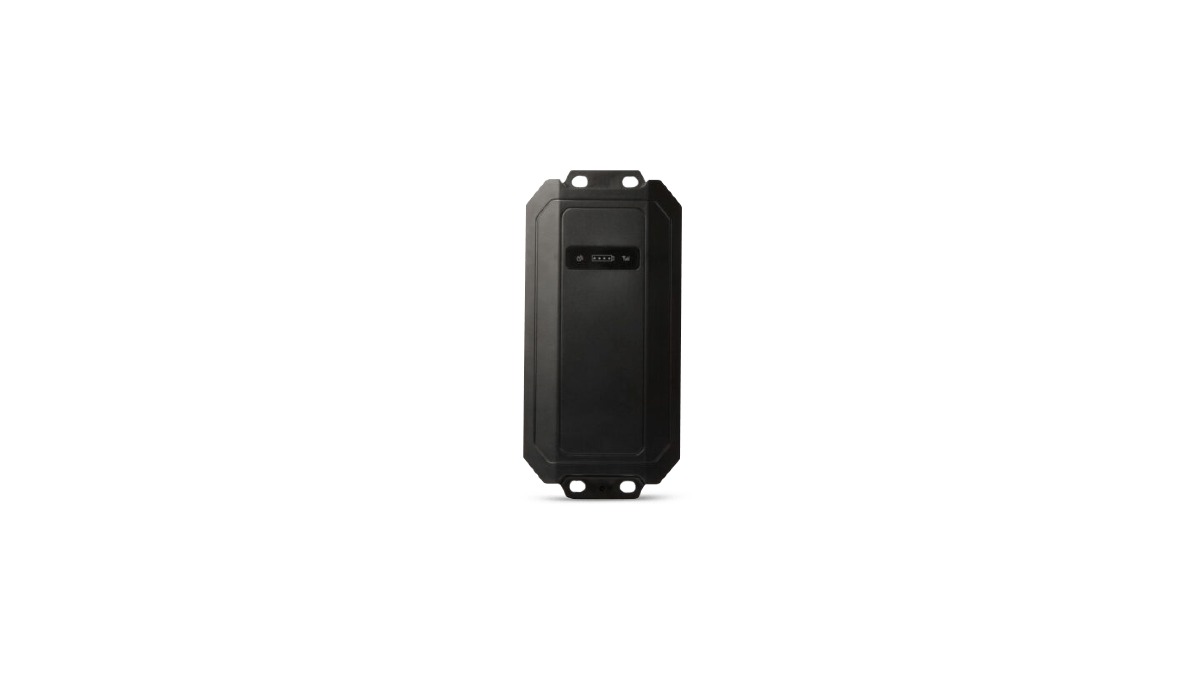
- AssetTrack GPS family: Up to 10-year battery life on a single charge when reporting once daily, with Wi-Fi positioning and multi-network connectivity across cellular, BLE, and satellite for long-haul and remote inventory.
- Scout AI: A built-in natural-language assistant that lets operations teams ask plain-English questions like “which containers have been idle more than 72 hours?” and get answers without building a report.
- 3 billion+ interconnected BLE gateways: A purpose-built commercial network, including mobile hubs on vehicles and forklifts. That delivers consistent indoor and outdoor coverage rather than depending on random consumer phones.
- Environmental sensors: Temperature, humidity, shock, and tamper monitoring for sensitive cargo, cold-chain inventory, and pharmaceutical/healthcare assets.
- ERP and WMS integration: SOC 2 compliant, with full API integration into Oracle, SAP, Microsoft Dynamics, and other systems of record.
The proof points are unusually concrete. A major automotive manufacturer uses GPX to track over 246,000 returnable containers and achieves a 95% recovery rate, saving roughly $2.1 million annually in container replacement costs alone, an 18x ROI on the program. GPX serves businesses across construction, fleet, healthcare, automotive, in-transit logistics, yard operations, and supply chain visibility programs, including customers like Airbus, Toyota, Stellantis, and SpaceX.
Best for: Organizations whose inventory is partly or mostly mobile, across facilities, vehicles, yards, job sites, and shipments, and that need real-time location data to flow into their existing ERP, WMS, or operations stack.
2. Oracle NetSuite, Cloud ERP With Real-Time Inventory at the Core
Oracle NetSuite remains one of the most widely deployed cloud ERPs in the world, and its inventory module is a key reason. Because inventory, financials, and order management all sit on a single database, stock changes propagate in real time across every channel and location without batch syncs or nightly reconciliations.
NetSuite’s inventory tracking covers multi-location stock, lot and serial traceability, bin management, demand-based replenishment, and landed cost calculation. For organizations already running NetSuite financials, the inventory module is a natural extension and dramatically reduces the data-silo problem that haunts standalone inventory tools.
Strengths: Single source of truth across ERP, financials, and inventory; strong multi-subsidiary and multi-currency support; deep customization via SuiteScript.
Considerations: Implementation cost and complexity are real. NetSuite is rarely the cheapest option, and it does not include physical tracking hardware, for IoT/BLE/GPS-level visibility, it’s usually paired with a hardware layer like GPX.
Best for: Mid-market to enterprise businesses that want inventory, accounting, and order management on one cloud platform.
3. SAP S/4HANA Supply Chain Management, Enterprise-Grade Real-Time Visibility
For Fortune 500 and large-enterprise supply chains, SAP S/4HANA is the heavyweight. The in-memory HANA database is what makes “real-time” actually mean real-time at massive scale, billions of inventory records, millions of transactions per day, all queryable without the lag that older databases imposed.
S/4HANA’s Extended Warehouse Management (EWM), Inventory Management, and Integrated Business Planning modules together provide the kind of end-to-end visibility that complex global manufacturers and distributors need: serial-level traceability, advanced demand sensing, automated replenishment, and tight integration with shop-floor and IoT systems.
Strengths: Massive scale, deep manufacturing functionality, strong analytics, mature integration with industrial IoT and shop-floor automation.
Considerations: Implementation timelines are measured in quarters or years, not weeks, and total cost of ownership is high. Most SAP customers pair it with specialized real-time tracking hardware partners for the last-mile visibility piece.
Best for: Large enterprises with complex multi-plant, multi-country supply chains and the appetite for a long-horizon transformation.
4. Microsoft Dynamics 365 Supply Chain Management
Microsoft Dynamics 365 SCM has become the natural choice for organizations already running on the Microsoft stack, Azure, Power BI, Teams, and the Power Platform. Its inventory module supports real-time stock visibility, demand forecasting powered by Azure Machine Learning, multi-site planning, and integrated quality management.
The big differentiator in 2026 is the deep integration with Microsoft Copilot. Inventory planners can ask Copilot questions in natural language, generate replenishment scenarios, and surface anomalies, without leaving the Dynamics interface. For organizations standardizing on Microsoft for productivity and analytics, the cognitive cohesion is significant.
Strengths: Tight integration with the broader Microsoft ecosystem, strong AI/Copilot tooling, solid out-of-the-box analytics.
Considerations: Like other enterprise ERPs, Dynamics 365 SCM is not a hardware play. Real-time physical tracking still requires an IoT/BLE/GPS layer underneath.
Best for: Mid-market and enterprise organizations already invested in Microsoft 365, Azure, and Power Platform who want their inventory system to plug into the same fabric.
5. Fishbowl Inventory, Real-Time Tracking for Manufacturers and Wholesalers
Fishbowl has carved out a strong niche as the real-time inventory and manufacturing platform of choice for small and mid-sized businesses, particularly those that have outgrown QuickBooks-only setups but aren’t ready for NetSuite-level complexity or cost.
Fishbowl handles multi-location inventory, manufacturing work orders, bill of materials, barcode scanning, lot/serial tracking, and integrations with QuickBooks, Xero, Shopify, and major shipping carriers. The on-premise option also appeals to organizations that want tighter control over their data.
Strengths: Strong manufacturing and assembly support, deep QuickBooks integration, fair pricing for the feature set, flexible deployment.
Considerations: The user interface shows its age in places, and reporting customization can be limited compared to cloud-native rivals.
Best for: Manufacturers, distributors, and wholesalers in the SMB-to-lower-mid-market range who need real manufacturing inventory functionality without ERP-level commitment.
6. Cin7 Omni, Real-Time Multi-Channel Inventory for Brands and Retailers
Cin7 Omni is built for the world where one SKU lives in a warehouse, a 3PL, a retail store, an Amazon FBA bin, and three Shopify storefronts simultaneously. Its core promise is real-time inventory synchronization across every sales channel and stock location, with built-in EDI for retail partners and native integrations across more than 700 systems.
The platform’s strength in 2026 is its B2B and DTC convergence, the same inventory engine handles wholesale orders, retail replenishment, and direct-to-consumer fulfillment without forcing teams to reconcile across separate systems.
Strengths: Best-in-class multi-channel orchestration, strong EDI and 3PL integrations, robust support for product brands selling across retail and DTC.
Considerations: Onboarding is more involved than many SMB tools, and pricing rises quickly as channel and integration counts grow.
Best for: Consumer product brands, omnichannel retailers, and growing DTC companies juggling multiple sales channels, warehouses, and 3PLs.
7. Zoho Inventory, Real-Time Inventory for SMBs and Growing Teams
For small businesses, e-commerce sellers, and growing teams that need real-time inventory tracking without enterprise pricing, Zoho Inventory has become a default starting point. It connects natively to Shopify, Amazon, eBay, Etsy, and the rest of the Zoho ecosystem (Books, CRM, Analytics), with multi-warehouse support, serial and batch tracking, and shipping integrations baked in.
Zoho’s pricing is hard to beat at the SMB end of the market, and the platform’s strength is breadth over depth. It covers most of what a sub-100-employee business needs without forcing a sales-led procurement process.
Strengths: Aggressive pricing, fast time-to-value, native ecosystem integration, free tier for very small operations.
Considerations: Less suited to complex manufacturing, deep customization, or organizations that need bespoke reporting and workflows at scale.
Best for: SMBs, e-commerce sellers, and early-stage businesses that need real-time inventory visibility without the overhead of an enterprise platform.
Real-Time Inventory Tracking Software Comparison Table
| Platform | Real-Time Tracking Tech | Best For | Key Strength |
|---|---|---|---|
| GPX Intelligence | BLE + GPS + Wi-Fi + Cellular + Satellite + Smart Labels | Real-time tracking of mobile inventory across facilities, yards, and in-transit | Multi-modal hardware + Scout AI + ERP integration |
| Oracle NetSuite | Software-only, barcode scanning | Mid-market to enterprise needing single ERP | Inventory + financials on one database |
| SAP S/4HANA SCM | Software-only, IoT-ready via partners | Large enterprises, complex global supply chains | In-memory HANA database, deep manufacturing |
| Microsoft Dynamics 365 SCM | Software-only, Azure IoT integration | Microsoft-first mid-market and enterprise | Copilot AI, Power Platform integration |
| Fishbowl Inventory | Barcode scanning, manufacturing work orders | SMB-to-mid manufacturers and distributors | Manufacturing depth + QuickBooks integration |
| Cin7 Omni | Multi-channel sync, barcode, EDI | Omnichannel brands, retailers, DTC | 700+ integrations, channel orchestration |
| Zoho Inventory | Barcode scanning, e-commerce sync | SMBs and e-commerce sellers | Aggressive pricing, Zoho ecosystem |
Honorable Mentions: Other Real-Time Inventory Tracking Software Worth Knowing
The seven platforms above are our headline picks, but the inventory software landscape is wide and a handful of additional tools regularly surface in buyer comparisons. None of them displace our top 7 for the audiences we framed, but several are excellent fits in narrower contexts:
- Acumatica Cloud ERP – Strong enterprise alternative for organizations that want non-user-based pricing and flexible cloud/on-prem deployment. Especially popular with distributors and project-based manufacturers.
- Lightspeed Retail – POS-first platform with built-in inventory tracking, well-suited to single- and multi-location retail and hospitality. Frequently cited for its 24/7 support model.
- Odoo – Open-source, modular ERP with a free tier. Strong fit for businesses with unique workflows that need to customize inventory logic without paying for unused modules.
- Veeqo – Amazon-owned multi-channel inventory and shipping platform, free for Amazon sellers. Strong for growing online retailers syncing Amazon, eBay, Shopify, and Walmart.
- inFlow Inventory – A perennial favorite among small businesses for its barcode system, multi-user mode, and reasonable one-time-license option alongside SaaS plans.
- Sortly – Mobile-first inventory and asset management with strong QR/barcode scanning and customizable fields. Popular with field-service teams and small operations.
- Brightpearl – Omnichannel retail platform unifying inventory, orders, and accounting. Particularly strong for retail brands scaling across stores, marketplaces, and DTC.
- Square for Retail – At $60/month per register, the most accessible option for small retailers needing real-time POS-linked inventory, multi-location stock, and shrinkage reconciliation.
- SYSPRO ERP – Flexible ERP with strong manufacturing depth and a notable POS engine, suitable across business sizes.
- Asset Panda – Cloud-based with unlimited users and fields, popular for asset-heavy organizations that need flexible custom configurations rather than rigid SKU-based inventory.
2026 Must-Have Features: AI Predictive Replenishment, BLE/IoT Sensors & Agentic AI Interfaces
The software landscape is crowded, but the feature set that genuinely separates a 2026-ready platform from a barely-modernized 2018 tool is fairly narrow. When you’re evaluating any of the systems above, or any vendor that didn’t make our shortlist. These are the capabilities that have moved from “advanced” to “expected.”
- True real-time updates, not “near real-time.” Sub-minute latency between a physical event (a scan, a movement, a tamper) and the system reflecting it. Anything measured in hours is a different category of product.
- AI-powered demand forecasting and predictive replenishment. Machine learning models that consume historical sales, seasonality, supplier lead times, and external signals to predict 14-, 30-, and 90-day demand at the SKU-location level.
- IoT, RFID, and BLE integration. The ability to ingest data from physical tags, sensors, and gateways, not just barcode scanners. This is where standalone inventory software ends and platforms like GPX begin.
- Multi-location and multi-channel synchronization. A single source of truth across warehouses, stores, 3PLs, marketplaces, and DTC channels, with no nightly batch syncs.
- Agentic and natural-language interfaces. 2026 is the year of agentic AI in operations. Platforms like GPX (Scout AI) and Microsoft Dynamics (Copilot) let users query inventory in plain English and trigger workflows without dashboards.
- Computer vision and image-based counting. Increasingly used for cycle counts, shelf monitoring, and yard inventory, reducing manual count cycles by 60-80% in early deployments.
- Geofencing, tamper alerts, and environmental monitoring. Critical for high-value, regulated, or perishable inventory.
- Bill of Materials (BOM) and Material Requirements Planning (MRP). Non-negotiable for manufacturers, work orders, raw materials, work-in-process, and finished goods all tracked under one inventory model.
- Costing methods support. FIFO, LIFO, and Weighted Average Costing are required for accurate financials, COGS reporting, and tax compliance. Platforms that only support one method create downstream accounting pain.
- Serial number and lot tracking. Critical for regulated industries, medical, pharmaceutical, food, automotive, electronics, and indispensable for recalls.
- Mobile inventory access. Native iOS and Android apps for scanning, lookups, transfers, and cycle counts, ideally with offline support for warehouse and field use.
- EDI integration. Non-negotiable for organizations selling to large retail partners, 3PLs, or distributors. Cin7 and similar platforms lead here.
- Reverse logistics support. Returns, restocking, refurbishment, and disposal workflows are increasingly material to margin, and increasingly visible to customers.
- ABC analysis and prioritization logic. Built-in support for classifying inventory by value contribution (typically A items = 10-20% of SKUs driving 70-80% of value) so teams know where to focus.
- Open APIs and pre-built integrations. ERPs, WMSs, TMSs, POSs, and accounting systems all need to talk to each other. Closed platforms are a dead end.
- Mobile and web access with role-based controls. Floor teams, drivers, planners, and executives each need a tailored view, without IT building it from scratch.
- SOC 2, ISO 27001, and audit-grade traceability. Real-time data is only as valuable as it is trustworthy. Compliance posture matters.
The Math Behind AI-Driven Predictive Replenishment
B2B inventory buyers in 2026 are rightly fatigued by vague “AI” claims. The mechanism behind modern predictive replenishment is not magic. It is probabilistic mathematics. Rather than relying on static safety stock formulas (a holdover from the 1960s), modern platforms model demand as a probability distribution that updates continuously as new sales, sensor, and external signals arrive.
The core formulation looks like this:
P(D_(t+k) | X_(1:t)) = ∫ p(D_(t+k) | θ) · p(θ | X_(1:t)) dθ
Where Dt+k is future demand at time t+k; X1:t is the full history of sales, sensor readings, and external variables observed through time t; and θ encapsulates the dynamic market variables that shape demand, supplier lead times, weather, promotions, macroeconomic signals, and so on. The term p(θ | X1:t) is the posterior distribution over those variables given everything the system has seen so far.
In plain English: the platform asks “given everything I have observed about sales, in-transit shipments, supplier behavior, and external signals up to right now, what is the probability distribution of demand 14, 30, or 90 days from now?” That distribution, not a single point estimate, is what drives modern replenishment decisions, safety stock targets, and stockout-risk thresholds. The platforms that compete on real AI rigor (NetSuite, SAP, Dynamics 365, and the predictive layer in GPX’s Scout AI) implement variants of this Bayesian posterior predictive structure. The ones that don’t are essentially running dressed-up moving averages.
Industry-Specific Considerations: Choosing by Vertical
The “best” real-time inventory tracking software shifts dramatically by industry. Below is how the priorities re-rank when you narrow the lens to a single vertical:
- Manufacturing: BOM, MRP, work-in-process tracking, and shop-floor integration are deal-breakers. SAP S/4HANA, Microsoft Dynamics 365 SCM, Katana, Fishbowl, and Odoo lead here; GPX layers in real-time tracking of raw materials, returnable containers, and finished goods between plants and customers.
- Retail and omnichannel: POS integration, real-time stock sync across stores and channels, and shrinkage reconciliation matter most. Cin7 Omni, Lightspeed, Brightpearl, and Square for Retail are strong; NetSuite handles larger multi-brand operations.
- E-commerce and DTC: Marketplace sync (Amazon, Shopify, eBay, Walmart), FBA visibility, and 3PL integration drive the decision. Cin7, Veeqo, Ordoro, and Zoho Inventory are typical picks; GPX adds value where physical product needs to be tracked end-to-end (perishables, high-value goods, returns).
- Healthcare and medical devices: Lot/serial tracking, expiry management, regulatory traceability (FDA, DSCSA), and asset utilization across floors and facilities. GPX’s BLE-based AssetTags and environmental sensors are widely used here alongside ERP systems like Oracle or SAP.
- Construction, fleet, and field operations: Tools, equipment, and consumables move constantly between job sites, vehicles, and yards. This is where GPX’s multi-modal hardware (BLE + GPS + cellular) is most differentiated, paired with a financial system like NetSuite or Dynamics 365 for the back office.
- Automotive and supply chain: Returnable containers, just-in-sequence delivery, and supplier collaboration are core. SAP and Microsoft dominate the system-of-record layer; GPX provides the physical tracking layer across plants, suppliers, and logistics.
Decision Framework: How to Choose the Best Real-Time Inventory Management System for Your Tech Stack
There is no universal “best” platform. There is only the best platform for your inventory shape, team, and stage. The right way to choose is to answer six questions honestly before you take a single demo.
1. How mobile is your inventory? If most of it sits on shelves and gets picked, a software-only platform (NetSuite, Cin7, Zoho) is usually enough. If significant portions of it move, between sites, in trucks, across yards, on job sites. You need a hardware-plus-software platform like GPX, layered with whatever ERP you already run.
2. How complex is your channel mix? Single-channel sellers can run lean. Brands selling across retail, DTC, marketplaces, and wholesale should weight Cin7 Omni or NetSuite heavily, channel orchestration is where they shine.
3. What’s already in your stack? If you’re a Microsoft shop, Dynamics 365 reduces friction. QuickBooks shops get the most lift from Fishbowl. SAP enterprises will almost always extend S/4HANA. Don’t fight your existing investments without a strong reason.
4. Where does indoor and in-transit visibility matter? Most inventory pain in 2026 lives in the physical gaps, yards, trailers, job sites, hospitals, plants, where barcode scanners alone can’t see. If those gaps are costing you money, the tracking-hardware layer is the highest-ROI investment you can make, and it’s worth picking carefully.
5. What’s your honest IT capacity? Enterprise platforms reward organizations that can dedicate implementation teams. SMBs without that capacity should bias toward cloud-native, fast-to-deploy options.
6. What’s the real budget envelope? Modern cloud inventory software ranges from roughly $25 $100/month at the SMB end (Zoho, Square, Sortly, inFlow) to $300 $1,000/month in the mid-market (Cin7, Katana, Fishbowl, Logiwa) to $3,000+/month for enterprise platforms (NetSuite, SAP, Dynamics 365). Hardware-based real-time tracking adds a per-asset cost ranging from $0 (Smart Labels often bundled with service) to $150 per device. The right number isn’t the lowest. It’s the one that pays back fastest against the inventory you’re losing today.
Once those six questions are answered, the shortlist usually narrows to two or three platforms. Run a 30-day pilot on the highest-risk corner of your operation. Your most mobile inventory, your most painful stockouts, your most complex location, and let the data decide.
The companies that win the next decade of inventory will not be the ones with the most expensive system. They’ll be the ones whose inventory data is true in the moment it’s needed, every time. If that’s what you’re solving for, GPX Intelligence is built for exactly that problem, and it plays well with every platform on this list. Reach out for a walkthrough or pilot, and we’ll help you put real-time visibility on the inventory that’s costing you the most today.
Frequently Asked Questions (FAQs)
How does AI improve real-time inventory tracking in 2026?
AI shows up in modern inventory platforms in three main ways. First, demand forecasting, machine learning models predict SKU-level demand far more accurately than traditional moving averages, factoring in seasonality, weather, promotions, and supplier variability. Second, anomaly detection, AI flags unusual movements, suspected shrinkage, and tamper events in real time, before they become losses. Third, agentic and natural-language interfaces, assistants like GPX’s Scout AI and Microsoft Copilot let operations teams query inventory data conversationally and trigger workflows without building dashboards or reports. Together, these capabilities are projected to lift retail gross margins by up to 25% by 2029 according to IHL Group research.
Does real-time inventory tracking software integrate with QuickBooks?
Yes, QuickBooks integration is one of the most heavily-searched and table-stakes capabilities in the inventory software category in 2026. Fishbowl is purpose-built around deep QuickBooks integration and is consistently the top pick for QuickBooks shops needing manufacturing-grade inventory. Zoho Inventory, Cin7, NetSuite, Acumatica, inFlow, and HandiFox all offer QuickBooks integration (Online, Desktop, or both). GPX Intelligence connects to QuickBooks indirectly through the ERP layer or via API, so real-time location and asset data flows into the same financial system that handles your books. If QuickBooks is your accounting backbone, make integration depth, not just integration existence, a hard requirement on every demo.
How do I track inventory outside the warehouse where Wi-Fi drops?
This is exactly where most legacy inventory systems fail and where modern real-time tracking platforms earn their keep. The answer is multi-network handoff. GPS and cellular (4G/5G) take over the moment a tagged asset leaves Wi-Fi range, so inventory in trucks, on job sites, in yards, or in transit across the country stays continuously visible. For the most remote locations (rural fleets, agriculture, maritime, off-grid construction), satellite connectivity fills the last gap. The most capable platforms in 2026, GPX Intelligence is built around exactly this, fuse BLE for indoor, Wi-Fi for facility transitions, GPS and cellular for outdoor and in-transit, and satellite for remote, into a single continuous data feed. The user doesn’t see the handoff; the asset just stays on the map.
What’s the best real-time inventory tracking software for multi-channel Shopify and Amazon sellers?
For multi-channel e-commerce sellers running Shopify, Amazon (including FBA), eBay, Walmart, and TikTok Shop in parallel, the strongest software-layer picks are Cin7 Omni (deep multi-channel orchestration, 700+ integrations, strong EDI for retail wholesale), Veeqo (Amazon-owned, free for Amazon sellers, native marketplace sync), and Zoho Inventory (most cost-effective at the SMB end with native Shopify, Amazon, and eBay connectors). For sellers who also need physical-layer tracking, high-value goods, perishables, returnable packaging, or expensive returns, pairing the software platform with GPX Intelligence’s Smart Labels or AssetTags closes the gap between “what the system says is in stock” and “where the physical inventory actually is.”
How much does it cost to implement RFID or BLE tracking in 2026?
BLE-based tracking has collapsed the historical cost barrier. GPX Intelligence’s Smart Labels start at roughly $9.75 per unit – peel-and-stick, sub-1mm thick, no SIM, no wiring, no charging, making them economical even for one-way shipment tracking where retrieving the hardware isn’t practical. Rugged BLE trackers like the GPX AssetTag and AssetTag Edge run higher (in the $30 $80 range per device depending on configuration), with up to 4-year replaceable battery life and IP67 durability for industrial use. Traditional cellular GPS tags still cost roughly $100 $150 per device upfront plus a monthly data plan. Passive RFID tags are cheapest at pennies per tag, but the infrastructure (gateways, readers, antennas) carries the cost. Add platform licensing, which typically runs $3.50/month per asset at the BLE end and scales with feature depth. For most enterprises, the right question is not “how cheap is the hardware?” but “what’s the payback period against the inventory we’re currently losing?” Most GPX deployments see ROI within 6-12 months.