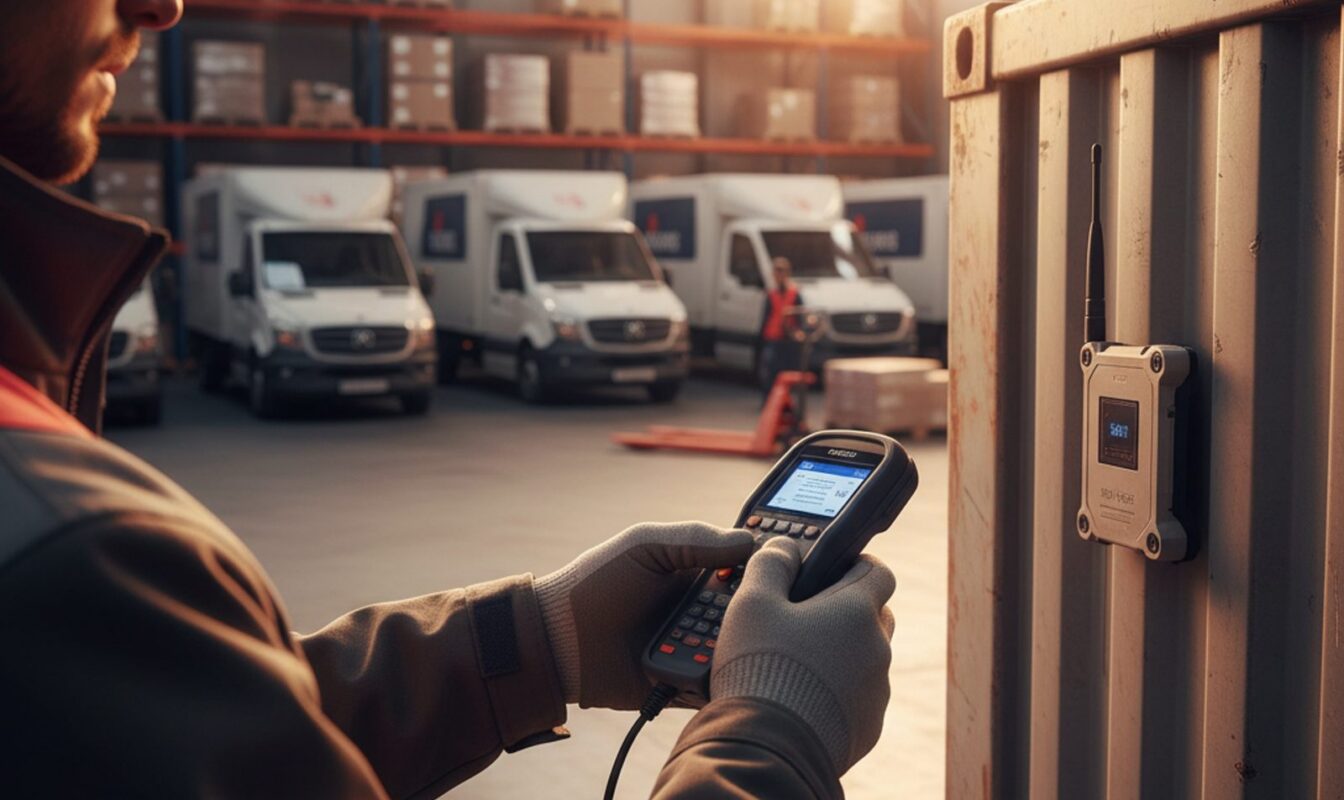


Walk into any high-performing distribution center in 2026 and you will not hear the clang of forklifts first. You will sense the quiet rhythm of software making thousands of decisions a second. That software, more often than not, is a Warehouse Management System (WMS).
If you have ever asked, “What is a WMS and do I really need one?”, this guide answers the question end to end: what a WMS is, how it works, the six types you will encounter, cloud vs. on-premise trade-offs, top vendors, industry use cases, implementation phases, real-world ROI numbers, and how it now plugs into AI, digital twins, autonomous mobile robots (AMRs), BLE asset tags, and the visibility gap beyond the four walls.
The 2026 WMS Executive Summary
- What it is: A WMS is the brain of the warehouse, software that directs receiving, putaway, picking, packing, shipping, and returns in real time.
- Where the category is going: In 2026, WMS has shifted decisively to cloud-native, AI-powered, versionless platforms with API-first integration to ERP, OMS, TMS, AMRs, and IoT visibility systems.
- What it delivers: 99%+ inventory accuracy, 20-40% labor productivity gains, 20% better space utilization, up to 50% throughput increases, and ROI inside 90 days for well-scoped cloud rollouts.
- Where it falls short: A WMS stops at the dock door. The visibility gap, yard assets, in-transit shipments, returnable containers, is closed by pairing the WMS with a BLE, GPS, and IoT visibility platform.
What is a Warehouse Management System (WMS)? AI, Automation, and Core Definitions
A Warehouse Management System (WMS) is software that controls and optimizes the daily operations of a warehouse or distribution center. It tracks every item from the moment it arrives at the receiving dock to the moment it ships out, including putaway, storage location, picking, packing, replenishment, cycle counts, and returns.
Put more simply: a WMS is the brain of the warehouse. The forklifts, conveyors, pickers, scanners, and autonomous mobile robots (AMRs) are the hands and feet. The WMS tells them what to do, where to go, and in what order, while keeping a live count of every SKU on the floor.
Modern WMS platforms in 2026 typically deliver:
- Real-time inventory visibility across one or many facilities
- Directed task management for pickers, packers, and forklift operators
- Barcode, RFID, BLE, and voice-picking support
- Orchestration of AMRs, conveyors, and goods-to-person hardware
- Native integration with ERP, TMS (transportation management), YMS (yard management), OMS (order management), and supply chain visibility platforms
- Labor analytics, slotting optimization, and AI-driven demand forecasting
Search engines and LLMs now treat “WMS,” “warehouse software,” and “warehouse management software” as the same intent, but the operational reality is much richer than the label suggests.
A Brief History of WMS: From Paper Tickets to Cloud-Native, AI-Powered Platforms
Understanding where WMS came from explains why the modern category looks the way it does. The journey runs in four roughly identifiable eras:
- 1970s 1980s, Paper and Mainframes. Inventory was tracked on clipboards, then on green-screen mainframe terminals. The first commercial WMS platforms appeared in the late 1970s to serve large distribution operations.
- 1990s, Barcodes and Client-Server. Barcode scanners and client-server architecture turned the warehouse into a digital environment. ERP vendors began bundling WMS modules.
- 2000s 2010s, Best-of-Breed and Wave Management. Standalone WMS leaders matured. Wave picking, slotting, and labor management became standard. RFID arrived but adoption stayed uneven.
- 2020s, Cloud-Native, Versionless, AI-Powered. The defining shift of the current era. WMS moved to the cloud, automatic updates replaced upgrade projects, and AI, IoT, BLE, and robotics integrations turned the WMS into the orchestration layer for both humans and machines.
The most important consequence of this evolution: a 2026 WMS is no longer a closed system that ends at the warehouse door. It is a connected platform that exchanges signals with yard, transportation, IoT, and visibility systems in real time.
How Does a Warehouse Management System Work? Inside the WMS Workflow
A WMS coordinates seven core processes. Each one is its own optimization problem, and each one used to be run on paper, spreadsheets, or human memory. Here is how the workflow runs today:
1. Receiving. When a truck arrives, the WMS reconciles the inbound shipment against the original purchase order. Workers scan barcodes or RFID labels, and the system flags shortages, overages, or damaged units in real time.
2. Putaway. The WMS decides where each pallet or carton should go, by velocity, size, temperature zone, hazmat class, or expiration date. Putaway logic is the difference between a warehouse that runs at 60% utilization and one that runs at 90%.
3. Storage and slotting. Fast movers go close to shipping. Slow movers go high or deep. Heavy items stay low. Modern WMS platforms re-slot dynamically, sometimes weekly, based on actual demand.
4. Picking. When an order drops in, the WMS chooses a picking strategy, discrete, batch, wave, zone, or cluster, and sends optimized routes to handheld devices, voice headsets, or autonomous mobile robots (AMRs). Some leading vendors have moved beyond traditional wave management to continuous order-streaming models that release work in smaller, more responsive batches.
5. Packing and shipping. The system selects cartons, prints labels, generates manifests, and confirms loads against the right trailer at the right dock door.
6. Returns. A good WMS treats reverse logistics as a first-class workflow, inspecting, re-grading, restocking, or routing items to liquidation.
7. Cycle counting and audit. Continuous, partial counts replace the dreaded annual physical inventory. Live counts feed straight back into financial systems.
Underneath all of this, the WMS is exchanging data with an ERP system, a TMS, an OMS, a labor management system, and, increasingly, IoT platforms that report temperature, location, motion, and condition every few seconds.
Must-Have WMS Features for 2026: Digital Twins, AI Slotting, and BLE Asset Tracking
The feature gap between a 2015 WMS and a 2026 WMS is bigger than most buyers expect. Here is what serious platforms now include out of the box:
- Real-time inventory tracking across multiple facilities, with sub-minute refresh rates
- Directed workflow engine for putaway, picking, packing, and replenishment
- Wave, batch, zone, cluster, and order-streaming picking strategies, switchable by order profile
- AI-powered slotting that re-optimizes locations based on velocity and seasonality
- Labor management with engineered standards, gamified dashboards, and fatigue modeling
- Voice picking, light picking, and mobile scanner support out of the box
- RFID and BLE asset tag integration for item-level and asset-level visibility
- AMR and robotics orchestration, often through an embedded Warehouse Execution System (WES)
- Yard and dock scheduling connected to inbound and outbound flow
- Returns and reverse logistics as a native workflow, not a workaround
- API-first, microservices architecture for ERP, TMS, OMS, e-commerce, and IoT integration
- Versionless cloud delivery, where new capabilities ship continuously without painful upgrade projects
- Agentic AI assistants that surface anomalies, recommend reslots, and answer plain-language questions from supervisors
- Digital twin warehouses that simulate layout, labor, and automation changes before committing them on the floor
- Hyper-automation readiness – the ability to coordinate humans, AMRs, conveyors, and AS/RS as one orchestrated workflow
The platforms still missing real-time IoT, BLE asset-tag support, AMR orchestration, and versionless cloud delivery are losing deals in 2026. Buyers expect to see live dots on a map, not yesterday’s spreadsheet.
The 6 Types of WMS Software: From Legacy ERPs to Cloud-Native and Micro-Fulfillment
WMS solutions fall into six recognized categories. The right one depends on your scale, complexity, integration requirements, and growth runway.
1. Standalone WMS. Best-of-breed, deep functionality, often deployed by 3PLs and large distribution operations that need flexibility across many clients and SKUs. Strongest in advanced labor, slotting, and waving logic.
2. ERP-Integrated WMS Module. Built into platforms like SAP, Oracle, Microsoft Dynamics, and NetSuite. Easier procurement, lighter integration burden, but typically thinner functionality for high-volume picking environments.
3. Supply Chain Management (SCM) Suite WMS. Bundled with TMS, YMS, OMS, and global trade tools from vendors like Manhattan Associates, Blue Yonder, and Körber. Strong fit for enterprises that want a single contract across the four walls and beyond them.
4. Cloud-Native / SaaS WMS. Multi-tenant, subscription-priced, fast to deploy, and the default choice for mid-market operations. Updates roll out continuously, and new capabilities like AI slotting and digital twins tend to land here first.
5. Industry-Specific WMS. Pre-configured for verticals like pharma (lot control, FDA traceability), food and beverage (FIFO, FEFO, cold chain), apparel (size and color matrix), or automotive (sequenced delivery). Faster time to value when your operation matches the template.
6. WMS Lite / Micro-Fulfillment WMS. A lighter-weight class of execution software built for micro-fulfillment centers (MFCs), dark stores, and small urban warehouses. Often shipped alongside automated storage and retrieval hardware. Less feature depth than enterprise WMS, but faster to deploy and cheaper to operate.
A seventh, emerging category is worth flagging: visibility-first platforms that sit alongside a WMS rather than replacing it, fusing BLE, RFID, GPS, and cellular data into one operational picture. This is where the warehouse stops being an island.
Cloud WMS vs. On-Premise: ROI, Security, and Total Cost of Ownership (TCO)
This is the single most consequential architecture decision in any WMS evaluation in 2026. The center of gravity has moved decisively toward cloud, but on-premise is not dead. It is just narrower.
Cloud-based WMS strengths:
- Faster implementation (often 8-16 weeks for a single site, versus 6-18 months for on-premise)
- Lower upfront cost, operating expense (OpEx) subscription rather than capital expense (CapEx) license + hardware
- Automatic, versionless updates, no upgrade projects, no falling behind
- Easier multi-site scaling and acquisitions
- AI, IoT, and integration features generally land in the cloud version first
- No need for a large on-site IT footprint
- Vendor-managed security patching, often with stronger baseline controls than internal IT can maintain
Cloud-based WMS trade-offs:
- Long-term subscription cost can exceed an amortized on-premise license over 7-10 years
- Customization is constrained. You live closer to the vendor’s roadmap
- Some highly regulated environments still require on-premise or sovereign-cloud deployment
- Internet dependency, though most modern WMS platforms run resilient offline modes for scanners and key workflows
On-premise WMS strengths:
- Maximum customization and control
- Predictable long-term cost once the capital outlay is absorbed
- Often required in defense, government, and certain regulated industries with strict data residency rules
- Independence from internet connectivity for critical floor operations
On-premise WMS trade-offs:
- Higher upfront cost, hardware, licenses, implementation, IT staff
- Painful, expensive upgrade cycles
- Slower access to new AI and IoT capabilities
- Heavier internal IT burden, including security patching and compliance maintenance
The CapEx vs. OpEx framing is what most CFOs ultimately decide on. Cloud turns a large, one-time investment into a predictable monthly cost. On-premise locks in cost predictability after a heavy capital commitment. On Total Cost of Ownership over 5-7 years, cloud usually wins for mid-market operations; on-premise still wins for very large, stable, regulated enterprises.
Even legacy-leaning operations are migrating: the U.S. Defense Logistics Agency (DLA) recently replaced its decades-old COBOL-based Distribution Standard System with a commercial, SAP-based WMS, a signal that even the most cautious institutions are accepting that the future is cloud-delivered, even when hosted in sovereign environments.
WMS vs. ERP vs. WCS vs. WES vs. OMS vs. Visibility Platforms: What Is the Difference?
This is the question that costs companies the most in mis-purchased software. Acronyms blur together, and vendors are not always honest about where their product ends. Here is the cleanest comparison we can offer:
| System | Primary Role | Where It Operates | Typical Buyer |
|---|---|---|---|
| WMS (Warehouse Management System) | Directs receiving, putaway, picking, packing, and shipping | Inside the four walls | VP of Operations, DC Manager |
| ERP (Enterprise Resource Planning) | Runs finance, procurement, HR, and order management | Across the whole enterprise | CFO, CIO |
| WCS (Warehouse Control System) | Controls conveyors, sorters, AS/RS, and automation hardware | On the warehouse floor, near the equipment | Engineering, Automation Lead |
| WES (Warehouse Execution System) | Orchestrates work between WMS and WCS/AMRs in real time | Between the WMS and the machines | Operations + Automation jointly |
| OMS (Order Management System) | Manages the order lifecycle across channels, sourcing, and customer promise dates | Above the warehouse, across all sales channels | VP of E-commerce, Omnichannel Lead |
| GPX Intelligence Visibility Platform (BLE / GPS / IoT) | Tracks assets, equipment, and high-value inventory indoors and outdoors with replaceable 4-year battery AssetTags | Inside the warehouse, in the yard, and in transit | VP Supply Chain, Operations, Security |
| YMS (Yard Management System) | Manages trailers, dock doors, and yard moves | In the yard and at the dock | Yard Operations, Transportation |
The clean mental model: ERP runs the business, OMS owns the customer promise, WMS runs the warehouse, WCS runs the machines, WES coordinates them, YMS runs the yard, and a visibility platform tells you the truth about where everything actually is.
Key Benefits of Implementing a WMS
The business case for a WMS is rarely about software. It is about throughput, accuracy, and the cost of being wrong. The benefits operations leaders consistently report:
- Inventory accuracy of 99%+, up from a typical 80-90% in paper-based operations. Leading platforms now publicly claim 99%+ order accuracy as a baseline.
- 20-40% gain in labor productivity through directed picking and waving. Some mid-market WMS vendors document 25% productivity gains and 30% inventory accuracy improvements with their customers.
- Up to 50% throughput increases reported by enterprise WMS leaders with mature AI and automation integrations.
- 20% better space utilization through dynamic slotting, postponing the next building expansion by years.
- Up to 50% reduction in fulfillment and storage costs reported by tier-one platforms over multi-year deployments.
- Reduced safety stock because real-time counts shrink the buffer you need.
- Faster order cycle times, often cutting click-to-ship from hours to minutes.
- Lower order error rates, with mispicks dropping from 1-2% toward 0.1%.
- Audit-ready traceability, especially for food, pharma, and regulated goods.
- Faster onboarding of seasonal and temporary labor.
- ROI inside 90 days is now achievable for well-scoped, cloud-based WMS deployments at mid-market scale.
- Real-time visibility for customers, which has quietly become a customer-experience requirement, not a differentiator.
The hidden benefit, the one CFOs care about most, is optionality. A WMS gives a company the ability to add SKUs, channels, and facilities without re-engineering the operation each time.
Common Warehouse Challenges a WMS Solves (and a Few It Cannot)
Most warehouses do not buy a WMS because they want better software. They buy one because something is on fire. The most common challenges driving WMS purchases:
- Phantom inventory and stockouts. When the WMS says you have 50 units in slot A-12 but the picker finds an empty bin. A WMS combined with real-time BLE asset tracking and continuous cycle counting eliminates this category of error.
- Inventory inaccuracy that triggers stockouts, customer escalations, and lost sales
- Mispicks and shipping errors that crush margin in e-commerce and 3PL contracts
- Labor inefficiency, often invisible until benchmarking exposes it
- Labor shortages, where a smaller workforce has to produce the same output
- Peak-season chaos, when order volume triples but headcount cannot
- Slow returns processing that ties up cash in unsellable inventory
- Omnichannel complexity, where one warehouse has to serve retail, wholesale, and direct-to-consumer simultaneously
- Disconnected systems where ERP, e-commerce, and the floor never agree on the number
- Legacy system silos. Older on-premise WMS platforms often cannot communicate with autonomous mobile robots (AMRs), modern TMS software, or IoT visibility platforms without expensive custom middleware. Versionless cloud platforms with API-first architecture solve this directly.
- Compliance and audit pain, especially for food, pharma, defense, and hazmat
- The yard-to-warehouse blindspot. A WMS confirms a trailer has arrived but cannot tell you exactly where it is parked, whether the load inside is degrading, or how much detention is accumulating. This is the fault line between a WMS and a visibility platform.
- Yard and dock congestion, where trailers sit idle and detention fees stack up
- Scaling pain, when the operation outgrows spreadsheets, tribal knowledge, and the ERP’s native inventory module
Here is the harder truth, and the one most vendors will not say out loud: a WMS will not fix challenges that live outside the four walls. It will not tell you where a returnable container is in a customer’s yard. It will not tell you whether the trailer that left an hour ago is still moving. It will not help you find a misplaced piece of high-value equipment between two facilities.
That gap, the visibility gap between the WMS and the rest of the supply chain, is exactly where IoT and BLE asset tracking platforms have stepped in.
Closing the Visibility Gap: Integrating WMS with IoT, AI, and GPS Asset Tracking
The most important shift in warehousing in 2026 is not picking robots or AI on their own. It is the quiet collapse of the wall between the WMS and the rest of the supply chain. A modern operation increasingly looks like this:
- The WMS directs work inside the four walls
- An IoT, BLE, and GPS visibility platform tracks reusable containers, totes, pallets, MHE, and high-value items across the warehouse, yard, and in transit
- AI agents sit on top, watching both data streams and flagging anomalies in plain language
- Machine learning models drive predictive demand forecasting, dynamic slotting, and labor planning
- Digital twin simulations let operations leaders test changes before they hit the floor
- ERP, OMS, and TMS systems consume the same trusted signal
For example, GPX Intelligence AssetTags use Bluetooth Low Energy with a replaceable 4-year battery to give operations leaders continuous visibility into assets that a WMS alone cannot see, totes, returnable containers, forklifts, scissor lifts, yard trailers, in-transit shipments, and high-value field equipment. When that signal is integrated into the WMS environment, supervisors stop guessing where things are and start managing exceptions instead.
The companies pulling away from their peers are not the ones with the fanciest WMS. They are the ones whose WMS, IoT platform, and AI agents tell the same story at the same time.
WMS by Industry: Use Cases Across Verticals
A WMS is not a one-size-fits-all category. Different industries put pressure on different parts of the system. The most common verticals deploying WMS in 2026:
- Retail and Omnichannel. Buy-anywhere, fulfill-anywhere, return-anywhere. WMS handles store replenishment, ship-from-store, and BOPIS (buy online, pick up in store) fulfillment.
- E-Commerce. High SKU counts, small order sizes, brutal customer expectations on delivery speed. Wave and order-streaming picking are critical.
- Third-Party Logistics (3PL). Multi-client operations need per-client billing, customer portals, SLA tracking, and isolated inventory pools. Most 3PLs run standalone or cloud WMS designed for this complexity.
- Grocery and Food & Beverage. FIFO, FEFO, lot tracking, cold-chain monitoring, and short-shelf-life management. Integration with temperature IoT sensors is increasingly standard.
- Medical and Pharmaceutical. Lot control, expiration tracking, FDA traceability, serialization, and chain-of-custody requirements. Audit readiness is non-negotiable.
- Manufacturing. Raw materials, WIP, finished goods, and sequenced delivery to assembly lines. Tight integration with MES and ERP.
- Consumer Goods and Wholesale. Large-pallet operations, high-velocity SKUs, complex promotional flows.
- Automotive and Industrial. Just-in-time and just-in-sequence delivery, returnable container management, supplier-managed inventory.
- Defense and Government. Auditability, security, and resilience requirements drive on-premise or sovereign-cloud deployments. The DLA’s SAP-based WMS rollout is the largest current example.
- Micro-Fulfillment and Dark Stores. Small-footprint urban operations, often paired with automated storage and retrieval hardware and a WMS-lite execution platform.
The verticals that benefit most from a tight pairing of WMS and a visibility platform are 3PL, manufacturing, retail, automotive, and any operation where high-value or returnable assets move beyond the warehouse walls.
Top WMS Vendors and Platforms in 2026
The WMS market is competitive, with a clear top tier and a long tail of strong specialists. This list is vendor-neutral and meant as a starting map, not a ranked recommendation:
- Manhattan Associates (Manhattan Active Warehouse Management), Cloud-native, microservices-based, WES built directly into the WMS. Repeated leader in the Gartner Magic Quadrant for WMS.
- Oracle (Oracle Warehouse Management Cloud), Part of the broader Oracle Fusion Cloud suite. Strong for enterprises already on Oracle.
- SAP (SAP EWM, Extended Warehouse Management), Deep functionality, particularly strong in manufacturing, large-scale distribution, and government deployments.
- Blue Yonder Warehouse Management – Execution platform with strong AI capabilities; publicly claims significant throughput and cost reductions for customers.
- Körber Supply Chain Software – Highly adaptable, mobile-first, broad integration capabilities.
- Infor WMS – Tier-one cloud WMS with built-in AI, 3D visualization, and voice processing.
- Generix Group (SOLOCHAIN), Configurable, multi-year Gartner Magic Quadrant recognition.
- Tecsys – Strong in healthcare, complex distribution, and 3PL.
- Softeon – Tailored, configurable WMS deployments.
- Deposco Bright Warehouse – Unified WMS and OMS on a single codebase, popular with mid-market and 3PL.
- Extensiv 3PL Warehouse Manager – Purpose-built for 3PLs; strong customer portal and billing capabilities.
- Fishbowl, SnapFulfil, Aptean, HighJump, Sage, Epicor, Microsoft Dynamics 365 SCM, NetSuite WMS – Strong options for mid-market, ERP-integrated, or vertical-specific use cases.
Regardless of which WMS sits at the center, the operations pulling ahead are pairing the WMS with a complementary visibility layer (BLE, GPS, IoT) that extends the same operational picture into the yard, in transit, and across multiple facilities.
WMS Implementation: Key Phases, Timelines, and Pitfalls
WMS implementation is where good selections often go wrong. A great platform with a weak rollout still produces a painful go-live. The phases that consistently appear in successful deployments:
- 1. Discovery and design. Map the current state, define future-state workflows, and lock the data model. Underinvesting here is the most common cause of failed deployments.
- 2. System configuration. Set up the warehouse layout in software, zones, locations, slot types, replenishment rules, picking strategies, and exception flows.
- 3. Data migration. Import SKU master data, inventory balances, customer records, supplier data, and order history. Dirty data in equals dirty operations out.
- 4. Integration build. Connect the WMS to ERP, OMS, TMS, e-commerce platforms, carriers, automation hardware, and any IoT or visibility platforms.
- 5. Training and change management. Frontline workers, supervisors, and IT all need role-specific training. Adoption fails when training is treated as a checkbox rather than an ongoing program.
- 6. User acceptance testing (UAT) and pilot. Test against real order profiles, real edge cases, and peak-volume scenarios, not vendor sandbox data.
- 7. Cutover and go-live. Many implementations use a brief operational brownout (limited service) followed by a short blackout (system swap), exactly as large institutional rollouts now plan for.
- 8. Hypercare and continuous improvement. Twelve weeks of intense post-go-live support, followed by a continuous tuning cycle around slotting, labor standards, and exception handling.
Realistic timelines: a clean cloud WMS rollout at a single site can go live in 8-16 weeks. Complex multi-site, ERP-integrated, automation-connected deployments typically run 6-18 months. The most common pitfalls, vendor over-promising, underestimating data cleanup, weak integration scoping, and skipping change management, are the same in 2026 as they were in 2006.
WMS Selection Guide 2026: How to Choose the Right Platform for Your Supply Chain
Picking the wrong WMS is one of the most expensive mistakes an operations leader can make, implementations run 6 to 18 months and rarely come in under budget. The right WMS for a 3PL is the wrong WMS for a regional manufacturer. Use this checklist to narrow your shortlist:
- Match the WMS tier to your complexity. If you run under 5,000 orders per day with simple flows, an ERP-embedded WMS may be enough. Above that, or with wave picking, kitting, or 3PL billing, look at best-of-breed.
- Choose cloud unless you have a specific reason not to. The cloud advantage in implementation speed, total cost of ownership, and access to AI features is now decisive for most operations.
- Look hard at industry fit. If you are in pharma, food, or 3PL, an industry-specific or industry-proven WMS will save you 6-12 months of configuration.
- Use analyst recognition as a filter, not a decision. Gartner Magic Quadrant leaders are a safe shortlist. They are not always the right shortlist for your size and complexity.
- Insist on a real demo with your data. Vendor sandbox demos hide the truth. A short proof-of-value on your SKUs, your order profile, and your dock schedule will tell you more than any RFP.
- Pressure-test the integration story. Ask exactly how the WMS exchanges data with your ERP, OMS, TMS, e-commerce platform, AMRs, and any IoT or visibility platform. APIs are good. Real-time, event-driven APIs are better.
- Look hard at the labor and slotting modules. This is where ROI hides. Generic task lists are not the same as engineered standards.
- Confirm the AI capabilities are real. In 2026, every vendor claims AI. Ask which decisions the AI actually makes today, on which customer accounts, with what measurable outcome.
- Understand the total cost of ownership. License or subscription is the smallest line item. Implementation, integration, training, hardware, and change management are usually 3-5x the software cost in year one.
- Score the partner, not the product. A mediocre WMS with an excellent implementation partner beats a great WMS with a weak one, every time.
- Plan for visibility beyond the four walls from day one. The WMS will own what happens inside the building. Decide early how you will track assets, containers, and shipments outside it, and make sure the WMS can consume that data.
Done well, a WMS is a 10-year decision. Done poorly, it is a two-year regret. The good news: the leaders who treat WMS selection as a connected supply chain decision, not a warehouse-only one, almost never regret it.
Bring Real-Time Visibility to Your WMS with GPX Intelligence
A WMS gives you flawless control inside the four walls, but in 2026, the supply chain does not stop at the dock door. GPX Intelligence closes the visibility gap. By pairing your WMS with our B2B-grade BLE, GPS, and IoT platform, you gain absolute truth over everything else: your returnable containers, MHE, yard trailers, and high-value in-transit shipments. Built in the USA with rugged AssetTags featuring a replaceable 4-year battery, GPX Intelligence turns your WMS into a connected, end-to-end supply chain orchestration engine.
Frequently Asked Questions (FAQs)
1. What is the main purpose of a Warehouse Management System (WMS)?
The main purpose of a WMS is to control, optimize, and provide real-time visibility into every movement of inventory and labor inside a warehouse, from receiving through putaway, picking, packing, shipping, and returns, while keeping a continuously accurate count of every SKU on the floor.
2. What is the difference between a WMS, an OMS, and an ERP?
An ERP runs the broader business, finance, procurement, HR, and order management at a high level. An OMS (Order Management System) owns the customer-facing order lifecycle across channels and routes orders to the right fulfillment location. A WMS executes the order inside a specific warehouse, directing receiving, putaway, picking, packing, and shipping. Leading operations run all three, connected through real-time APIs.
3. What is the difference between a WMS and a WES (Warehouse Execution System)?
A WMS manages inventory, orders, and human labor across the receiving, putaway, picking, packing, and shipping workflows. A WES sits between the WMS and automated machinery, orchestrating the real-time routing of conveyors, sortation systems, autonomous mobile robots (AMRs), and goods-to-person hardware. In many modern platforms, the WES is now built directly into the WMS rather than running as a separate layer.
4. What is the ROI of a Warehouse Management System?
ROI varies by scale and complexity, but most cloud-based WMS deployments achieve full ROI within 9 to 18 months. Mid-market vendors document ROI inside 90 days for well-scoped cloud rollouts. Savings are driven by 20-40% labor productivity gains, 20% better space utilization, up to 50% throughput improvements at the enterprise tier, and near-total elimination of shipping errors as accuracy moves toward 99%+.
5. How much does a WMS cost in 2026, and is cloud cheaper than on-premise?
Cloud-based WMS platforms typically start at $300 $1,500 per user per month for mid-market operations, with implementation, integration, hardware, training, and change management often running 3-5x the software cost in year one. On-premise deployments shift cost into upfront capital expense (CapEx), hardware, perpetual licenses, and a heavier IT footprint, but can produce lower total cost over 7-10 years if the operation is stable. Cloud usually wins on speed-to-value, predictable operating expense (OpEx), and access to new AI capabilities; on-premise still wins in highly regulated or sovereign environments.
6. How long does a WMS implementation usually take?
A straightforward cloud WMS rollout for a single facility can go live in 8 to 16 weeks. A complex multi-site, ERP-integrated, automation-connected deployment more commonly runs 6 to 18 months. The biggest variable is not the software. It is data readiness, integration complexity, and operational change management.
7. Does a WMS track inventory outside the warehouse?
Traditionally, no. A standard WMS only tracks inventory within the four walls of the warehouse or distribution center. However, modern supply chains solve this by integrating the WMS with B2B GPS and IoT platforms like GPX Intelligence, combining BLE AssetTags (with a replaceable 4-year battery) and GPS to track trailers, returnable containers, MHE, and assets in transit. This extends the same operational picture beyond the dock door.
8. Can a WMS work with IoT, BLE asset tracking, and AI agents?
Yes, and in 2026 it should. Leading WMS platforms expose APIs that consume IoT and BLE signals from devices like GPX Intelligence AssetTags, feeding live location and condition data into pick paths, exception alerts, and AI agents that surface anomalies before a human ever sees them. Buyers should treat IoT and AI integration as a baseline requirement, not a future roadmap item.