

Entering 2026, cargo theft has established a brutal new baseline. Losses across U.S. and Canadian supply chains surged past $725 million in the trailing twelve months according to Verisk CargoNet, a 60% jump from the prior year. Construction equipment theft sits separately on top of that, costing the U.S. industry over $1 billion annually, with the National Insurance Crime Bureau reporting that fewer than 25% of stolen pieces of heavy equipment are ever recovered. The common thread connecting both numbers gets little airtime in board meetings: the thieves stealing this gear in 2026 know exactly what your tracker looks like and where it sits. They cut three wires. They yank a box from under the dashboard. The asset disappears, and the dot on your map dies.
A covert GPS tracking sticker breaks that pattern. With no wires to cut, no exposed antenna, and no power cable to trace, a concealable BLE tracker hides where wire cutters cannot reach. This article walks through how covert tracking actually works on job sites, why low-power BLE broadcasts are difficult for thieves to detect, and how stacking visible decoys with hidden sticker trackers creates a recovery pipeline that compresses response times from hours to minutes.
Why Visible Hardwired Trackers Are Failing on Job Sites
The first wave of fleet GPS hardware was built around assumptions that no longer hold. A box installed under the dashboard, wired into the ignition wiring, with a roof-mounted antenna. That was the standard install for two decades. Every electrician, mechanic, and increasingly every organized thief, knows the standard mounting locations.
Holiday weekends and overnight hours have become the prime theft window. The pattern is consistent: a crew shows up after the last security patrol, opens the cab, locates the OBD-II port or the under-dash wire bundle, severs the cable, and hauls the asset off the lot. By the time the morning shift opens the gate and notices an empty footprint, the tracker has been silent for eight to twelve hours and the asset is across a state line or already at a chop yard.
The asymmetry is the real problem. A hardwired tracker is a single point of failure with a known location. The thief needs sixty seconds with a wire cutter. The fleet manager needs the police, the insurance adjuster, and a replacement vehicle. That math has been working in the criminals’ favor for years.
The Camouflage Advantage: How Covert GPS Stickers Evade Detection
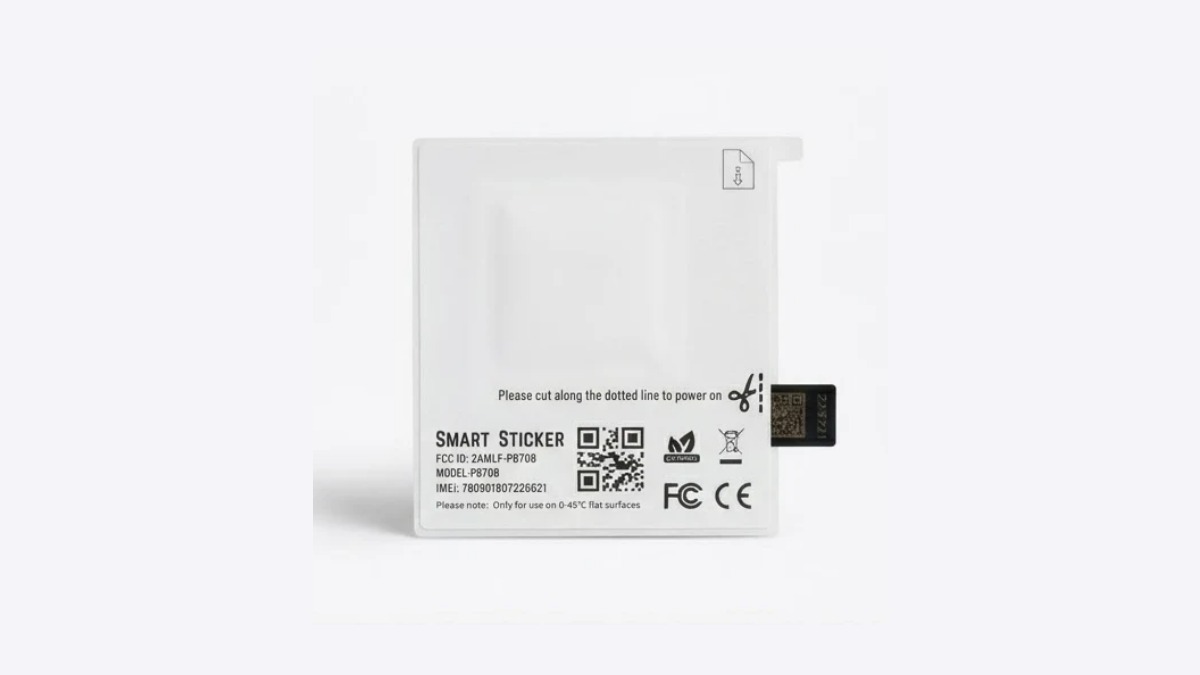
A covert GPS tracking sticker inverts the asymmetry. The GPX AssetTag is roughly the size of an Airtag, runs on a four-year non-replaceable battery, and requires zero wiring or external power source on the asset itself. Installation takes thirty seconds: peel the backing, press the adhesive against any clean surface, and the device is live.
That form factor means the tag can be placed where a thief will not look:
- Underneath the chassis of a generator
- Inside the lid of a sealed toolbox
- Between layers of a stretch-wrapped pallet
- Behind a hydraulic line on an excavator
- Slipped inside the foam padding of an equipment case
- Mounted on the underside of a trailer crossmember
Detection by scanning is also harder than most fleet operators assume. Bluetooth Low Energy broadcasts at intervals measured in milliseconds with transmit power often below 0 dBm. A thief carrying a generic BLE scanner app would need to be within roughly twenty to thirty feet of the asset, scanning the right channel at the right millisecond, with no other Bluetooth devices nearby creating noise. In practice, that is not how cargo and equipment theft happens. Thieves move fast, work in low light, and rely on visual identification of known tracker form factors.
A small sticker has no visual signature. There is nothing for them to find.
How Covert Tracking Compares to Standard Hardware Approaches
The trade-offs across tracking approaches become clear when laid side by side. Each form factor solves a different problem, and the right answer for most fleets is not picking one but stacking the right two.
| Tracking Approach | Visibility to Thief | Time to Disable | Non-Powered Assets | Annual Cost |
|---|---|---|---|---|
| GPX AssetTag (Covert BLE Sticker) | Hidden anywhere on the asset | Cannot be located | Yes (tools, generators, pallets, trailers) | $45 flat-rate, hardware included |
| Hardwired Telematics | Visible, wired into vehicle | Under 60 seconds with wire cutters | No | $300 to $600+ |
| Cellular GPS Box | Visible, often under the dash | 1 to 2 minutes with battery removal | Limited | $200 to $400+ |
| OBD-II Plug-in Tracker | Visible at OBD port | Instant unplug | No | $120 to $300+ |
The covert approach wins on every metric that matters during an active theft event: invisibility to the attacker, refusal to be disabled, coverage of the non-powered assets that legacy systems cannot touch, and a flat-rate cost that does not scale linearly with fleet size. Beyond the four columns, the GPX AssetTag also installs in 30 seconds with peel-and-stick adhesive, runs on a 4-year sealed battery with no field service required, and feeds Scout AI for predictive recovery alerts that hardwired and OBD systems do not natively offer. The trailers, generators, pallets, and tool crates that hardwired systems cannot serve at all are exactly the equipment categories with the highest theft exposure on a typical construction site. The trade-off is a single one: covert tags do not provide engine diagnostics or driver behavior data, because they are not wired into a powered vehicle. For non-powered assets, that trade-off does not exist. For powered equipment, the better answer is to run both: a hardwired GPS unit visible to mechanics and dispatchers, and a covert AssetTag hidden where the thief cannot find it.
Stacking Security: Combining Visible Decoys with Hidden Sticker Trackers
The most effective theft recovery strategy in 2026 is not one tracker. It is two trackers working together.
The visible unit, whether a hardwired GPS box in the cab, a standard telematics device on the dashboard, or a roof antenna pod, serves as a decoy. Thieves expect to find one. When they cut the wires and pull the unit, they believe they have neutralized the tracking. They get back in the truck and drive.
The covert AssetTag, hidden somewhere a thief would not search, continues broadcasting. As the stolen equipment passes through neighborhoods, fuel stops, and parking lots, the GPX terrestrial BLE network of 150 million gateways picks up the broadcast and reports the position. Scout AI flags the geofence breach in seconds. The alert chain routes simultaneously to the dispatcher, the contracted security firm, and law enforcement.
The recovery rate on assets equipped with this two-layer approach climbs above 85% in industry studies. The single-tracker approach with a visible hardwired unit only sits at the 20-25% recovery rate that has held steady for a decade. The difference is the second tracker the thief never knew was there.
Predictive and Agentic Loss Prevention with Scout AI
Hardware that can be hidden is only half the answer. The other half is the platform that decides when a normal movement becomes a theft event.
Scout AI runs predictive and agentic monitoring on every device in a customer’s fleet. The platform learns the normal pattern of each asset: which job sites it visits, what hours it operates, which routes it follows between yards. When that pattern breaks, an excavator that has been parked at site A for six weeks suddenly moves at 2:47 AM on a Sunday, or a pallet of tools leaves a fenced yard outside the hours of any scheduled pickup, Scout AI does not wait for a human to read a dashboard. It pushes the alert.
That alert chain is configurable to a customer’s exact playbook. A typical setup routes simultaneously to:
- The fleet manager via SMS and the GPX mobile app
- A dispatcher webhook that opens a ticket in the customer’s incident system
- A Slack or Microsoft Teams channel for the operations team
- The contracted security firm via API
While the alert is being dispatched, the AssetTag continues to report position through the BLE network as the asset is on the move. Recovery teams arrive at the asset’s actual current location, not the last known position before the visible tracker was disabled.
The agentic layer matters most for law enforcement. Scout AI can automatically generate a secure, time-limited live-tracking URL, which can be shared directly with the local police dispatch assigned to the case. The responding officer opens the URL in any browser, sees the asset’s position updating live, and routes to it without an app install, a credential exchange, or a phone tag with a fleet manager who is asleep. At 3:00 AM on a Sunday, that single agentic step compresses the recovery window from hours of coordination into minutes of pursuit. The fleet manager stops being a middleman in the recovery chain. The platform does the dispatch work.
Scout AI also surfaces post-incident analysis: which lanes saw the most theft activity in the last 90 days, which yards have repeat after-hours movement, which assets are statistically the highest theft risk going into the next holiday weekend.
Stop Funding the Theft Loss Column
Every untracked piece of equipment on a job site is a five-figure line item one bad weekend away from being replaced. The contractors and logistics operators winning in 2026 are not the ones buying the most expensive trackers. They are the ones buying the trackers thieves cannot find. Recovery rates have moved from a hardware spec into a security architecture decision, and the architecture that wins is layered. A visible decoy absorbs the cut-and-run attack. A covert tracker survives it. An agentic platform routes the recovery before the asset crosses the next county line.
The math behind that architecture is finally accessible without an enterprise contract. Flat-rate covert tracking, hardware included, with predictive AI built into the platform, has compressed what used to be a six-figure security capital project into a per-asset annual subscription. For fleets ready to stop writing off the theft loss column, the GPX AssetTag delivers the covert layer at $45 per asset per year with no installation fee and no multi-year contract. Visit the GPX asset tracking devices page for the pilot program, or request pricing to start tagging your fleet before the next holiday weekend.
Frequently Asked Questions (FAQs)
Are covert tracking stickers easily detectable by thieves with scanning devices?
No, not in any practical scenario. BLE asset tags broadcast at very low power, often below 0 dBm, on intervals measured in milliseconds. A thief would need a specialized BLE scanner, the right channel selection, and physical proximity within roughly twenty to thirty feet, with no other Bluetooth devices in the area creating noise. Theft crews typically work fast, in low-light conditions, and rely on visual identification of known tracker form factors. A small sticker has no visible signature, and ambient Bluetooth noise from phones and accessories makes targeted scanning impractical.
Can I use covert stickers on non-powered assets like trailers, pallets, and generators?
Yes, and this is one of the strongest use cases for covert sticker tracking. Non-powered assets cannot host a hardwired GPS unit because there is no vehicle electrical system to draw from. Trailers, pallets, generators, scaffolding sections, tool crates, returnable shipping containers, and equipment cases are all common AssetTag deployments. The four-year battery and weatherproof construction make the device suitable for assets that move between job sites, sit in storage between phases, or ship one-way to customer locations.
What happens after a covert sticker detects theft and how does recovery work?
When Scout AI flags a geofence breach or anomalous movement on a tagged asset, the platform routes alerts simultaneously to the fleet manager, dispatcher, and contracted security firm through configurable webhooks and APIs. The AssetTag continues reporting position through the GPX terrestrial BLE network as the asset is on the move while the alert chain is active. Recovery teams arrive at the asset’s actual current location rather than the last known position before a visible tracker was disabled. Industry recovery rates for assets equipped with covert BLE tags, paired with a visible decoy tracker, climb above 85% compared with 20 to 25% for visible-only tracker setups.