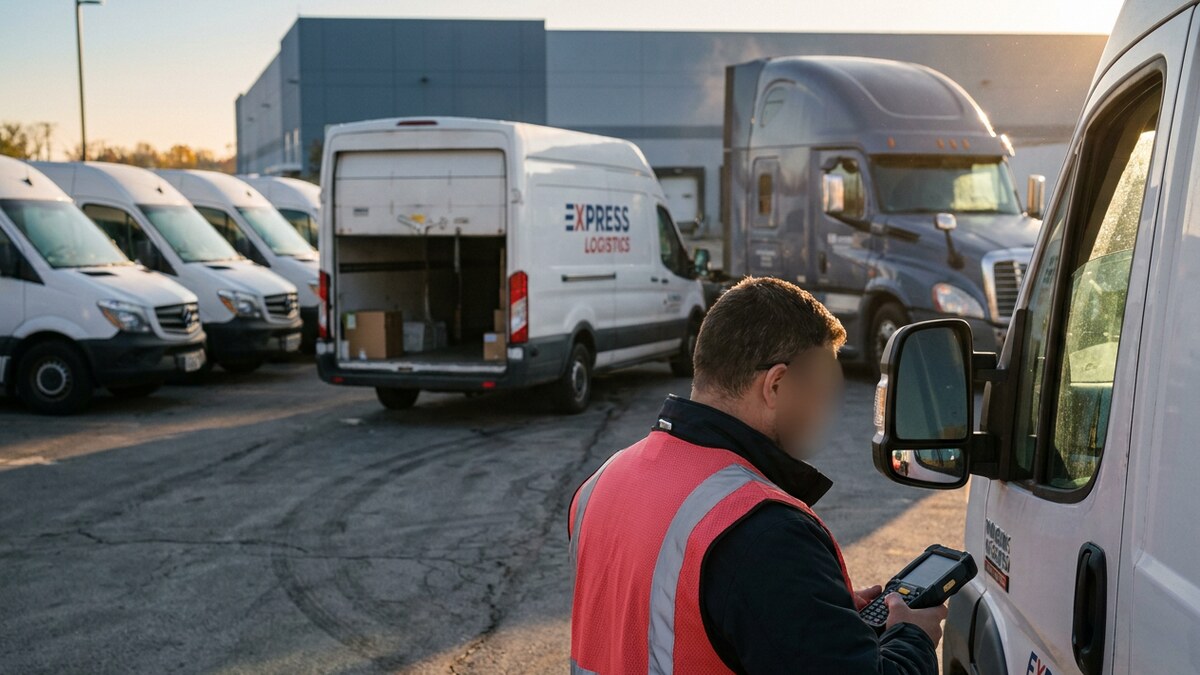


Supply chain risk falls into nine categories, from operational and transportation risk to cyber, climate, and reputational risk. Disruptions amplify as they move downstream, so early detection is the difference between a minor delay and a margin-killing event. GPS tracks assets in transit, BLE pinpoints them on site and indoors, RFID identifies items at scale, and AI reads across all three to predict trouble before it lands. GPX Intelligence combines these layers, with the GPX AssetTag delivering years of tracking on a 4-year replaceable battery.
A single late shipment rarely stays a single problem. It backs up a production line, triggers expedited freight charges, frustrates a customer, and erodes margin three departments away from where it started. That chain reaction is the heart of supply chain risk, and it is why real-time visibility has become the most valuable currency in modern logistics.
This guide breaks down the major types of supply chain risk, explains how each one works and spreads, weighs the trade-offs of managing it proactively, and shows where GPS tracking, BLE beacons, RFID, and AI fit into a real-world risk strategy. Whether you run a fleet, a construction yard, a healthcare distribution network, or a multi-site manufacturing operation, the goal is the same: see the disruption coming before it costs you.
What Is Supply Chain Risk in 2026? Mechanics, Predictive Analytics, and Digital Twins
Supply chain risk is the probability that a disruption, anywhere from raw material sourcing to final-mile delivery, prevents goods, components, or assets from moving on time, intact, and at expected cost. It covers everything from a port closure halfway around the world to a misplaced trailer in your own yard.
The mechanics are straightforward. Every supply chain is a sequence of dependencies. Each node, a supplier, a carrier, a warehouse, a distribution center, depends on the node before it. When one node fails or slows, the delay transfers downstream and often amplifies along the way. A two-day supplier delay becomes a one-week customer delay once safety stock, rescheduling, and rerouting compound the original gap.
What separates 2026 from a decade ago is the shift from hindsight to foresight. Predictive analytics now models disruption probability from live IoT sensor feeds, transit histories, weather, and port congestion data. Leading operations build digital twins, virtual replicas of their physical network, to stress-test routes and simulate failures before they happen in the real world. Both depend on one input above all others: clean, continuous location and condition data from the assets themselves.
Risk lives in three places at once:
- Inside your operation: equipment breakdowns, labor shortages, inventory errors, and lost or stolen assets.
- Across your partners: supplier insolvency, carrier capacity gaps, quality failures, and single-source dependencies.
- In the wider environment: weather events, geopolitical shifts, regulatory changes, and cyberattacks on connected systems.
Understanding where a risk originates determines how you defend against it. You control the first category directly, influence the second through contracts and monitoring, and absorb the third through resilience and rapid response.
The ROI of Supply Chain Resilience: Why Predictive Risk Management Is a Core Business Strategy
Supply chains have grown longer, leaner, and more interconnected, which raises both efficiency and fragility at the same time. Just-in-time inventory strategies that once cut carrying costs now leave little buffer when a shock hits. The result is that disruptions reach the customer faster and hurt more.
Several pressures make proactive disruption management a baseline requirement rather than a competitive luxury:
- Compressed margins. Expedited freight, write-offs from spoiled or lost goods, and idle labor erode profit quickly when a shipment goes off plan.
- Customer expectations. Buyers expect accurate delivery windows and real-time status. A blind spot in your network turns into a service failure on their end.
- Asset value. High-value equipment, returnable containers, and in-transit inventory represent capital that walks away when tracking stops at the loading dock.
- Regulatory and compliance demands. Sectors like healthcare and automotive carry chain-of-custody and condition-monitoring requirements that paper trails alone no longer satisfy.
The ROI math is consistent. The cost of visibility is fixed and predictable. The cost of disruption is variable and arrives at the worst possible moment. Once a single major event is priced in, the investment in resilience pays for itself. The organizations that weather disruption best are not the ones with the shortest supply chains. They are the ones with the clearest view of what is happening inside them.
9 Key Types of Supply Chain Risk (and How IoT and Generative AI Mitigate Them)
Supply chain risk is not a single threat. It is a family of distinct risk types, each with its own triggers and its own defenses. The nine categories below cover the ones that disrupt physical goods and assets most often.
1. Operational risk. Failures inside day-to-day execution: equipment breakdowns, production stoppages, inventory inaccuracies, and assets that go missing between sites. Operational risk is the most visible category because it shows up in your own four walls and your own yard.
2. Logistics and transportation risk. Disruptions in the physical movement of goods: carrier delays, route congestion, theft in transit, and shipments that arrive damaged or in the wrong condition. This is where in-transit visibility pays off most directly.
3. Supply (sourcing) risk. Threats tied to where your inputs come from: supplier insolvency, single-source dependency, quality defects, and raw material scarcity. A sole supplier with no backup is a concentrated point of failure.
4. Demand risk. Volatility on the customer side: sudden demand spikes, forecast errors, and seasonal swings that leave you overstocked or short. Poor demand visibility forces reactive, expensive corrections.
5. Financial risk. Currency fluctuation, rising input costs, payment defaults, and the cash-flow strain that disruption creates downstream.
6. Environmental and climate risk. Weather events, natural disasters, and longer-term climate shifts that close ports, flood routes, and idle facilities. This category now overlaps with sustainability compliance, including Scope 3 emissions tied to freight movement and the loss of reusable packaging.
7. Geopolitical and regulatory risk. Tariffs, trade restrictions, sanctions, border delays, and changing compliance rules that reroute or halt the flow of goods.
8. Cyber and data risk. Attacks on the connected systems that run modern logistics, from warehouse management software to telematics platforms. As supply chains digitize, the data layer becomes a target.
9. Reputational risk. The downstream cost when failures, recalls, or ethical lapses in your network reach customers and the public.
Each of these categories shares one weakness: it thrives in the dark. IoT hardware (GPS, BLE, and RFID) supplies the live data that exposes risk as it forms, and generative AI turns that data into plain-language alerts, root-cause summaries, and forecasts. The sections ahead map each technology to the risks it mitigates.
The Bullwhip Effect in Logistics: Stopping Supply Chain Disruptions Before They Spread
The reason supply chain risk deserves dedicated attention is amplification. Disruptions rarely stay contained. They cascade, and the cost grows at each step.
Consider a returnable transport item, a reusable container, a piece of rented equipment, a medical device cart, that goes missing between two sites. The immediate loss is the replacement cost. But the ripple extends further:
- The job or shipment that needed the asset stalls, idling labor.
- A replacement is rush-ordered at premium pricing.
- The downstream customer receives a delayed or incomplete delivery.
- Staff spend hours searching, reconciling records, and filing reports instead of doing productive work.
The original loss multiplies because each node absorbs the shock and passes a larger version of it forward. This amplification, known as the bullwhip effect when it concerns demand and inventory, is exactly why early detection matters so much. A risk caught at the source costs a fraction of the same risk caught three nodes later. Visibility technology earns its keep by shrinking the gap between when something goes wrong and when you know about it.
Active Supply Chain Risk Management: Cost Analysis, Trade-Offs, and Overcoming Data Silos
Treating risk as something to monitor and manage rather than absorb after the fact carries clear advantages, and a few honest trade-offs. The table below lays them out side by side.
| Dimension | Pros of Proactive Risk Management | Trade-Offs to Plan For |
|---|---|---|
| Total cost of ownership | Cuts expedited freight, asset loss, and emergency replacements. Protects margin during disruption. | Upfront investment in tracking hardware, software, and process change. |
| Visibility | Real-time location and condition data across in-transit, yard, and indoor environments. | Data delivers value only when it flows into the systems teams already use. |
| Response speed | Early alerts shrink the time between disruption and reaction, limiting the ripple effect. | Alert systems need tuning so teams act on signal, not noise. |
| Resilience | Diversified sourcing and buffers reduce single points of failure. | Redundancy raises carrying cost and complexity if overbuilt. |
| Compliance | Chain-of-custody and condition records satisfy regulatory and audit demands. | Data retention and security obligations grow with the volume collected. |
The biggest obstacle in that right-hand column is integration. Logistics directors are right to worry about buying hardware that will not talk to their existing ERP or Warehouse Management System, because data trapped in a standalone app creates a new silo instead of removing one. The answer is an API-first platform. When GPS and BLE feeds push directly into the dashboards and systems teams already run, tracking data enriches the single source of truth rather than splitting it. Evaluate any tracking investment on how cleanly it integrates, not just on the hardware spec.
Next-Gen Asset Visibility: Leveraging GPS, BLE Beacons, RFID, and Machine Learning
The risk types above thrive in the dark. Disruption you cannot see is disruption you cannot stop. Four technologies, used together, turn that darkness into a live picture of where your assets are, what condition they are in, and what is about to go wrong.
GPS Tracking for In-Transit and Outdoor Visibility
GPS delivers location data across wide outdoor areas, which makes it the backbone of in-transit and fleet visibility. A GPS tracker on a trailer, container, or high-value shipment reports position in near real time, so you know whether freight is on route, stalled, or off course. For transportation risk, GPS shortens the gap between a delay and your awareness of it, and the geofencing it enables flags when an asset leaves an authorized zone, an early signal of theft or misrouting. Optimized GPS routing also trims empty miles and fuel burn, which lowers the Scope 3 emissions tied to freight movement.
BLE Beacons for Yard, Site, and Indoor Tracking
GPS loses precision indoors and in dense environments like yards, warehouses, and construction sites. Bluetooth Low Energy fills that gap. BLE beacons are small, low-power tags that broadcast their presence to readers and gateways, pinpointing assets at close range where satellite signals struggle. The GPX AssetTag is built for exactly this role: a rugged BLE tag with a 4-year replaceable battery, designed to track tools, equipment, returnable containers, and inventory across the indoor and on-site environments where most asset loss actually happens.
That replaceable battery matters more than it first appears. Sealed tracking hardware forces a full rip-and-replace cycle the moment the power runs out, a recurring capital cost that fleet and yard operators feel every few years. Because the GPX AssetTag battery is replaced rather than the whole tag, the device stays in service for the long haul and keeps total cost of ownership low. Reliable BLE container tracking also protects expensive reusable packaging from the silent losses that drive up both cost and waste.
RFID for High-Volume Item-Level Identification
RFID excels at fast, item-level identification at fixed checkpoints. Passive RFID tags are inexpensive enough to apply to large volumes of inventory, and readers at dock doors, gates, and processing stations log items as they pass without line-of-sight scanning. For operational and inventory risk, RFID reduces the manual counting errors and reconciliation gaps that quietly drain accuracy. It answers the question “did this item pass this point” at scale and at low cost per tag.
Machine Learning for Prediction and Noise-Free Alerts
GPS, BLE, and RFID generate the data. Machine learning turns that data into foresight. By analyzing patterns across location histories, dwell times, and condition readings, AI models flag anomalies before they become losses: a trailer idling longer than normal, an asset drifting outside its usual route, a demand pattern that signals a coming stockout.
Just as important, machine learning solves the alert-fatigue problem that buries large tracking deployments. Thousands of tracked points generate a flood of status changes, and most of them mean nothing. AI filters that noise, suppresses false positives, and surfaces only the critical anomalies that need a human decision. The result is a short list of alerts that matter rather than an inbox no one reads. Layered on top of tracking hardware, machine learning becomes the analytical brain of the visibility stack.
Used in combination, these four layers cover the full journey. RFID confirms items at checkpoints, BLE pinpoints assets on site and indoors, GPS follows them across the open road, and AI watches the whole picture for the signals a human would miss.
IoT Tech Stack Comparison: Choosing Between GPS, BLE, RFID, and AI for Real-Time Visibility
Each technology owns a different part of the supply chain. The comparison below shows where each one fits, so you match the tool to the risk instead of forcing one solution onto every problem.
| Technology | Best Environment | Tracking Range | Primary Risk It Addresses | Best For |
|---|---|---|---|---|
| GPS (Active) | Outdoor, in-transit, fleet | Global, via satellite | Transportation, theft, misrouting | Vehicles, trailers, long-haul shipments |
| BLE (GPX AssetTag) | Yard, indoor, on-site | Short to medium range | Asset loss, on-site visibility | Tools, equipment, containers, RTIs (4-year replaceable battery) |
| RFID (Passive) | Fixed checkpoints, high volume | Very short range | Inventory accuracy, reconciliation | Item-level identification at gates and docks |
| AI / Machine Learning | Across all data layers | Data-driven, not physical | Demand, prediction, anomaly detection | Forecasting and noise-free early warnings |
No single row is the answer. The strongest risk programs stack these layers so the strengths of one cover the limits of another, with AI reading across all of them and an API-first platform feeding the combined data into the systems teams already use.
Strategic Framework: How to Build an AI-Driven Supply Chain Risk Strategy
The right strategy starts with your risk profile, not a technology shopping list. Work through these questions in order, and the tooling decisions follow naturally.
- Where do your losses actually happen? If assets disappear on site and in the yard, lead with BLE tags. If freight goes dark on the road, lead with GPS. If inventory counts never reconcile, RFID solves that first.
- What is the value of what moves? High-value equipment and returnable assets justify rugged, long-life tracking. Low-cost, high-volume inventory favors inexpensive RFID tags applied at scale.
- Indoor, outdoor, or both? Match the technology to the environment. Outdoor and in-transit point to GPS, while indoor and dense on-site environments point to BLE.
- How fast do you need to react? If a delay of hours is costly, you need real-time alerts and AI-driven anomaly detection, not end-of-day reports.
- Will it integrate? Confirm the platform pushes data into your ERP, WMS, and telematics platforms through open APIs, so visibility strengthens your single source of truth instead of fragmenting it.
- What does compliance require? Regulated sectors like healthcare and automotive need chain-of-custody and condition records built in from the start.
The most resilient operations rarely choose one technology. They build a layered stack matched to where their specific risks live, then add AI to turn the combined data into early warnings. Start with your single biggest source of loss, prove the value, and expand from there. Visibility compounds: every asset you can see makes the whole network easier to defend.
Future-Proof Your Fleet and Freight: Predictive Asset Tracking With GPX Intelligence
Supply chain risk does not announce itself. It hides in the gaps between your loading dock and your customer, and it grows the longer it goes unseen. GPX Intelligence closes those gaps with rugged GPS and BLE asset tracking built for in-transit, yard, indoor, and on-site environments, paired with the API-first data foundation that AI-driven risk detection depends on. The GPX AssetTag delivers years of dependable tracking on a 4-year replaceable battery, so your visibility never quietly switches off. Talk to the GPX team about mapping your risk profile to the right tracking stack and turning blind spots into early warnings.
Frequently Asked Questions (FAQs)
What is the difference between active GPS and passive RFID in logistics?
Active GPS provides real-time global location through satellite signals, so you track an asset continuously while it moves. Passive RFID has no power of its own and only registers when an asset passes through a physical, short-range reader checkpoint such as a dock door or gate. GPS answers “where is it right now,” while RFID answers “did it pass this point.”
How does Bluetooth Low Energy (BLE) fix warehouse and indoor blind spots?
BLE beacons ping nearby local gateways without needing satellite line-of-sight, so they deliver pinpoint accuracy indoors and in dense yards where GPS signals drop out. This makes BLE the right tool for tracking tools, equipment, and containers across warehouses, construction sites, and on-site environments.
What is the best tracking technology for returnable transport items (RTIs)?
BLE tags with long-life replaceable batteries, like the GPX AssetTag with its 4-year replaceable battery, are the standard for returnable transport items. They combine yard-level and indoor precision with low maintenance cost, which protects reusable containers and packaging from the silent losses that erode margin.