

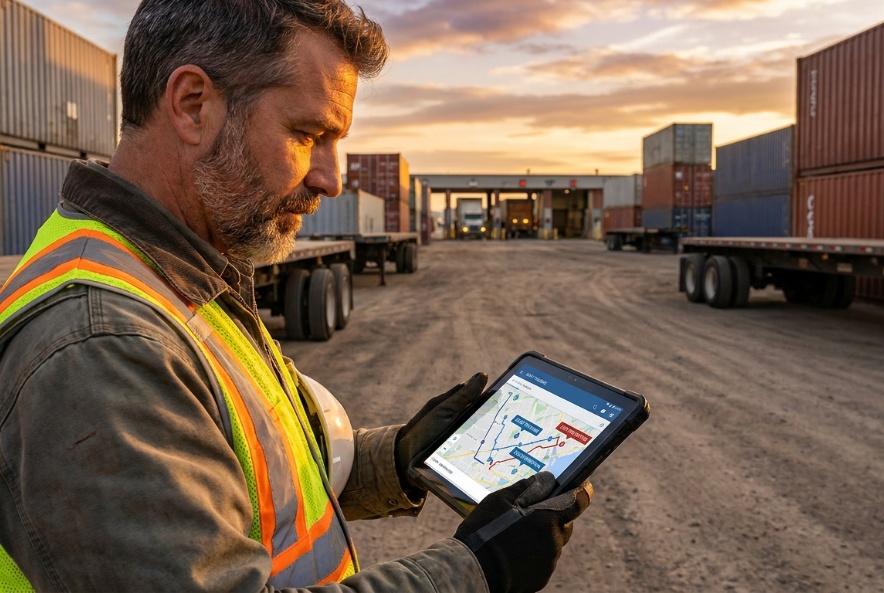
I’ve watched the same story play out hundreds of times since starting GPX Intelligence. Someone calls us after a painful loss. A stolen trailer, a vanished shipment, equipment that just disappeared from a job site. In that moment, everything about our solution clicks. The demo goes great, the ROI is obvious, and we’re talking about years of coverage for a fraction of what they just lost. It’s a no-brainer.
Then a few weeks go by. The sting fades. The equipment gets replaced. And somewhere between the quote and the purchase order, they talk themselves out of it. “It probably won’t happen again.”
It does happen again, almost every time. Some of these folks come back after a second loss. Some after a third. That’s the thing about supply chain theft and asset loss. It’s never the isolated incident you want to believe it was.
The customers who get it right are the ones who act before the next event, not after. One that stands out: a company came to us knowing they had leakage somewhere in their logistics chain but couldn’t figure out where. They bought 1,000 disposable shipment trackers. Within a week, one week, they flagged a shipment of precious metals that was supposed to be headed to Florida but was moving toward Texas.
Four hundred and twenty-five thousand dollars’ worth of product, drifting further off-route by the hour. They contacted law enforcement, officers met the truck at a stop, and the full shipment was recovered. The entire investment paid for itself ten times over on a single intercept. They’ve since rolled GPX across their global operation.
That’s the reality of loss prevention: the ROI isn’t theoretical. It’s sitting in the next shipment you can’t see. The question isn’t whether you can afford to invest in visibility. It’s how many times you’re willing to absorb the loss before you do.
The True Cost of Lost Inventory: Why AI Supply Chain Visibility is Mandatory
A critical piece of equipment goes missing. The immediate reaction is to order a replacement and keep the line moving. Three weeks later, it happens again. And again. Each time, the reactive approach masks a compounding financial liability that never appears on a single line item.
Supply chain leaders know their organizations are losing equipment. Missing trailers, misplaced specialized tools, and stolen inventory are often treated as unavoidable realities of doing business. But this acceptance is exactly what transforms a manageable problem into a boardroom crisis. Without real-time visibility, you cannot quantify the bleed. Without quantifying the bleed, you cannot stop it.
The Compounding Crisis of Missing Assets
The challenges compound quickly. Manual tracking methods only tell you where an asset was hours ago. Physical audits consume labor hours that should be spent on high-value tasks. Safety stock balloons because no one trusts the location data. And when theft does occur, recovery rates without active tracking can drop below 10% for small assets and tools, turning every stolen item into a near-total loss.
The scale of the problem is staggering. Cargo theft now costs the U.S. supply chain up to $35 billion annually, with strategic theft rising 1,500% since the first quarter of 2021. In the United States, the trucking sector, which handles 72.7% of freight tonnage, remains a primary target for organized theft. The construction industry similarly bleeds hundreds of millions of dollars each year due to stolen equipment. These are not isolated incidents. They are systemic financial drains that require a modern, intelligent solution.
The threat profile has fundamentally changed in 2026. Traditional “smash-and-grab” incidents are giving way to cyber-enabled freight theft, where criminals infiltrate dispatch systems, hijack carrier identities, and use GPS spoofing to conceal unauthorized route changes. The National Motor Freight Traffic Association’s 2026 Transportation Industry Cybersecurity Trends Report documented that digital compromise now routinely precedes or directly enables the physical theft of freight. CargoNet recorded $111.88 million in cargo theft claims in a single quarter of 2025. The average attacker breakout time, from initial system compromise to lateral movement, has dropped to just 18 minutes. A legacy tracker that simply reports coordinates cannot defend against this. GPS spoofing prevention now depends on multi-constellation GNSS, cellular triangulation, and behavioral anomaly detection layered into an AI logistics platform, not a standalone dot on a map.
The Hidden Financial Drain of Supply Chain Asset Loss
To understand the true financial impact of supply chain asset loss, you must look beyond the replacement cost of stolen items. The real damage includes operational downtime, project delays, emergency rental fees, expedited shipping for replacements, potential contract penalties, damage to customer relationships, and increased insurance premiums.
When workers cannot locate critical test equipment or specific shipping containers, production halts. Companies are forced into paying premium rates for emergency rentals. Staff members waste countless hours manually searching the yard or conducting physical audits instead of executing high-value tasks. AI-driven supply chain solutions can reduce logistics costs by up to 15% and drastically cut the time employees spend searching for information.
Ghost Assets: The Phantom Inventory Inflating Your Balance Sheet
The internal numbers are equally alarming. Gartner estimates that 10% to 30% of assets listed on the average company’s asset register are no longer owned by that company. These are items that are lost, stolen, or entirely unusable, yet they remain on the corporate balance sheet.
This phantom inventory creates multiple financial distortions:
- Artificially inflated asset valuations that mislead investors and stakeholders.
- Working capital tied up in equipment that no longer exists or functions.
- Overpaid taxes on assets the company does not actually possess.
- Inaccurate depreciation schedules that distort financial planning.
- Insurance premiums calculated on assets that cannot be protected because they are already gone.
The larger your inventory, the more difficult it becomes to detect these phantom assets. And every undetected ghost asset compounds the financial distortion quarter after quarter.
Supply Chain Disruption: The Ripple Effect of Missing Assets
The cost of lost inventory extends far beyond direct replacement. Supply chain operational waste ripples through the entire company in ways that are difficult to trace back to a single missing item.
Consider the sequence: A specialized tool goes missing. Production stops while workers search for it. After two hours, they give up and order an emergency replacement. The replacement arrives in three days with expedited shipping fees. Meanwhile, the downstream production schedule slips. Customer delivery dates are missed. Contract penalties accrue. Customer satisfaction drops. The original tool is eventually found in an unmarked storage area, but by then the damage is done.
This lack of transparency drains labor budgets and introduces severe supply chain disruption costs that are nearly impossible to recover.
How AI Supply Chain Visibility Prevents Loss Before It Occurs
The antidote to this financial drain is AI supply chain visibility. Legacy GPS trackers report where an asset is. An AI logistics platform interprets what that location actually means. Legacy tracking methods rely on manual scans or periodic check-ins that provide intermittent data. Real-Time Location Systems combined with predictive analytics provide an entirely different level of control.
GPX Intelligence utilizes active GPS tracking hardware paired with the Scout AI agent to deliver continuous, proactive oversight. This technology shifts the operation from manually reacting to lost items to actively preventing the loss before it occurs. It also establishes the behavioral baseline needed for GPS spoofing prevention, so coordinate manipulation during a cyber-enabled freight theft attempt shows up as an anomaly rather than a successful diversion.
Scout acts as an embedded data analyst that constantly monitors asset behavior. It automatically flags unusual dwell times, identifies when assets enter unknown locations or cross geofence boundaries, and spots behavioral anomalies indicative of potential theft. This system increases the accuracy of operational findings by more than 80%, leading to better, faster decisions and fewer costly errors.
Documented ROI: Real-World Financial Impact of AI Visibility
The financial impact of AI-powered asset tracking is well documented across industries:
| Operational Scenario | Investment | Financial Outcome | Strategic Benefit |
|---|---|---|---|
| German Automotive Manufacturer | $107,000 total | $515,000 in verified savings | Eliminated $50,000 in external consultant fees by using AI analysis |
| Large-Scale Enterprise Deployment | $660,000 total (includes labor) | $5.8 million in verified savings | Drastic reduction in manual labor and automated workflow creation |
| Hospital Network RTLS | Scaled hardware deployment | $300,000 to $500,000 saved annually | Minimized equipment loss and reduced emergency rental expenditures |
| Concrete Construction Company Asset Tracking | GPS tracking implementation | $6.5 million in total savings (2,000% ROI) | Complete visibility across distributed job sites |
The immediate recovery of $60,000 in critical test equipment lost during shipment demonstrates how quickly this technology pays for itself, often within the first incident.
The Scout AI Advantage: Agentic AI in Logistics, From Days of Analysis to Minutes
Traditional supply chain analysis requires specialized expertise and significant time investment. Scout AI fundamentally changes this equation by embedding agentic AI in logistics directly into the platform. Operations directors and CFOs are no longer searching for dashboards in 2026. They are searching for AI agents that can answer complex questions about asset utilization, dwell time, and cross-fleet performance in plain language, without waiting on an analyst.
| Analysis Task | Manual Effort | With Scout AI | Time Reduction |
|---|---|---|---|
| Complex Dwell Analysis | 3 Days (approx. 24 hours) | 2.5 Minutes | >95% |
| Anomaly Detection | 4 to 8 Hours (periodic) | Continuous, Automated | Significant |
| Cross-Fleet Reporting | 1 to 2 Days (monthly) | Minutes | >90% |
This reduction in analysis time translates directly into labor cost savings. Organizations no longer need to hire specialized data analysts or engage expensive external consultants to extract value from their tracking data. Scout provides these analytical capabilities within the platform at no additional cost.
Protecting Corporate Capital with Predictive Logistics
Transitioning to AI-driven visibility fundamentally protects your corporate capital. Organizations no longer have to accept a 10% to 30% ghost asset rate or spend thousands of dollars on external consultants to decipher complex logistics spreadsheets.
You cannot fix a financial leak that you cannot see. Investing in continuous, intelligent tracking technology turns a massive financial liability into a controlled and predictable system. It empowers your team to make immediate, accurate decisions that protect the bottom line against both smash-and-grab theft and the cyber-enabled freight theft tactics dominating 2026 loss reports.
The investment is straightforward: approximately $115 annually per tracked asset. Against that cost, organizations typically see theft reduction of up to 50%, recovery rate improvements of up to 80%, and complete elimination of ghost asset uncertainty. Most deployments achieve positive ROI within the first six months.
Frequently Asked Questions (FAQs)
How does AI supply chain visibility prevent theft?
AI systems monitor real-time location data to establish normal behavioral patterns for your assets. If a piece of equipment experiences an unusual dwell time, moves outside a designated geofence, or shows coordinate inconsistencies that signal GPS spoofing, the AI instantly flags the anomaly. Security or operations teams can intervene before the asset is permanently lost, which is especially critical against the cyber-enabled freight theft tactics documented in the NMFTA 2026 Transportation Industry Cybersecurity Trends Report.
Why are Real-Time Location Systems (RTLS) more reliable than manual barcode scanning?
Real-Time Location Systems provide continuous, automated location updates without requiring human intervention. Manual scanning is prone to human error and only provides location data at the specific moment the item was scanned, leaving massive blind spots in the supply chain. RTLS delivers accuracy measured in minutes, not shifts, and the data feed is machine-readable for anomaly detection, predictive logistics, and agentic AI workflows that cannot run on stale barcode scans.
Can predictive logistics reduce labor costs?
Yes. By using AI agents to instantly answer complex data queries regarding asset utilization and location, companies eliminate the need for staff to conduct manual audits or spend days building spreadsheet reports. This drastically reduces administrative labor and overtime costs, and it reallocates analyst hours to strategic work instead of data wrangling.
How quickly can organizations expect to see ROI from asset tracking?
Most organizations project a positive ROI within the first six months of deploying GPS tracking solutions. In many cases, the recovery of a single high-value asset can offset the entire annual investment. The exact timeline depends on the scale of initial asset loss and the inefficiency of previous manual tracking processes.
What is the difference between a standard GPS tracker and an AI logistics platform?
A standard GPS tracker reports coordinates. An AI logistics platform interprets them. A tracker shows you where your asset is; a platform like GPX Intelligence with the Scout AI agent continuously evaluates whether that location is normal, whether dwell times are abnormal, whether route deviation signals theft, and whether coordinate data itself is being manipulated through GPS spoofing. The platform ingests real-time data to establish behavioral baselines and flag anomalies instantly, replacing an army of human analysts with an embedded AI copilot. This is the semantic shift behind the 2026 move toward agentic AI in logistics, and it is the difference between reacting to loss and preventing it.
Why do companies often delay purchasing GPS tracking after a theft incident?
The urgency fades quickly once stolen equipment is replaced. GPX Intelligence founder experience across hundreds of cases shows organizations talk themselves out of the purchase within weeks, convincing themselves the loss was an isolated event — a belief the pattern of repeat incidents does not support.
Is supply chain theft likely to happen again after a first incident?
Almost always, yes. Across hundreds of cases observed at GPX Intelligence, organizations that experience one theft are hit again. Some customers returned after a second loss, others after a third, before finally acting on asset tracking.