Supply Chain Risk Management: How GPS, BLE, RFID, and AI Build Resilient Operations

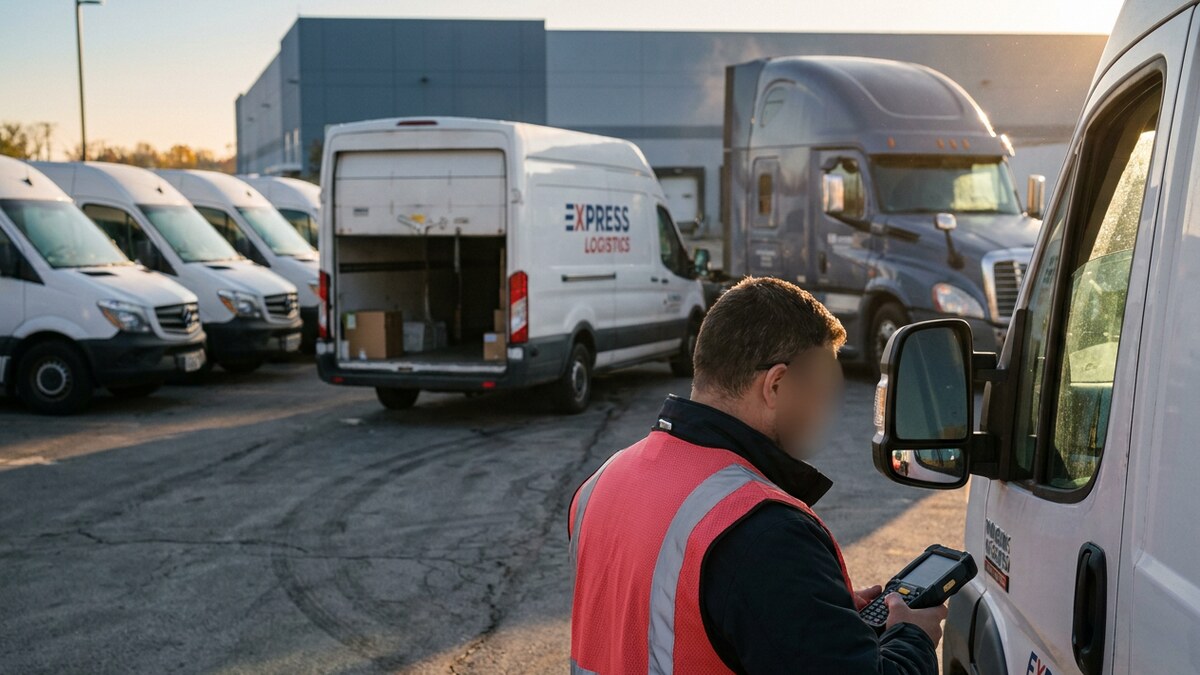
A logistics director at a US automotive parts distributor opens her dashboard at 7:00 AM and sees a problem she has no answer for. A truckload of just-in-time components left the port two days ago, the carrier ETA still reads “on schedule,” and the plant 600 miles away expects the parts on the line by noon. Then the phone rings. The shipment never crossed the state line. It has been parked at a yard since yesterday afternoon, and nobody knew, because the only signal she had was a status field a human updated by hand.
That single blind spot is what supply chain risk management exists to eliminate. The numbers explain why it now sits on boardroom agendas. Supply Chain Dive data puts the average cost of a disruption at roughly $1.5 million per day, and supply chain attacks nearly doubled between 2024 and 2025 for a global cost of $53.2 billion. In a 2026 survey, 72% of supply chain executives said automated mitigation capabilities are now mandatory to navigate modern disruptions. Visibility is no longer a competitive advantage. It is the cost of staying in business.
This guide breaks down what supply chain risk management is, how it works, its real advantages and limitations, and how four technology layers (GPS, BLE, RFID, and AI) turn a reactive operation into a predictive one.
The average supply chain disruption costs roughly $1.5 million per day, and in high-tech sectors that figure climbs to $3.5 million. Proactive visibility is no longer optional. It is the cheapest insurance a logistics operation can buy.
What this guide covers:
- What supply chain risk management (SCRM) is and why multi-tier visibility matters
- The 5-stage SCRM framework for B2B logistics
- Top supply chain disruption risks in 2026
- The cost-versus-ROI business case for resilience
- How GPS, BLE, RFID, and AI each close a different visibility gap
- A side-by-side comparison of all four visibility tools
- How to build a future-proof technology stack
What Is Supply Chain Risk Management (SCRM) & Why Multi-Tier Visibility Matters
Supply chain risk management (SCRM) is the strategic process of identifying, assessing, and mitigating vulnerabilities across a global logistics network. By combining technologies like GPS, BLE, RFID, and predictive AI, businesses gain the multi-tier visibility needed to prevent financial losses from geopolitical, operational, and cyber disruptions.
SCRM covers every stage from raw material sourcing through manufacturing, warehousing, transportation, and final delivery to the customer. The phrase that matters most is multi-tier visibility. A delay at a Tier 1 supplier is visible quickly, but the risk that stops a production line is often buried two or three tiers deep, inside a Tier 2 or Tier 3 vendor that never appears on a standard dashboard.
The discipline has shifted from a procurement footnote to a board-level priority. Geopolitical tensions, climate events, cyber threats, and demand swings now expose how fragile globally connected supply chains have become. The market reflects that urgency: the supply chain risk management market grows from $3.45 billion in 2025 to $3.73 billion in 2026, and analysts forecast it to reach roughly $5 billion by 2030.
At its core, SCRM answers four questions for every shipment, supplier, and node in the network:
- What could go wrong? The full inventory of threats, from a delayed container to a single-source supplier failure.
- How likely is it, and how badly does it hurt? The probability and financial impact of each threat.
- What do we do about it? The mitigation plan, the backup supplier, the alternate route, the safety stock.
- How do we know in time to act? The real-time data that turns a 48-hour surprise into a 2-hour heads-up.
That fourth question is where physical tracking technology and AI separate modern programs from the spreadsheets of a decade ago.
The 5-Stage Supply Chain Risk Management Framework for B2B Logistics
A mature SCRM program runs as a continuous cycle rather than a one-time audit. Each stage feeds the next, and live data keeps the loop honest.
1. Risk Identification. Teams map the entire network and catalog every threat across suppliers, transportation lanes, facilities, and systems. This includes multi-tier mapping of Tier 1, Tier 2, and Tier 3 suppliers, since a disruption two or three suppliers deep is often invisible until it stops a production line. The goal is a living digital twin of the network rather than a static spreadsheet that ages the moment it is saved.
2. Risk Assessment and Scoring. Each identified risk gets scored on two axes: how likely it is to happen and how much damage it does if it does. A low-probability event that halts production outranks a frequent event with minor impact.
3. Prioritization. Resources are finite, so teams rank risks by their combined score and focus on the threats that move revenue, compliance, and customer satisfaction the most. Manufacturing carries the heaviest exposure, making up 37.3% of the SCRM market because a single missing part halts an entire line.
4. Mitigation and Response Planning. This is where strategy becomes action: dual-sourcing critical components, building safety stock, diversifying transportation lanes, and writing the playbooks that tell teams exactly what to do when an alert fires. IDC projects that 50% of firms will move to multi-shoring sourcing strategies, splitting orders across regions rather than depending on one low-cost hub.
5. Continuous Monitoring. The cycle stays alive through real-time tracking of shipments, assets, and supplier signals. This is the stage where GPS, BLE, RFID, and AI do their heaviest lifting, converting raw location and condition data into early warnings that trigger the mitigation plans built in stage four.
Top Supply Chain Disruption Risks in 2026: Geopolitical, Cyber, and Freight Threats
Not all threats behave the same way, and a strong program addresses each category with the right tools. The risk landscape has shifted measurably in recent years.
- Operational and logistics risk. Late shipments, route delays, carrier failures, freight forwarding errors, theft, and damaged goods in transit. Logistics risk management accounts for roughly 26% of the SCRM market, reflecting the focus on transport, freight, and visibility across shipping networks.
- Geopolitical risk. Trade tensions, sanctions, tariffs, and maritime chokepoints. This emerged as the leading concern for 19% of businesses and now posts the fastest growth of any risk domain.
- Cybersecurity risk. Attacks on connected systems and supplier networks. Cyber risk climbed from 5% of concern in 2023 to 16% in 2025 as networks grew more digital and interconnected.
- Financial risk. Supplier insolvency, currency swings, and inflation, which ranks as a top concern at 18% due to rising procurement and transportation costs.
- Environmental and climate risk. Extreme weather, natural disasters, and the disruptions tied to them. A majority of companies report disruptions caused by climate events, and rising scrutiny of Scope 3 emissions now makes environmental performance an ESG reporting requirement in modern supplier contracts.
Physical and environmental risks share a common requirement: you cannot manage what you cannot see. The technology layers below exist to remove that blindness.
Cost vs. ROI: The Business Case for Proactive Supply Chain Resilience
A formal SCRM program delivers measurable returns, and it carries real costs. Decision-makers deserve an honest view of both sides.
The advantages:
- Fewer and shorter disruptions. Early detection shrinks the window between a problem starting and a team responding, which directly cuts the daily cost of an outage.
- Stronger business continuity. Pre-built mitigation plans, backup suppliers, and alternate routes keep product flowing when a primary path fails.
- Lower theft, loss, and shrinkage. Real-time location data on high-value assets deters theft and speeds recovery when it happens.
- Better customer trust. Accurate ETAs and proactive communication protect the customer relationships that take years to build.
- Regulatory and compliance readiness. Documented chain-of-custody and condition records satisfy auditors in regulated sectors like pharma, food, and defense.
- Data-driven negotiation. Hard performance data on carriers and suppliers strengthens contract terms and accountability.
The challenges:
- Upfront investment. Hardware, software, and integration carry a cost, though the average disruption hit dwarfs the price of prevention.
- Integration complexity. Connecting tracking data to existing ERP, WMS, and TMS platforms requires planning and clean APIs.
- Data overload without intelligence. Raw location pings create noise. Without an analytics layer to interpret them, teams drown in dashboards.
- Change management. Staff and partners need training to trust automated alerts and act on them rather than waiting for manual confirmation.
The strongest programs treat these challenges as design requirements rather than reasons to delay. The right hardware and AI stack solves the data overload challenge directly, which is where the next sections focus.
GPS Supply Chain Tracking: Achieving Real-Time In-Transit Visibility
GPS tracking is the backbone of in-transit visibility. A cellular GPS tracker reports the live location of a truck, trailer, container, or high-value shipment as it moves across roads, ports, and borders, replacing the hand-updated status field with ground truth.
This solves one of the most expensive challenges in B2B logistics: ghost freight. Third-party carriers often fail to update their TMS, so a shipment shows “in transit” long after it has stalled in a yard. A GPX cellular GPS tracker acts as an independent source of truth that overrides faulty carrier telematics data, so the logistics team trusts the device rather than the status field.
For supply chain risk management, GPS delivers four capabilities that matter most when goods are moving:
- Live location and route monitoring. Teams see exactly where a shipment is, not where a schedule says it should be.
- Geofencing alerts. A virtual boundary around a yard, port, or delivery zone fires an instant alert when an asset arrives, departs, or strays off the approved lane.
- Automated ETA accuracy. Live position data feeds dynamic arrival estimates, so the receiving plant and the customer get the truth instead of an optimistic guess.
- Theft deterrence and recovery. The moment a high-value load deviates or stops where it should not, the alert turns a multi-day loss into a same-hour recovery effort.
GPS answers the question “where is it on the move?” with precision. Its limit is line of sight to satellites, which is exactly the gap the next layer fills. Explore the GPX visibility platform.
BLE and RFID Asset Tracking: Eliminating Indoor Blind Spots and Inventory Shrinkage
Cellular GPS goes quiet the moment an asset rolls under a steel roof, into a stacked container, or deep inside a distribution center. This is the last-yard black hole, and it is where most shipments are lost, not on the open highway but inside the congested destination yard and warehouse. Bluetooth Low Energy (BLE) and RFID exist to track the assets GPS cannot reach: pallets in a warehouse, tools on a job site, equipment moving between hospital floors, and containers buried in a yard.
BLE asset tracking uses small, low-power tags that broadcast to a network of fixed and mobile readers. Hardware like the GPX AssetTag is built specifically for this role, with a 4-year battery life and a replaceable cell, so a deployment scales to thousands of assets without constant maintenance. It bridges the gap between the highway and the warehouse door, delivering continuous indoor zone-level visibility without the cost of dense fixed infrastructure at every chokepoint.
RFID tracking uses tags read at fixed points such as dock doors, gates, and conveyor lines. Passive RFID tags carry no battery and cost very little per unit, which makes them ideal for high-volume inventory counts and chain-of-custody scans as goods pass a reader. Active RFID extends range for larger assets.
The practical difference between the two comes down to how visibility is delivered:
- BLE gives near-continuous location across a zone, ideal for assets that move unpredictably inside a facility and need to be found on demand.
- RFID gives a precise read at a specific gate or checkpoint, ideal for confirming an item passed a known point at a known time.
Used together, GPS, BLE, and RFID create unbroken visibility from the supplier dock, through transit, into the facility, and back out again. See the GPX hardware lineup.
Predictive Supply Chain Analytics: How AI & Machine Learning Automate Risk Mitigation
Location data alone is a stream of coordinates. Artificial intelligence is the layer that reads that stream, spots the pattern, and warns a team before a delay becomes a disruption. This is the difference between knowing a truck stopped and knowing that the stop, combined with weather, port congestion, and historical lane data, will miss the production window by four hours.
This layer also solves the quiet productivity killer in most logistics operations: dashboard fatigue. Teams are drowning in data but starving for insight, forced to log into five different portals to assemble one picture. A unified platform consolidates disparate data streams from GPS, BLE, RFID, and IoT sensors into a single pane of glass, so the machine learning models read one clean feed and surface the decision rather than the raw noise.
AI strengthens supply chain risk management across several high-value functions:
- Predictive disruption detection. Models ingest GPS telemetry, IoT condition sensors, weather, and customs data to flag at-risk shipments hours or days ahead of impact.
- Dynamic ETA and route optimization. Machine learning recalculates arrival times and reroutes around emerging congestion in real time.
- Demand forecasting and inventory positioning. AI analyzes historical sales, seasonality, and live supply constraints to pre-position stock and prevent both stockouts and excess carrying costs.
- Anomaly detection. Models learn the normal behavior of a lane or asset and flag the unusual stop, the temperature excursion, or the off-pattern route automatically.
- Autonomous control tower coordination. The most advanced programs let AI agents triage alerts, recommend the mitigation play, and coordinate the response across teams, turning the five-stage cycle into a self-monitoring system.
The market direction is clear. IDC predicts that by 2026, 55% of global 2000 OEMs will redesign their service supply chains around AI to pre-position parts and prevent disruptions. The payoff depends as much on clean data integration as on the algorithms, which is why the hardware layer and the intelligence layer have to be built as one system.
Comparing Logistics Visibility Tools: GPS vs. BLE vs. RFID vs. AI Analytics
These technologies are not competitors. They are complementary layers, each closing a gap the others leave open. The quick answer for which tool wins each environment:
- Choose GPS for over-the-road and cross-border freight where live outdoor location is the priority.
- Choose BLE for dynamic warehouse and yard environments where assets move unpredictably and need continuous indoor location.
- Choose RFID for high-volume inventory counts and chain-of-custody confirmation at fixed checkpoints.
- Choose AI analytics as the brain that ingests all three feeds to predict disruptions and automate the response.
The table below shows where each one delivers the most value in a supply chain risk management program.
| Visibility Layer | Primary Strength | Coverage | Power and Battery | Best Supply Chain Use Case | Risk It Reduces |
|---|---|---|---|---|---|
| GPS Tracker (cellular) | Live outdoor location across roads, ports, and borders | Nationwide and cross-border, outdoor | Rechargeable or long-life cell, varies by model | In-transit shipment and fleet tracking | Transit delays, theft, route deviation |
| GPX AssetTag (BLE) | Continuous indoor and yard zone-level location | Facilities, warehouses, yards, and indoor sites | 4-year battery life, replaceable cell | Finding pallets, tools, and equipment indoors | Lost assets, indoor blind spots, shrinkage |
| RFID (passive and active) | Precise read at a fixed checkpoint or gate | Dock doors, gates, conveyor lines | Passive needs no battery; active is powered | High-volume inventory counts and chain of custody | Inventory error, miscounts, custody gaps |
| AI Analytics Layer | Predicts disruptions and recommends action | Network-wide, software based | Cloud or edge compute, no field battery | Early warnings, forecasting, control tower | Reactive response, data overload, surprise |
A resilient program layers all four: GPS for the road, BLE for the building, RFID for the checkpoint, and AI for the brain that ties them together.
How to Build a Future-Proof Supply Chain Risk Management Technology Stack
The right stack is the one that matches your highest-impact risks, not the one with the longest feature list. Use these questions to size the decision before you buy anything.
- Where do your shipments lose visibility? If the blind spot is on the road, lead with GPS. If it is inside a facility or yard, BLE tracking closes the gap. If it is at a specific checkpoint, RFID confirms the read.
- What does a single disruption cost you per day? Multiply that figure across a year of incidents and the investment case writes itself against the average daily disruption cost.
- Do you need to react faster or predict sooner? Hardware tells you what is happening now. The AI layer tells you what is about to happen, which is the upgrade that separates resilient operations from reactive ones.
- How clean is your data integration? The value of any tracking layer depends on feeding it into your ERP, TMS, or WMS through reliable APIs. Build the integration plan before the rollout.
- Does it scale to your asset count? A pilot of 50 tags behaves differently than a fleet of 50,000. Long battery life, group-based management, and a unified platform decide whether the program survives scale.
The strongest move is to start with the layer that addresses your largest exposure, prove the return on a focused pilot, then expand into a unified GPS, BLE, RFID, and AI platform that gives you one view of every asset from the supplier dock to the customer door. GPX Intelligence builds that unified visibility stack for B2B operations across fleet, construction, healthcare, automotive, and in-transit logistics. Talk to the team to map your highest-risk lanes and build the right stack at gpx.co.
Frequently Asked Questions (FAQs)
How do I monitor multi-tier supply chain risks in real-time?
To monitor multi-tier risks, companies move beyond manual audits and integrate a unified technology stack. This means deploying cellular GPS for in-transit freight, BLE and RFID for indoor asset tracking, and feeding that telemetry into an AI analytics layer. The combination creates a live digital twin of your network that exposes vulnerabilities in Tier 1 and Tier 2 suppliers before they reach the production line.
How does predictive AI prevent supply chain disruptions?
Predictive AI prevents disruptions by analyzing historical patterns alongside real-time data to forecast failures before they happen. Rather than simply reporting that a truck is late, the models ingest GPS telemetry, weather data, and port congestion metrics to flag high-risk shipments 48 to 72 hours in advance, giving control tower teams the time to reroute freight and protect the delivery window.
What is the best asset tracking solution for high-value logistics?
The best solution depends on the environment. Cellular GPS trackers are best for over-the-road and cross-border freight. For continuous indoor tracking inside distribution centers and yards, BLE tags such as the GPX AssetTag, with a 4-year battery life and a replaceable cell, offer the most cost-effective and scalable zone-level visibility. Most high-value programs combine both.
What is the first step to building a supply chain risk management strategy?
The first step is risk identification: map your full network, including multi-tier suppliers, and catalog every threat across suppliers, transportation lanes, facilities, and systems. Once the threats are visible, you score them by likelihood and impact, then prioritize the ones that most affect revenue, compliance, and customer satisfaction.