
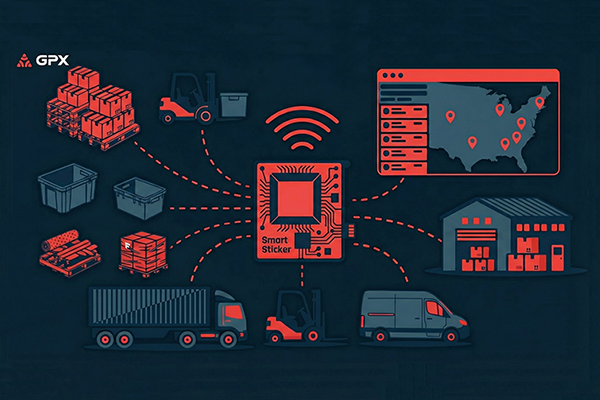

Modern operations depend on reliable connectivity. The newest tracking stickers and smart tags connect to nearby smartphones, gateways and cellular IoT networks, giving you continuous visibility as your assets move through warehouses, job sites and the field. These devices activate in seconds and work on tools, pallets, shipments, generators, vehicles and other high-value items.
They use BLE, crowdsourced device signals and cellular GPS to deliver location updates without the wiring or installation work required by older telematics hardware. Even consumer products like AirTags use a similar idea, but commercial tags offer stronger range, better reporting and a more dependable network for real business use.
Companies adopt these modern tracking stickers because they reduce tool loss, limit downtime and cut hours of manual search time. If you want a clear view of where your equipment is and how it moves, this guide outlines what you need to know.
In this blog, we have researched and highlighted the top 7 GPS tracking sticker and smart tag providers in the United States. These solutions cover both BLE-based sticker labels and full cellular GPS pucks, giving you options for indoor and outdoor tracking across any operation.
Why “Ghost Assets” Are Silent Budget Killers”]
Many companies focus on theft, but the larger cost often comes from missing visibility across day-to-day operations. These gaps create delays, duplicate purchases and unnecessary expenses that accumulate across job sites.
Common challenges driving the shift to automated tracking:
- Industry Losses: The National Equipment Register reports more than 1 billion dollars lost each year in the construction and logistics sectors due to theft. Recovery rates for untracked assets remain below 25 percent.
- Search and Rescue Labor Cost: Field teams spend an average of 40 hours each month locating shared equipment across large sites. This is one full week of paid labor with no productive output.
- Insurance Premium Bloat: Many organizations continue paying premiums on assets that are missing or discarded because they cannot prove loss or verify location history.
- Hoarding Culture: Without reliable visibility, site managers keep extra tools and equipment “just in case,” which leads to unnecessary purchasing and inflated inventory.
- Theft Recovery Window: The first four hours after theft are critical for recovery. Consumer tags depend on nearby phones. Commercial GPS trackers operate independently and continue reporting location even in rural areas.
These challenges are the core drivers behind the move to modern tracking solutions. Better visibility reduces waste, improves asset utilization and protects the company’s bottom line.
Top 7 GPS Tracking Stickers & Tag Providers
We researched the leading GPS sticker and asset tag providers in the United States. The options range from thin BLE smart labels similar to AirTags to rugged GPS pucks built for long-term outdoor tracking. Each solution offers a different balance of battery life, connectivity and durability depending on the type of asset you need to monitor.
1. GPX Intelligence (Smart Label)
A true paper-thin smart sticker that turns a regular shipping label into a live tracker for modern supply chains.
Instead of a plastic box or bolt-on puck, the GPX Smart Label is a flexible label ~1 mm thick with the battery, antenna, and chip laminated inside. It rides on BLE “crowdsourced” networks, so there’s no SIM card to manage, no wiring, and no dedicated gateway required—just peel, stick, and you’re online.
How it Works: Nearby smartphones, forklifts, or facility vehicles hear the BLE signal and securely relay location and status into the GPX platform. That means every tag automatically joins a shared network of listeners, giving you lane-level and site-level visibility without having to deploy heavy infrastructure at every dock or yard.
Specs:
- Thickness: ~1mm (printable, flexible label format)
- Battery Life: ~30–45 Days (eco-friendly Zn-Mn battery).
- Installation: Peel-and-stick, no tools or wiring
Best For: High-volume logistics where you need to tag a lot of things quickly—pallets, laptop cases, outbound shipments, high-value parcels. GPX Smart Labels give you low-profile, “use-and-recycle” visibility that plugs into a connected system instead of adding more bulky hardware to manage.
2. Samsara (AG51 Asset Tag)
Samsara’s AG51 is a BLE asset tag built for fleets already using Samsara gateways. It extends equipment visibility across trucks, trailers and yard operations.
How It Works: The tag communicates with vehicle gateways to report signal loss, proximity and location changes. This supports trailer checks, tool accountability and fleet-wide tracking inside the Samsara platform.
Specs:
- Three AA batteries
- Battery life: 3 to 5 years
- IP67 waterproof and impact-resistant
Best For: Fleets using Samsara for ELD, telematics or camera systems.
3. Digital Matter (Yabby3 and Oyster3)
Digital Matter offers low-maintenance GPS pucks known for long battery life and reliable outdoor performance.
How It Works: Uses LTE-M and NB-IoT cellular networks for reporting. These low-power networks increase battery efficiency while maintaining wide-area coverage.
Specs:
- Up to 10-year battery life depending on reporting
- Uses standard AAA lithium batteries
- Rugged outdoor design
Best For: Dumpsters, containers, rental equipment and outdoor assets that remain stationary for long periods.
4. Verizon Connect (Asset Hardware)
Verizon Connect provides enterprise-level tracking for organizations that need dependable coverage and automated compliance reporting.
How It Works: Devices run on the Verizon network. Hardwired units draw power directly from equipment to enable continuous tracking.
Specs:
- Battery-powered and hardwired options
- Strong rural and nationwide coverage
- PTO and run-hour monitoring
Best For: Large fleets with IFTA, DVIR or regulatory reporting needs.
5. Tenna (Mixed-Fleet Hybrid System)
Tenna combines QR stickers and GPS pucks to track both small tools and large equipment within one connected platform.
How It Works: Workers scan TennaQR stickers to check tools in and out. TennaGo hardware handles GPS tracking for heavier machinery.
Specs:
- QR stickers for low-cost tools
- GPS pucks for yellow iron
- Unified dashboard for mixed fleets
Best For: General contractors managing tools, equipment and machinery across multiple job sites.
6. Logistimatics (SlapTrack Disposable Shipment Tracker))
Logistimatics’ SlapTrack Disposable Shipment Tracker is a lightweight, single-use tracker designed for high-visibility shipment monitoring without the need for retrieval or recharging.
How It Works: The device automatically reports location over the cellular network during transit. It activates when your shipment is in motion and provides continuous updates until delivery. SlapTrack uses a combination of GPS, cellular positioning, and WiFi signal mapping to maintain visibility through warehouses, docks, and distribution centers.
Specs:
- Disposable, single-use design for hassle-free shipments
- Long battery life lasting through multi-day or multi-week transit
- Slim, low-profile form factor ideal for pallets, boxes, and high-value cargo
- Recyclable construction designed to reduce waste compared to traditional single-use trackers
Best For: High-value shipments, medical supplies, electronics, retail goods, LTL freight, and any shipment where you need reliable tracking without recovering the device afterward
7. LandAirSea (LAS 54)
The LAS 54 is a compact real-time GPS puck used for active monitoring and fast recovery scenarios.
How It Works: Uses GPS and cellular networks to send updates every few seconds.
Specs:
- Battery life: 1 to 3 weeks
- Magnetic, waterproof housing
- Small and discreet form factor
Best For: Theft recovery, repossession work, surveillance and high-risk deployments.
Why the Smart Label Redefines Disposable Shipment Tracking
For years, shippers have faced a painful choice: invest in expensive, reusable GPS trackers and deal with the reverse logistics nightmare, or accept shipment blind spots for low cost, one way cargo.
Now, there is a third option. Introducing the GPX Smart Label – and ultra thing, disposable Bluetooth tracker designed to deliver essential crowdsourced location visibility at a fraction of the traditional cost. Starting as low as $9.75 per unit, the Smart Label is changing the conversations around one way logistics.
The Problem with Traditional Shipment Tracking
When comparing the market, existing solutions excel at fleet management or high end monitoring, but they fail to address the core need for affordable, single use shipment tracking:
- Contract Complexity and Cost: Many platforms require large hardware investments and minimum contract terms that make them unfeasible for per-shipment tracking.
- Return Logistics Burden: High cost sensor devices must be retrieved, cleaned, recharged, and redeployed, adding significant administrative overhead and risk of asset loss.
The GPX Smart Label was engineered specifically to fill this gap, offering a low cost, tear to start solution that is designed to be disposed of after use.
Smart Label vs. The Competition: A Head-to-Head Comparison
| Feature | GPX Smart Label | Tive | FedEx SenseAware | Apple AirTag |
|---|---|---|---|---|
| Tracker Type | Ultra-Thin Disposable | Reusable | Multi-Sensor Reusable | Consumer Fob |
| Primary Use Case | One-Way, High Volume, Low-Cost Tracking | Real-Time, Multi-Sensor Visibility | High-Value Parcel Monitoring | Personal Item Finding |
| Approximate Cost | As low as $9.75 per unit | High Subscription/Hardware Cost | High Flat-Rate per Journey (Approx. $150-$200) | High Unit Cost (Approx. $29-$35/Unit) |
| Form Factor | Paper thin (0.4 – 1.2 mm), 4 g | 107 x 61 x 21 mm, 159 grams | 115 x 115 x 19 mm, 202 grams | 31.9 x 8.0 mm, 11 grams |
| Reverse Logistics | None – designed for one way disposal/recycling | Required – mandatory retrieval | Required – mandatory retrieval | Required – mandatory retrieval |
Why the Smart Label Wins for Disposable Logistics
The difference is clear: existing solutions like Tive and SenseAware require retrieval, where the Smart Label provides a true disposable option for every type of shipment:
Unbeatable Price Point: At just $9.75 per unit, the Smart Label makes tracking every single one way shipment – from low cost parcels to high volume goods – financially viable. This contrasts sharply with the subscription fees or high rental costs of other real time trackers or the $150+ cost of a single journey monitoring service.
Zero Reverse Logistics: The Smart Label is activated by cutting along a dotted line and uses an eco-friendly Zn-Mn battery and recyclable materials, eliminating the retrieval process entirely.
Ultra-Thin Form Factor: At just 4 grams and the thickness of paper, this paper thin tracker is easily integrated into labeling or packaging without adding bulk or weight, making it the most ideal solution for shipment logistics environments.
For any businesses needing low-cost, hassle-free visibility for one way logistics, the GPX Smart Label is the definitive next generation solution.
Ready to start tracking every shipment without the retrieval headache? Contact us today to integrate the GPX Smart Label.
How to Choose the Right Tracking Sticker or Tag
Choosing the right device is simple once you match it to how your assets move.
If your tools, pallets or equipment stay on-site or inside a warehouse, a BLE smart label or Bluetooth sticker is the right fit. These tags connect through nearby phones and gateways, giving you reliable visibility at a low cost.
If your assets travel off-site or move through remote areas, you need a cellular GPS puck. These devices report their own location through the cellular network, which makes them ideal for trailers, generators, vehicles and outdoor equipment.
Thin stickers are best for indoor, high-volume tracking. Larger GPS devices are best for long-distance, outdoor tracking. Choose based on the level of visibility you need and how often the asset moves.
Frequently Asked Questions (FAQs)
Do GPS stickers work inside steel shipping containers?
No. A standard GPS device needs a clear view of the sky to get a satellite signal. A steel container blocks that signal. For these situations, you need a door-mounted tracker with an external antenna or a device that uses cellular triangulation. Cellular triangulation is less accurate but can still give a general location through metal walls.
Can I track assets internationally?
Yes, but only with the right connectivity plan. Most GPS devices sold in the United States are locked to US carriers. For cross-border or overseas shipments, you need a Global IoT SIM with roaming. If you ship by air, the device must be approved by the airline or it may be held at the airport.
Can I track a shipment for 12 dollars?
Yes, but the 12 dollar price applies to bulk orders. These low-cost tags are usually BLE smart stickers or Bluetooth devices. They rely on nearby phones to update their location, which works well in urban areas. For rural areas or long-distance travel, you need a cellular GPS puck that has its own connection path.
Apple AirTag vs. commercial tracker. Which is better?
AirTags work well for personal items because they rely on nearby iPhones. Commercial trackers are built for business use and report through cellular networks. If an asset is in a location without Apple devices nearby, an AirTag may not update. A cellular GPS device continues reporting as long as there is cellular coverage.
Do I have to pay a monthly fee?
Yes for cellular GPS. The device uses a small data plan to send its location. Trackers with no monthly fee are usually Bluetooth-only and do not provide real-time updates or outdoor-range coverage.