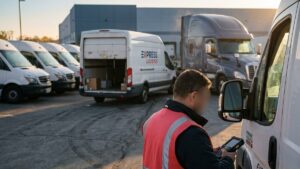


Global supply chains have been hit with a decade of disruption compressed into just a few years. Port closures, tariff shocks, climate events, labor strikes, cyber incidents, and the Red Sea rerouting crisis have all reset the rules. At the same time, the buyer side of the equation has shifted to a true omnichannel fulfillment economy where customers expect to buy anywhere, fulfill anywhere, and return anywhere, often inside a 24-hour window. The companies that came through with their margins intact were not the ones with the cheapest networks. They were the ones with the most agile ones. In 2026, agility has moved from a buzzword on a strategy deck to a measurable operational capability that decides who wins the next contract, who keeps the next customer, and who absorbs the next disruption without bleeding cash.
This guide explains what an agile supply chain actually is, how it differs from a lean or resilient one, the benefits and applications it unlocks across industries, the common pitfalls operators run into, and how to choose the right agility strategy for your fleet, your assets, and your customers.
Key Takeaways:
- Definition: An agile supply chain is built for speed and rapid adaptation to changing demand, supply, and disruption conditions, not just for lowest unit cost.
- Technology backbone: Real-time GPS and BLE asset tracking, IoT sensors, predictive analytics, digital twins, and agentic AI form the operational backbone of supply chain orchestration in 2026.
- Measurable ROI: Leading operators report productivity gains in the 25 percent range, throughput improvements approaching 50 percent, recovery rates above 90 percent on tracked assets, and 90-to-180-day payback on the agility tech layer.
What Is an Agile Supply Chain? (Agile vs. Lean vs. Resilient Logistics Explained)
An agile supply chain is a logistics and operations model designed for speed, responsiveness, and rapid adaptation to changing demand, supply, and disruption conditions. Instead of optimizing only for the lowest unit cost, an agile supply chain optimizes for the shortest time-to-response when something changes, whether that change is a customer order spike, a port closure, a stolen asset, a delayed shipment, or a new regulation.
The distinction from a lean supply chain matters because the two are often confused:
- Lean supply chain: Built to remove waste, minimize inventory, and drive down cost per unit. Works well in stable, predictable demand environments.
- Agile supply chain: Built to flex, reroute, and respond in real time. Works well in volatile, uncertain, or unpredictable environments.
- Resilient supply chain: Built to absorb shocks through redundancy, multiple sourcing, and risk buffers. Works well when disruption is the assumed baseline.
The leading operators in 2026 do not pick one. They blend agile and resilient principles on top of a lean cost base, and they use real-time visibility data from GPS and BLE asset trackers, IoT sensors, and AI platforms to know when to flex which lever.
Why Agile Supply Chain Management Matters in 2026: Mitigating Risk and Demand Volatility
The pain points driving agility investment today are no longer theoretical. Supply chain leaders are operating against a backdrop of structural volatility that traditional ERP forecasting was never designed to handle. Here are the realities forcing the shift:
- Disruption frequency is rising. The average enterprise now reports a material supply chain disruption every few weeks, not every few years.
- Demand signals are fragmenting. Direct-to-consumer, omnichannel retail, just-in-case inventory strategies, and shorter product lifecycles all compress reaction windows.
- Omnichannel fulfillment is the new baseline. Customers expect to buy on one channel, receive from another, and return through a third, often with same-day or next-day service-level expectations. Networks built for single-channel fulfillment cannot keep up.
- Labor shortages and rising wage costs. Driver, warehouse, and yard labor availability has tightened across North America, and peak-season volume spikes amplify the pressure. Agile networks lean harder on visibility, automation, and exception management to do more with the same headcount.
- Returns and reverse logistics volume. E-commerce return rates have climbed sharply, and reverse-logistics complexity now rivals outbound fulfillment as a cost and service variable.
- Cargo theft and asset loss are at record levels. Industry data shows cargo theft incidents have grown sharply year over year, with billions in annual losses across full truckload, less-than-truckload, and last-mile freight.
- Visibility gaps remain the number one operator complaint. Most carriers still report shipment positions every two to four hours, leaving long blind windows during dwell, transfer, and handoff.
- Customer tolerance for delays is collapsing. B2B buyers now expect the same shipment transparency they get from consumer apps.
An agile supply chain answers all five of these pressures by turning every asset, vehicle, container, and shipment into a real-time data source, then layering AI on top of that data to recommend the next best action before the disruption becomes a financial event.
5 Core Pillars of an Agile Supply Chain Framework: AI, IoT, and Predictive Telemetry
An operationally agile supply chain consistently exhibits five characteristics that together form the foundation of modern supply chain orchestration. If your network is missing any of these, agility is aspirational rather than real, and capabilities like digital twins and predictive analytics will struggle to deliver value on top of an incomplete data layer.
1. End-to-End Real-Time Visibility
You cannot react to what you cannot see. Real-time visibility means continuous location, condition, and status data across every node, vehicle, trailer, container, and high-value asset, including the indoor segments where GPS alone goes dark. Modern visibility stacks combine cellular GPS for in-transit tracking, BLE asset tags for indoor and yard precision, and satellite connectivity for off-grid lanes.
2. Demand Sensing and Predictive Analytics
Agile operators replace static forecasts with rolling demand signals pulled from point-of-sale data, order patterns, weather, and macroeconomic indicators. AI models then translate those signals into recommended inventory positions, routing changes, and capacity bookings days or weeks earlier than legacy planning cycles.
3. Flexible Sourcing and Multi-Modal Routing
An agile network is not single-threaded. It assumes that any lane, supplier, or port can fail and pre-qualifies alternates. When a disruption hits, the system shifts mode, carrier, or origin without a multi-week procurement cycle.
4. Collaborative Partner Ecosystems
Suppliers, carriers, 3PLs, brokers, and customers all see the same shared truth in real time. Agility breaks down when each tier hoards its own data.
5. Autonomous and Agentic Decision Support
In 2026, the leading platforms include agentic AI layers that not only flag exceptions but execute defined responses, such as rerouting a shipment, releasing a backup carrier, opening a ticket, or alerting recovery teams when a high-value asset deviates from its geofence.
Top ROI Benefits of Supply Chain Agility: Autonomous Fulfillment and Loss Prevention
The business case for agility is no longer abstract. Operators who have moved from reactive to agile models consistently report measurable gains across five dimensions:
- Faster disruption response. Dynamic rerouting and exception management reduce time-to-mitigation from days to minutes, protecting service levels during port closures, weather events, and carrier failures.
- Lower inventory carrying costs. Demand sensing reduces the need for blanket safety stock, freeing working capital while maintaining or improving fill rates.
- Higher cargo and asset recovery rates. Continuous tracking combined with AI-flagged anomalies pushes theft and loss recovery rates significantly higher, with leading operators reporting recovery rates well above 90 percent on tracked assets.
- Improved on-time-in-full performance. Real-time visibility allows proactive ETA updates, dock scheduling, and customer communication, lifting OTIF scores and reducing chargebacks.
- Stronger customer retention and pricing power. B2B customers will pay a premium for a supplier that can prove shipment status, condition, and chain of custody on demand.
Industry benchmark data backs up the model. Logistics technology providers tracking agile-network deployments have reported productivity gains in the 25 percent range, space and stock utilization improvements of 20 to 30 percent, throughput increases approaching 50 percent in fulfillment operations, and order accuracy levels above 99 percent. Payback windows on the technology layer that enables agility, including GPS and BLE tracking hardware, IoT sensors, and AI exception platforms, frequently land inside 90 to 180 days when the network has meaningful loss, dwell, or stockout exposure.
The compounding effect is what makes agility durable. Each visibility data point feeds the AI layer, which sharpens the next prediction, which tightens the next response, which improves the next customer outcome.
Agile Supply Chain vs Lean Supply Chain vs Resilient Supply Chain: A Side-by-Side Comparison
Operators evaluating their next investment cycle need a clear sense of which model fits which business condition. The table below summarizes the differences at a glance.
| Dimension | Lean Supply Chain | Agile Supply Chain | Resilient Supply Chain |
|---|---|---|---|
| Primary Goal | Lowest unit cost | Fastest response to change | Absorb and recover from shocks |
| Inventory Posture | Minimum, just-in-time | Dynamic, demand-driven | Buffered, just-in-case |
| Best Environment | Stable, predictable demand | Volatile, fast-changing demand | High-disruption, high-risk |
| Visibility Requirement (Enabled by GPX) | Periodic reporting | Continuous real-time tracking with AI alerts | Multi-source telemetry plus redundancy |
| Typical KPIs | Cost per unit, inventory turns | Time-to-respond, OTIF, recovery rate | Time-to-recover, supplier redundancy |
| Technology Backbone | ERP, MRP | GPS/BLE tracking, IoT, AI, demand sensing | Risk platforms, dual sourcing tools |
Industry Use Cases: Agile Logistics in Fleet, Healthcare, and Heavy Equipment Tracking
Agility plays out very differently depending on what you move, how far, and how often. Here is how it looks in the verticals where the agility return is currently the highest.
Fleet and Trucking
Fleet operators apply agile principles by tracking every tractor, trailer, and chassis in real time, using GPS telematics combined with BLE tags on trailers and high-value cargo. When a load is delayed at a yard, the dispatcher sees the dwell event immediately and reassigns the next load to a closer asset, protecting service hours and on-time delivery. AI-driven anomaly detection flags suspicious movement patterns linked to cargo theft within minutes rather than hours.
Construction and Heavy Equipment
Construction supply chains are uniquely vulnerable because high-value equipment moves between remote job sites, suppliers, and rental yards. An agile construction operator uses long-life asset trackers on generators, light towers, compressors, and skid steers so the project manager always knows what is on site, what is idle, and what was moved overnight. When a piece of equipment crosses a geofence after hours, the recovery team is notified before sunrise.
Healthcare and Medical Logistics
Hospitals and medical distributors apply agility to mobile medical equipment, temperature-sensitive shipments, and specimen logistics. Real-time location plus temperature and humidity monitoring on cold-chain shipments protects high-value biologics and reduces wasted product. Indoor BLE tracking helps clinical engineering teams locate infusion pumps, ventilators, and crash carts in seconds rather than hours.
Automotive and Dealer Networks
Automotive supply chains use agility to manage finished vehicle logistics, in-bound parts, and dealer inventory. Real-time tracking on vehicle haulers, rail cars, and individual VIN-level units lets OEMs and dealers respond to demand shifts and recover stolen units quickly. Buy-here-pay-here dealers in particular benefit from covert GPS tracking on financed vehicles.
Third-Party Logistics (3PL) Providers
3PLs sit at the center of the omnichannel fulfillment economy and feel every demand shift, peak season, and disruption first. Agile 3PLs apply real-time visibility across every client account, every trailer pool, and every cross-dock so they can rebalance capacity, reassign loads, and prove chain of custody to brand-side customers in real time. BLE smart labels on individual SKUs, GPS trackers on shared trailer pools, and AI exception alerts on dwell and route deviation give 3PL operators a service-level advantage when bidding against carriers still relying on manual updates.
In-Transit Logistics, Yard, and Last Mile
In-transit visibility is where most carriers lose the customer. Agile shippers bridge the gap by attaching disposable BLE smart labels to shipments and pallets, so the load is visible inside cross-docks, drop yards, and last-mile facilities where GPS cannot reach. This eliminates the two-to-four-hour reporting gaps that traditional carrier tracking leaves behind.
Driving Logistics Orchestration with Next-Gen GPS, BLE Asset Tags, and Agentic AI
Agility is impossible without continuous, accurate, and trustworthy data. The GPX Intelligence AI-powered supply chain visibility platform provides the hardware and AI layer that turns a stated agility strategy into an operating reality, feeding the digital twin models, predictive analytics, and agentic AI engines that sit above the data layer. Three product families map directly to the agile supply chain use cases above.
- GPX AssetTag (BLE). Long-life indoor and yard tracker with a four-year replaceable battery, IP67 rating, and aisle-level precision through a 3-billion-plus BLE gateway network. Ideal for trailers, containers, returnable assets, and indoor equipment tracking where GPS goes dark.
- GPX AssetTrack and AssetTrack Voyager (GPS). Cellular and satellite-capable GPS trackers for vehicles, heavy equipment, and high-value mobile assets, with global coverage across the United States, Canada, and Mexico and satellite fallback for off-grid lanes.
- GPX Smart Labels. Disposable BLE tags for one-way and returnable shipments that close the in-transit visibility gap inside terminals, drop yards, and cross-docks where carriers traditionally go silent.
The Scout AI platform sits on top of every tracker, giving operators natural-language access to their data. Instead of building dashboards for every question, a logistics manager can simply ask Scout questions like which shipments have deviated from route in the last 30 days, which lanes have the highest theft risk, or which assets have been idle for more than 14 days. That is what turns visibility data into agile decisions.
Overcoming Supply Chain Blind Spots: Legacy ERPs, Data Silos, and Integration Pain Points
Operators who try to retrofit agility onto a legacy network run into a predictable set of obstacles. Knowing them in advance is most of the battle:
- The Franken-Stack integration problem. Most enterprises run a fragmented mix of TMS, ERP, OMS, telematics, and other legacy systems that do not exchange data in real time. The result is conflicting truth across dashboards and a network that cannot react at the speed agility requires. Solve by anchoring the network on a single visibility platform that ingests data from all upstream systems and pushes a unified, real-time picture out to operations, planning, and customer service.
- Data silos across carriers and partners. Solve by mandating a single visibility platform across the network and writing data-sharing requirements into carrier contracts.
- Tracking blind spots indoors and at yard handoffs. Solve with BLE asset tags and smart labels that bridge the GPS-dark segments.
- Scope 3 emissions and ESG compliance gaps. Blind supply chains cannot accurately measure carbon output across owned, contracted, and partner-operated lanes, which makes Scope 3 reporting and emissions targets nearly impossible to defend. Real-time GPS routing data, dwell tracking, and optimized lane assignments directly cut fuel waste and produce the audit-ready data ESG teams need.
- The bullwhip effect in reverse logistics. A small spike in returns can create disproportionate downstream congestion at consolidation points, cross-docks, and refurbishment centers if the network lacks predictive agility. Real-time visibility on inbound return volume and AI-driven capacity rebalancing absorb the spike before it cascades.
- Alert fatigue from too many low-value notifications. Solve with AI filtering that surfaces only material exceptions and routes them to the right person.
- Hardware costs that look high on paper. Solve by sizing the total cost of ownership against actual loss, theft, and dwell costs, where ROI typically lands well inside 12 months.
- Change management on the operator side. Solve by piloting on a single lane, vertical, or facility before scaling, so the wins are concrete before the rollout.
Ready to Build an Agile Supply Chain with Real-Time Visibility?
The fastest way to move from theory to operational agility is to start with the assets and lanes that hurt the most when something goes wrong, then layer in real-time tracking and AI alerts where the financial leverage is highest. GPX Intelligence supply chain visibility solutions work with fleet, construction, healthcare, automotive, and logistics operators across North America to deploy GPS and BLE visibility, the Scout AI platform, and recovery workflows that turn disruption events into routine operations. Book a discovery call with our agile supply chain experts to see how a next-gen visibility layer would map onto your specific network.
How to Build a Custom Agile Supply Chain Strategy (Step-by-Step Guide)
There is no single correct agility model. The right strategy depends on what you move, who you serve, and what disruption looks like in your industry. Use the following four-step decision framework to land on the right approach:
- Map your disruption profile. Identify the top three disruption events of the last 24 months, their financial impact, and how long each took to resolve. This becomes the baseline you are trying to beat.
- Audit your visibility gaps. Walk each lane and node from origin to destination and mark where you lose sight of the shipment, asset, or vehicle. Indoor segments, yards, and handoffs are the most common gaps.
- Pressure-test for omnichannel and reverse-logistics readiness. Map how a single order moves across channels, fulfillment nodes, and return paths, then check whether your visibility and exception data follow the order or stop at each handoff.
- Choose the right hardware and AI mix. Match GPS trackers to in-transit and outdoor assets, BLE tags to indoor and yard segments, and disposable smart labels to one-way and returnable shipments. Pair them with an AI platform that supports natural-language exception management.
- Pilot, measure, then scale. Start with one vertical, one lane, or one facility, measure the change in time-to-respond, OTIF, and recovery rate, then expand the model network-wide.
The operators who win the next disruption cycle will not be the ones with the biggest fleets or the deepest pockets. They will be the ones who see what is happening first, decide what to do fastest, and execute the response with the least friction. That is agility, and in 2026 it is built on visibility.
Frequently Asked Questions (FAQs)
Can a supply chain be both lean and agile (the Leagile model)?
Yes. The Leagile model is a hybrid approach that applies lean principles to the predictable, high-volume portion of the supply chain and agile principles to the volatile, customer-facing portion. The decoupling point is usually placed close to the point of demand, with lean replenishment upstream and agile fulfillment downstream. Most leading operators in 2026 run a Leagile network supported by a single real-time visibility layer, so the same GPS, BLE, and AI data feeds both the lean cost engine and the agile response engine.
How does an agile supply chain support omnichannel fulfillment and 3PL operations?
Omnichannel buyers expect to purchase on one channel, receive from another, and return through a third, often inside a 24-hour service window. Agile supply chains support this by giving every order a continuous visibility signal across channels, fulfillment nodes, carriers, and reverse-logistics paths. Third-party logistics providers benefit the most, because real-time GPS and BLE tracking, AI exception alerts, and shared dashboards across client accounts let 3PLs rebalance capacity, prove chain of custody, and absorb peak-season volume without missing service-level commitments.
What technology is required to make a supply chain agile?
The core stack includes GPS asset trackers for vehicles and outdoor equipment, BLE asset tags for indoor and yard segments, disposable smart labels for in-transit shipments, IoT sensors for condition monitoring, and an AI platform that can interpret the data and trigger exception workflows. Natural-language query tools such as the GPX Scout AI platform let operators ask questions in plain English instead of building dashboards for every scenario.