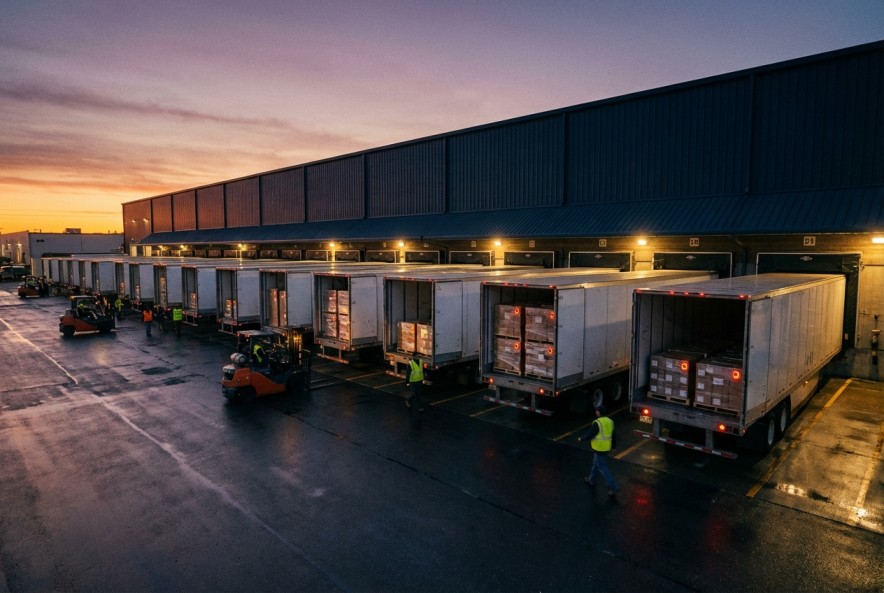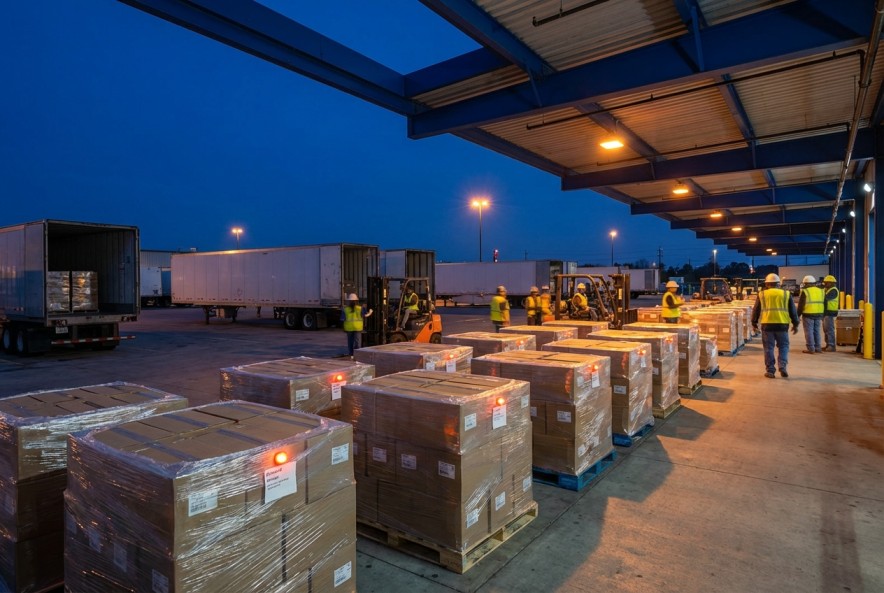


OTIF has become the scorecard retailers use to decide who gets shelf space, who gets penalized, and who gets pushed to the back of the line. As compliance thresholds climb and fee structures get sharper, even minor misses in appointment times, quantities, or documentation can trigger chargebacks that erase margin. The challenge is that OTIF isn’t one problem—it’s the downstream result of planning, pick/pack accuracy, carrier execution, and receiving constraints all lining up at once. The upside is that when you treat OTIF like an operational system, small improvements compound quickly into real profit protection. And the cost of getting it wrong can show up faster than you think.
A 37-minute delay at a Walmart receiving dock just cost your company $27,500. This is the new reality for logistics professionals. OTIF compliance is no longer a suggestion: it is a high-stakes requirement for survival in the modern retail market.
Over the past several years, On-Time In-Full (OTIF) transitioned from a simple metric to the dominant performance standard in logistics. Retail giants like Walmart and Target now demand 98% compliance as a minimum. For food, beverage, and CPG manufacturers, failing to meet these marks leads to massive profit losses.
The financial stakes are high. Mid-sized suppliers often see penalties reach seven figures, while major CPG firms report losses exceeding $20 million annually. One beverage manufacturer recently calculated that every percentage point improvement in OTIF performance translated to $1.4 million in recovered profits. This guide provides the technical strategies needed to turn OTIF compliance into a competitive advantage.
Understanding the Fundamentals of OTIF
OTIF is now the universal standard for measuring supply chain execution. Top-performing companies report 23% higher customer retention and 37% greater market share growth than industry averages. Understanding the mechanics of this metric is essential for operational success.
What is OTIF (On-Time In-Full)?
OTIF measures the ability to deliver exactly what was ordered (complete quantities and correct products) precisely when promised. It is a binary system: a shipment that is 15 minutes late or missing 1% of the order counts as a total failure.
The formula for calculating your OTIF percentage is:
On-Time In-Full (OTIF) Calculator
Your OTIF Score
This metric holds the entire supply chain accountable. It requires coordination from production through final delivery to ensure perfect execution.
The Growing Importance of OTIF in Logistics
OTIF requirements moved from aspirational goals to strict contractual obligations. Since 2017, major retailers have standardized penalties ranging from 3% to 5% of the order value.
By early 2025, retailers collectively imposed billions in penalties, marking a significant year-over-year increase. This reflects a shift toward precision supply chains where delivery windows are non-negotiable.
The Challenge of Standardizing OTIF Definitions
Compliance is difficult because every retailer defines “on-time” differently:
- Walmart: Requires delivery within a 30-minute window.
- Target: Uses a one-hour window based on appointment time, not actual arrival.
- Home Depot: Considers an order on-time if delivered on the correct date.
- Kroger: Uses a two-hour window starting from when unloading begins.
These inconsistencies create compliance risks. One electronics manufacturer discovered they achieved 97% OTIF by internal metrics but only 82% according to their largest customer, resulting in $800,000 in unexpected penalties. Successful suppliers use customer-specific tracking to manage these unique rules.
The Business Impact: Why OTIF Matters
OTIF performance directly affects financial health. Excellence in this area correlates with higher profit margins and stronger market valuations.
OTIF as a Key Performance Indicator (KPI)
OTIF is the primary KPI for supply chain execution. It forces end-to-end coordination:
- Manufacturing: Production must meet specific timing and quantity targets.
- Procurement: Materials must be available without overstocking.
- Warehousing: Accuracy in picking and packing is mandatory.
- Transportation: Delivery must occur within narrow windows.
High OTIF performance typically signals 27% higher profit margins than those struggling below 85% compliance, reflecting both operational excellence and stronger retail partnerships.
The Cost of Non-Compliance: Delivery Fines and Lost Opportunities
A 3% penalty on a $500,000 shipment equals a $15,000 fine. For large suppliers shipping millions monthly, annual penalties can exceed $3 million.
Beyond direct fines, hidden costs include:
- Reduced shelf space and limited promotional opportunities.
- Lower priority during inventory shortages and replenishment cycles.
- Exclusion from new store openings and product launches.
- Potential delisting as a supplier after persistent failures.
Strategies to Improve Your OTIF Performance
Improving OTIF requires a systematic approach to identify root causes. Focus on these four battle-tested strategies to drive immediate results.
Gain Real-Time Visibility Across Your Supply Chain
You cannot fix what you cannot see. Real-time visibility is the foundation of supply chain success. Traditional EDI updates often alert you to problems only after a delay has occurred. GPS tracking platforms provide second-by-second data, allowing for proactive intervention before delivery windows are missed.
Identify and Eliminate Sources of Delay
OTIF failures usually stem from specific bottlenecks. Analyzing logistics data often reveals:
- Carriers that are consistently late on certain lanes.
- Distribution centers with excessive dwell times during loading or unloading.
- Manufacturing facilities missing production schedules.
One CPG company analyzed 12 months of data and found 37% of failures came from a single warehouse where loading added 4.5 hours to dwell time. Redesigning these processes improved OTIF by 8 points within 60 days.
Leverage Data and Analytics for Proactive Decision-Making
Use predictive analytics to flag at-risk shipments 48 to 72 hours before delivery. Analytics platforms process variables like weather, traffic, and facility congestion to predict risks. This allows you to reroute shipments, expedite freight, or communicate with customers before a penalty is triggered. You can find more industry insights on supply chain trends at Supply Chain Dive.
Validate and Resolve Delivery Discrepancies
Retailers often assess penalties incorrectly. Protect your revenue by maintaining irrefutable evidence:
- GPS-validated arrival times within specified windows.
- Photographed proof of load condition and labeling.
- Digital time-stamped proof of delivery (POD).
One distributor recovered $875,000 in incorrectly assessed fines within six months by using GPS-based validation to prove trucks arrived on time despite late processing by the receiver.
The Role of Technology in Achieving OTIF Excellence
Modern technology makes high OTIF scores achievable. Automation and real-time data are the primary drivers of performance gains.
Real-Time Visibility Platforms: Your Single Source of Truth
Advanced platforms act as command centers, providing continuous location monitoring and automated alerts. These platforms eliminate information silos between suppliers, carriers, and retailers. Companies using these tools typically see OTIF improvements of up to 12% within the first 90 days.
Advanced Analytics for Performance Monitoring and Improvement
Analytics tools perform root-cause analysis and create performance scorecards for carriers and facilities. This shifts your team from a reactive to a proactive posture, identifying degrading performance before it becomes a systemic issue.
The ROI of Real-Time Visibility for OTIF Improvement
The investment in visibility pays for itself through:
- Eliminated OTIF penalties (3-5% of non-compliant order value).
- Reduced expedited shipping costs, which often cost 5 to 7 times standard rates.
- Decreased safety stock requirements, typically leading to 10-15% inventory reduction.
Adapting in Real-Time to Avoid Delivery Fines
Real-time adaptation means being able to reroute a truck based on weather or traffic in seconds. This capability transforms potential failures into successful, on-time deliveries. One distributor rescued 67% of at-risk deliveries by implementing real-time monitoring and intervention protocols.
Case Studies in Successful OTIF Improvement
Consumer Packaged Goods Manufacturer Achieves 98.2% OTIF
A CPG manufacturer was facing delisting due to sub-85% performance. By implementing GPS tracking and predictive analytics, they reached 98.2% OTIF in six months, eliminating $2.4 million in annual fines and securing $8.7 million in new sales.
Wholesale Distributor Recovers $1.7M in Incorrect Penalties
A distributor used GPS arrival data to dispute incorrect fines. They recovered $1.7 million in eight months and improved their actual delivery compliance to 97% through visibility-driven process improvements.
Future-Proofing Your Supply Chain with OTIF Excellence
OTIF performance is a survival requirement. The most successful companies view it as a framework for building resilient supply chains. By focusing on visibility, data-driven decisions, and systematic process improvement, you can protect your margins and grow your market share. Do not wait for penalties to accumulate: start optimizing your logistics data today.
Frequently Asked Questions (FAQs)
What is considered a good OTIF score?
The industry benchmark is 95% or higher for survival, while top retailers like Walmart demand 98% for their preferred suppliers. Today’s retail environment requires high precision: even 99% of an order delivered is considered a failure if the missing 1% triggers an OTIF exception. The standard is set by your largest customers, not your internal operational capacity.
What are the biggest obstacles to achieving high OTIF?
Fragmented visibility is the primary killer of OTIF scores because it prevents teams from seeing problems until it is too late. Secondary obstacles include unreliable production schedules, inefficient warehouse loading processes, and choosing carriers based solely on the lowest price rather than performance history or reliability.
How does real-time visibility improve OTIF performance?
GPS tracking and real-time data allow logistics teams to implement contingency plans before a delivery window is missed. It provides the critical minutes needed to reroute drivers or reschedule appointments, while revealing systemic patterns that allow you to eliminate recurring root causes in the supply chain.
What is the financial impact of poor OTIF performance?
Beyond the 3-5% direct fines, poor performance leads to expedited freight premiums, higher inventory costs, and administrative burdens. For major suppliers, the difference between 85% and 98% OTIF often exceeds $10 million per year in recovered profit and avoided penalties, not including the value of protected shelf space.
How can I dispute incorrect OTIF penalties?
Maintain digital, time-stamped proof of arrival using GPS tracking and digital proof of delivery. This objective data allows you to prove your truck was on-site within the delivery window, even if the retailer’s receiving dock was delayed in processing the vehicle. Documenting every step of the arrival and unloading process is key to successful disputes.
Why is OTIF more difficult to manage than traditional fill rates?
OTIF combines two distinct variables into a single, unforgiving metric. While a fill rate measures quantity and on-time performance measures speed, OTIF requires both to be perfect simultaneously. This necessitates a much higher level of coordination between production, warehousing, and transportation than traditional siloed metrics require.