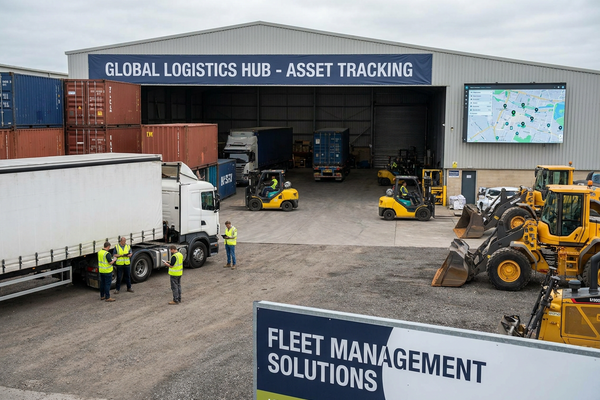


Cargo theft losses in the United States and Canada hit an estimated $725 million in 2025, a 60 percent jump in a single year. At the same time, the global asset tracking market is forecast to reach $32.45 billion in 2026 and grow at a 10.84 percent CAGR through 2031. The signal is clear. Operations leaders are moving away from spreadsheets, paper logs, and reactive dashboards toward continuous, real-time asset visibility powered by GPS, Bluetooth Low Energy (BLE), satellite, and AI.
Asset tracking has quietly become one of the highest-ROI investments in modern industrial operations. It protects revenue, secures inventory, accelerates SLAs, and feeds the AI models that now run predictive maintenance, theft prevention, and supply chain forecasting.
This guide explains what asset tracking is, how it works, the technologies behind it, the challenges it solves, and how to choose the right system for your operation.
Key Takeaways: 2026 Asset Tracking at a Glance
- Definition: Asset tracking is the real-time monitoring of physical assets (location, condition, utilization) using a hybrid stack of GPS, BLE, UWB, RFID, and AI-powered software.
- Tech stack: Modern systems fuse GPS + cellular + LPWAN + BLE + UWB + Wi-Fi + satellite into a single platform, with AI analysts layered on top for predictive ETAs, theft scoring, and agentic workflows.
- Asset vs. inventory: Asset tracking monitors what a business owns and reuses (trailers, equipment, tools). Inventory tracking monitors what a business sells or consumes (SKUs, raw materials). Different stack, different decision.
- ROI: According to IBM, enterprise-wide asset visibility can improve maintenance productivity by 28 percent and decrease inventory maintenance and repair costs by 18 percent. Most deployments break even inside 8 to 12 months.
- 2026 trend: The shift from passive dashboards to agentic asset intelligence, where AI agents take action automatically when an asset deviates, is the defining capability separating leaders from laggards.
What Is Enterprise Asset Tracking? 2026 Definition, IoT Sensors & RTLS
Enterprise asset tracking is the continuous, real-time monitoring of an organization’s physical assets, their location, condition, and utilization, using a combination of IoT sensors, wireless networks, and a centralized software platform. Tracked assets typically include vehicles, trailers, containers, construction equipment, medical devices, tools, returnable packaging, and high-value inventory in transit.
Modern asset tracking goes well beyond a dot on a map. A 2026-grade Real-Time Location System (RTLS) answers four questions at any moment:
- Where is the asset? Outdoors, indoors, in transit, or in storage.
- What condition is it in? Temperature, humidity, shock, tamper, battery status.
- How is it being used? Idle hours, runtime, utilization, dwell time.
- What happens next? Predictive ETAs, maintenance alerts, theft risk scoring.
That last layer, the predictive layer, is what separates legacy GPS tracking from AI-powered asset intelligence. It is also what every operations leader is now being asked to deliver.
Asset Tracking vs. Inventory Tracking: A Critical Distinction
Assets are long-lived items a business owns and uses to generate revenue: trucks, forklifts, generators, infusion pumps, returnable containers, IT equipment, and tools. Inventory is what a business sells, ships, or consumes: SKUs on a shelf, raw materials, spare parts, or finished goods moving through a supply chain.
Asset tracking monitors items the business intends to keep and reuse. Inventory tracking monitors items that flow through the business and need to be counted, replenished, and depleted. Most modern operations need both, but the technology stack, the data model, and the buying decision are different.
How IoT Asset Tracking Works: From GPS Telematics to BLE & UWB Nodes
IoT asset tracking systems combine three things: a tracking device attached to the asset, a wireless network that carries the location and sensor data, and a software platform that turns the data into decisions. The technology mix varies based on the asset type, environment, and reporting frequency.
Here are the eight core technologies powering enterprise asset tracking in 2026:
- GPS (Global Positioning System): Best for outdoor, long-range tracking of vehicles, trailers, and high-value mobile equipment. Reports location anywhere with a clear sky view.
- Cellular (4G LTE, 5G): Carries GPS data back to the platform over carrier networks. Standard for high-value, high-frequency reporting use cases.
- LPWAN (Low-Power Wide-Area Network): Includes NB-IoT, LTE-M, and LoRa. These networks extend battery life dramatically and reduce data costs, which is why LPWAN is the fastest-growing connectivity layer in IoT asset tracking.
- BLE (Bluetooth Low Energy): Powers low-cost, long-battery tags ideal for indoor visibility, yard tracking, and asset density use cases. BLE tags ping off ambient gateways, mobile hubs on vehicles, and smartphones, removing the need for expensive fixed infrastructure.
- Wi-Fi positioning: Fills indoor location gaps where GPS fails. Useful in hospitals, manufacturing plants, and processing facilities.
- UWB (Ultra-Wideband): A newer, high-accuracy indoor technology that delivers location precision down to 10 to 30 centimeters and works through walls. Adoption is rising in healthcare, manufacturing, and high-value asset rooms where BLE accuracy is not enough.
- Satellite: Critical for assets that move through cellular dead zones, including rural construction sites, agricultural fleets, and cross-border freight.
- RFID and NFC: Short-range tracking for chokepoint scanning, tool checkout, and pallet-level identification at gates and dock doors. Passive RFID tags are inexpensive but require line-of-sight readers; active RFID tags reach hundreds of meters but cost more.
Behind each of these technologies sits the math that turns a signal into a location. Outdoor systems use GPS satellite triangulation. Indoor BLE, Wi-Fi, and UWB systems use a combination of RSSI (Received Signal Strength Indication), TDOA (Time Difference of Arrival), trilateration, and fingerprinting to compute position from anchor points or gateways. Modern platforms abstract all of this away. You see a location on a map, not a math problem.
A modern asset tracking platform fuses several of these inputs into one continuous record. Outdoor location comes from GPS, indoor location switches to BLE or Wi-Fi, and sensor data layers on top. The result is a single source of truth that survives the asset moving from a facility, to a truck, to a job site, to a customer.
Architecture of a Predictive Asset Tracking Solution (Hardware to AI Cloud)
Every asset tracking deployment, regardless of vendor, has four common architectural layers. Understanding each one helps you spec the right system and avoid the common mistake of buying hardware before you have an integration plan.
1. Tracking devices and tags. The physical hardware attached to the asset. Options range from rugged GPS trackers with multi-year battery life, to indoor BLE tags, to peel-and-stick disposable labels for one-way shipments.
2. Connectivity layer. The wireless networks carrying data from the tag to the cloud. Cellular, LPWAN, BLE gateways, Wi-Fi, UWB, and satellite all play a role depending on the asset’s environment.
3. Cloud platform and analytics. The software where raw location and sensor data become reports, alerts, dashboards, and API integrations into your TMS, WMS, ERP, or CMMS systems.
4. AI and decision layer. The newest and most important piece. Modern platforms now include AI analysts that answer natural-language questions, predict ETAs, score theft risk, and trigger agentic workflows when an asset deviates from its expected path.
Asset Tracking vs. Inventory Management vs. Fleet Telematics
The terms get used interchangeably, but they solve different problems and the procurement decisions are not the same. Here is the side-by-side breakdown.
| Capability | Asset Tracking (GPX) | Inventory Management | Fleet Telematics |
|---|---|---|---|
| Primary focus | Location, condition, and utilization of physical assets across any environment | Stock counts and SKU-level quantity inside a facility | Engine diagnostics and driver behavior on powered vehicles |
| Best for | Trailers, containers, equipment, tools, shipments, returnables | Retail stock, raw materials, finished goods on shelves | Trucks, vans, and powered fleet vehicles |
| Indoor visibility | Yes, via BLE, Wi-Fi, and UWB positioning | Yes, but only at scan points | No, GPS-dependent |
| Outdoor + in-transit | Yes, GPS + cellular + satellite | No | Yes, but vehicle-only |
| Condition monitoring | Temperature, humidity, shock, tamper | Limited | Engine telemetry only |
| Battery life | Up to 5 years on GPX AssetTag (replaceable cell) | N/A (fixed scanners) | Hardwired to vehicle |
The honest summary: if your operation lives or dies on physical assets moving between locations and conditions, you need asset tracking. If it lives or dies on stock levels inside a single facility, you need inventory management. If it lives or dies on driver behavior and engine diagnostics, you need telematics. Most operations need at least two of the three, and the best modern platforms integrate them.
Top Supply Chain & Fleet Pain Points Solved by Real-Time Asset Monitoring
Asset tracking is rarely bought for its own sake. It is bought to solve a specific business challenge that is costing the operation revenue, time, or trust. Here are the highest-frequency challenges driving asset tracking adoption in 2026:
- Asset loss and cargo theft. Construction equipment, copper, electronics, and pharmaceutical loads are top targets. Real-time location, geofencing, route deviation alerts, and tamper sensors dramatically improve recovery rates and deter organized cargo theft.
- Ghost assets. Items that exist on the balance sheet or in the maintenance system but no longer exist physically because they were stolen, scrapped, or lost without being de-registered. Continuous tracking eliminates ghost assets and protects tax and depreciation accuracy.
- Idle and underutilized assets. Companies routinely discover after deployment that 20 to 40 percent of their fleet sits idle while they rent or purchase additional units. Utilization data exposes the gap.
- Cold chain compliance (FSMA Rule 204, FDA, GDP). Pharma cold chains, food and beverage shipments, and biologics increasingly require continuous temperature and humidity records. Automated condition logging detects temperature excursions in real time and supports FSMA Rule 204 traceability and FDA chain-of-custody mandates.
- Equipment hoarding in healthcare. Nurses and clinical staff hide infusion pumps, wheelchairs, and crash carts to guarantee access on their shifts, which turns a hospital’s $3M equipment fleet into a permanent shortage. BLE and UWB RTLS expose hoarded assets, reduce search time, and protect capex.
- Customer SLA failures. When customers ask “where is my shipment,” reactive answers cost accounts. Predictive ETAs and proactive exception alerts protect revenue and retention.
- Manual tracking labor. Spreadsheet check-in/check-out, paper logs, and physical audits absorb thousands of hours per year. Automated tracking redirects that labor to higher-value work.
- Faraday cage and cross-docking blind spots. GPS signals fail inside metal intermodal containers, under steel roofing, and at cross-dock chokepoints. BLE, Wi-Fi, UWB, and Yard Management System (YMS) integrations close those gaps that pure cellular GPS cannot, and feed gate-in/gate-out events directly into the platform.
- Battery lifecycle anxiety. Sealed, non-replaceable battery devices look cheaper upfront, then become a massive labor cost at year three when an entire fleet has to be rip-and-replaced. Multi-year, replaceable-cell devices like the GPX AssetTag (5-year battery with a user-replaceable cell) eliminate that cliff.
- Returnable container loss. Pallets, totes, IBCs, and reusable packaging vanish into customer yards. One automotive OEM achieved an 18x ROI by recovering returnable containers with BLE tracking.
- Regulatory compliance (ISO 55000, SOC 2, insurer mandates). Insurers now price continuous visibility into premiums. ISO 55000 asset management certification and customer audits both require traceable condition and location records.
The thread connecting all of these is the same: every operation has assets it cannot afford to lose track of, and every minute without visibility is a minute losing money.
B2B Industries Scaling Smart Asset Tracking (Construction, Healthcare & Freight)
Smart asset tracking is no longer concentrated in one sector. The fastest-growing B2B use cases in 2026 cut across construction, healthcare, automotive, fleet logistics, and freight, each with a unique combination of environment and risk profile.
Construction. Excavators, generators, compressors, and high-value hand tools vanish from job sites every weekend. Rugged GPS trackers with multi-year battery life secure heavy equipment, and BLE asset tags secure small tools at a fraction of the cost. The recovery economics alone justify deployment on most fleets above 25 assets.
Healthcare. Hospitals lose 10 to 20 percent of their mobile medical equipment annually. Infusion pumps, ventilators, wheelchairs, and crash carts wander between floors and end up in storage closets or hoarded in clinical workrooms. BLE and UWB Real-Time Location Systems (RTLS) cut search time, reduce equipment hoarding, and protect capex.
Automotive. OEMs and BHPH dealerships track returnable containers, finished vehicles, and dealer inventory. Major automotive manufacturers using BLE asset tracking have achieved 95 percent recovery rates on returnable containers and saved millions annually in replacement costs.
Fleet and logistics. Non-powered trailers, intermodal containers, and yard assets are the largest underserved category. Telematics misses them because they have no engine to plug into. Flat-rate asset tracking with multi-year battery life closes the gap.
In-transit freight and cargo security. Cargo theft is concentrated on high-value loads in transit. Continuous location, geofencing, and tamper alerts feed exception management workflows that route at-risk shipments to safer parking and alert recovery teams in real time.
Yard and supply chain visibility. Drop trailers, gate-in and gate-out events, and dwell time at customer locations all carry hidden cost. Yard-level visibility reduces detention fees, improves carrier scorecards, and integrates with YMS platforms.
Indoor visibility (non-warehouse). Healthcare floors, manufacturing plants, and processing facilities increasingly need room-level location without the cost of full RFID infrastructure. BLE gateway networks and UWB anchors deliver that visibility at a fraction of the deployment cost.
The Business Case: ROI of Asset Tracking
The economic argument for asset tracking has gotten cleaner every year. Sensor costs are down. Cellular IoT plans are down. Battery life is up. AI features that used to require separate analytics platforms are now built into the tracking software itself. Most deployments reach breakeven inside 8 to 12 months.
The productivity numbers reinforce the case. According to IBM, enterprise-wide asset visibility can improve maintenance productivity by 28 percent and decrease inventory maintenance and repair costs by 18 percent. Those are not marginal gains. On a mid-sized operation, they translate into seven-figure annual savings.
The ROI typically comes from five layers:
- Loss prevention. Recovery rates above 90 percent on stolen tracked assets, dramatic reduction in opportunistic theft.
- Utilization gains. Identifying idle assets eliminates 10 to 25 percent of unnecessary new purchases and rental spend.
- Labor reallocation. Automated check-in, audits, and reporting free up operations staff for higher-value work.
- SLA performance. Predictive ETAs and proactive exception alerts protect customer retention and reduce penalty charges.
- Compliance savings. Automated condition records eliminate the cost of manual cold chain logs and rejected shipments.
On the cost side of the ledger, the absence of visibility is no longer free. Insurers are pricing it in. Customers are auditing it. Boards are asking about it.
The Future of Asset Intelligence: AI Overviews, Digital Twins & Agentic Workflows
The next phase of asset tracking is already here, and it is not just better dashboards. The shift is from passive visibility (showing where assets are) to agentic asset intelligence (taking action when something is off).
Five trends are accelerating in 2026:
- Natural-language AI analysts. Platforms like GPX Scout let operations teams query their tracking data conversationally. Questions like “Which assets have been idle more than 48 hours?” or “Show me all shipments that deviated from route this week” replace static report builders.
- Agentic workflows. When an asset goes out of geofence after hours, the system no longer just alerts. It triggers a downstream action: dispatching security, notifying the carrier, opening a Slack channel, escalating to the risk platform.
- Digital twins of physical assets. Each tracked asset becomes a virtual replica updated in real time with location, condition, and usage data. Digital twins feed predictive maintenance models, simulate fleet utilization scenarios, and tie tracking data into broader Industry 4.0 architectures.
- Autonomous control towers. The end state is a self-orchestrating logistics environment where AI agents coordinate trucks, trailers, containers, and inventory in real time across multiple parties and modes.
- Asset energy management and ESG. Tracking data now feeds sustainability reporting, energy optimization, and carbon-intensity scoring. Idle-time analytics reduce fuel waste; condition-based maintenance extends asset life and lowers embodied carbon.
The companies investing in asset tracking now are building the data foundation that the next decade of operational AI will run on. Tracking data is no longer a side dashboard. It is training data for the systems that will increasingly run the operation.
How to Choose the Best B2B Asset Tracking Manufacturer & IoT Platform
The market is crowded, and most pitches sound interchangeable. Here is a practical framework for choosing the right B2B asset tracking manufacturer and IoT platform, organized by the questions that actually separate the strong vendors from the weak ones.
1. What environments do my assets move through? If they are exclusively outdoors and powered, cellular GPS is fine. If they move between outdoor, indoor, and in-transit, you need a hybrid GPS + BLE platform that handles all three from a single pane of glass.
2. How long does the battery need to last? If your assets get serviced annually, a one-year battery is acceptable. If they spend years in the field, look for multi-year battery options with replaceable cells. The GPX AssetTag delivers up to a 5-year battery life with a replaceable cell, which avoids the rip-and-replace labor cost of sealed devices at scale.
3. Does the platform cover the full asset lifecycle? Procurement, deployment, utilization, maintenance, depreciation, and retirement. Lifecycle-aware platforms tie tracking data to financial and maintenance records so the same data drives operations, finance, and compliance.
4. What does the total cost of ownership look like at five years? Hardware price is the easy number to compare. The harder numbers are subscription, replacement labor, battery cycles, and infrastructure (gateways, anchors, integrations). Always model the 5-year TCO, not the unit price.
5. Does the platform have built-in AI, or do I need a separate analytics tool? Modern platforms ship with conversational analysts and agentic workflows. Legacy platforms still require analyst headcount or separate BI investments.
6. How well does it integrate with my TMS, WMS, ERP, or CMMS? Ask for API integrations, sample webhooks, and reference customers using the integrations you need. If the vendor cannot produce them quickly, that is a signal.
7. Is the hardware platform-agnostic? If the system locks you into a proprietary device ecosystem, you trade flexibility for a discount. Open platforms that work across multiple device families and BLE networks scale better as your operation evolves.
8. What does the support model look like after the sale? Implementation, training, and ongoing optimization separate vendors that get deployed from vendors that get shelved. Ask for the named team and the response SLA before signing.
The right answer is rarely the cheapest device or the most expensive platform. It is the system that closes the gap between the assets you care about and the decisions you need to make about them in real time.
Take the Next Step Toward Real-Time Asset Visibility
Asset tracking is no longer a niche logistics tool. It is now the operational backbone for construction, healthcare, automotive, fleet, and freight operations across the country. The question is not whether to deploy it, but which platform will give your operation the best ratio of visibility, intelligence, and cost. Explore the GPX product family to see how AssetTag, AssetTrack, Smart Labels, and Scout AI deliver real-time asset visibility across every environment your business runs in, or talk to the GPX team for a tailored walkthrough.
Frequently Asked Questions (FAQs)
What is the difference between asset tracking and inventory tracking?
Asset tracking monitors the location, condition, and utilization of long-lived items a business owns and reuses, such as trailers, containers, equipment, tools, and returnable packaging. Inventory tracking monitors the SKUs a business sells, ships, or consumes, focusing on quantity, replenishment, and stock levels inside a facility. Most modern operations need both, but the technology, data model, and buying decision are different.
What is the best asset tracking technology for indoor environments?
It depends on accuracy and density. BLE is the best general-purpose indoor technology because tags are inexpensive, batteries last years, and they ping off ambient gateways and smartphones rather than requiring fixed infrastructure. Wi-Fi positioning works well where dense Wi-Fi already exists, with room-level accuracy. UWB is the precision option, delivering 10 to 30 centimeter accuracy for clinical, high-value, or high-density use cases. Most modern platforms blend two or three together rather than picking one.
How does GPS tracking prevent cargo theft in transit?
GPS tracking prevents cargo theft through four layers: real-time location reporting so dispatchers always know where a load is; geofencing alerts when a trailer leaves an authorized route or enters a high-risk zone; tamper and door sensors that fire the moment a trailer is opened outside a scheduled stop; and agentic exception workflows that automatically notify carriers, dispatch security, and escalate to recovery teams. Recovery rates on tracked loads typically exceed 90 percent compared to single-digit recovery for untracked freight.
Can asset tracking integrate with my existing ERP, WMS, or TMS?
Yes. Modern asset tracking platforms ship with REST APIs, webhooks, and pre-built connectors for major ERP (SAP, Oracle, NetSuite), WMS, TMS, and CMMS systems. Look for vendors that publish API documentation openly and can produce reference customers using the specific integration you need. API integrations are no longer a premium add-on; they are table stakes for any B2B IoT platform in 2026.
How long does the battery last on an asset tracking device?
Battery life varies by device type and reporting frequency. Cellular GPS trackers typically last 3 to 10 years depending on how often they report. BLE asset tags last longer because they consume less power. The GPX AssetTag delivers up to a 5-year battery life with a user-replaceable cell, which avoids the labor cost of replacing sealed devices at fleet scale.
How much does an asset tracking system cost?
Costs vary based on device type, network connectivity, and platform features. Disposable BLE labels start under $10 per asset for one-way shipments. Rugged BLE asset tags typically run $30 to $80 per device with annual subscriptions in the $40 to $50 range. Cellular GPS trackers with multi-year battery life range from $100 to $300 per device with monthly cellular plans starting around $5. Total cost of ownership over five years matters far more than the unit price.
What is AI-powered asset tracking and how does it work?
AI-powered asset tracking uses machine learning to turn raw location and sensor data into predictions, alerts, and automated actions. Modern platforms like GPX Scout let users query tracking data in plain English (“which assets are idle this week,” “show me shipments deviating from route”) and trigger agentic workflows when an asset is at risk. The next phase is autonomous control towers where AI agents coordinate trucks, trailers, and inventory in real time without manual intervention.